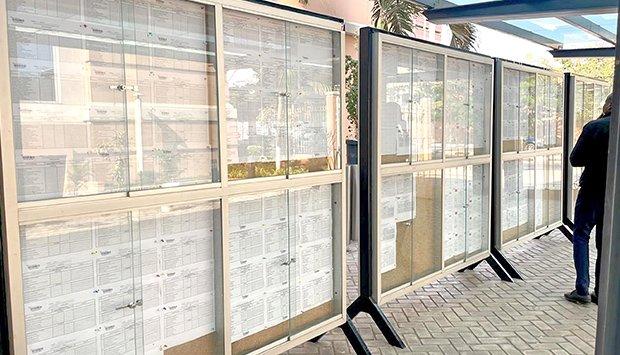
Africa-Press – Angola. The Constitutional Court (TC) released, Sunday, copies of the initial lists of candidates for the August 24 election, in compliance with the Organic Law on General Elections, which are posted in the windows and on the institution’s portal, giving the process the required smoothness.
The lists must remain accessible for a period of 48 hours, a criterion that offers, free of charge, the publicity of candidates, so that voters know who to vote for. The director of the Office of Political Parties of the Constitutional Court recently underlined that, with the disclosure of the lists, there is a legal possibility for them to be challenged.
Mauro Alexandre highlighted that we are facing a phase in force of the “all against all” type, where a party can challenge the candidacy of another party, on the grounds that there are enough elements to do so. After the initial publication of the lists, the competing forces have 10 days to correct any irregularities, a period that goes from the 26th, the date of publication, until the 5th of July.
The official informed that the applications that present insufficiencies will have the opportunity to supply them and present the necessary documents and, in the end, to have their processes validated by the plenary of the Constitutional Court, within 48 hours.
The delivery of candidacies to the TC took place from five (5) to the 25th of this month, involving seven parties and a political coalition, which, until confirmation of their validation, are profiled as serious competitors in the present election.
The process of organizing the General Elections of 24 August involves a series of acts, some of which have already expired, such as the Official Electoral Registration, with the definitive delivery of the Computer File of the Senior Citizens (FICM) to the CNE, which, in turn, in strict compliance with the Organic Law on General Elections, it deposited the aforementioned file with the Constitutional Court, which has the mission, under the terms previously defined by the Law, of verifying the data contained therein, in favor of the organization of the electoral process itself.
The National Electoral Commission (CNE) thus announced that the vote on 24 August will take place, in addition to the country, in South Africa, Zambia, DRC, Congo, Namibia, Belgium, France, Brazil, the Netherlands, Portugal, Great in Brittany and in several cities.
Voter Awareness Of Political Parties
With the release of copies of the initial lists of candidates for the General Elections of August 24, by the Constitutional Court, the certainty that the process of organizing the electoral process follows its normal course towards the “big day” becomes more evident , a state that suggests a look at the activities carried out by parties and coalitions.
The MPLA, which started its machine in advance, judging by the way in which it progressed in the field with the approval of the list of deputies, from which two women lined up as candidates for high positions in the state hierarchy, namely Esperança da Costa, proposed for future Vice-President of the Republic, and Carolina Cerqueira, proposed for future President of the National Assembly. UNITA follows the progress, although it has made little exposure of the nominees to deputies. Then come CASA-CE, PRS, APN and, the less notable, because they were recently founded, therefore, the Humanist Party of Angola (PHA) and P-NJANGO, the latter being led by Eduardo Jonatão “Dinho” Chingunje.
Florbela Malaquias, the only woman available to face the General Elections of 24 August, has won distinction, until now, purely and simply for that condition, for not having conducted a broad work within the scope of the actions developed in the pre-campaign. In case the Constitutional Court validates its candidacy, the PHA will have to run a lot to share with voters its ideas about the governance of the country.
Of the PRS, Angolans have one certainty: the application of Federalism, while CASA-CE wants to carry out a profound institutional reform, which involves the modernization of the State, to establish a new political and administrative system. One of UNITA’s main objectives is governance with all and the creation of mechanisms to return citizens to municipalities and communes, autonomy for Cabinda and the creation of a metropolitan area in Luanda.
The MPLA defines a political arc based on its administrative experience, promoting the consolidation of social programs and governance focused on the people and implemented with the people.
For More News And Analysis About Angola Follow Africa-Press