Africa-Press – Angola. They arrive in a hurry. They wear flip-flops over their socks to protect themselves from the typical cold of the season. Excited, they enter side by side. Go to the counter at the entrance. Greet the employee politely. They ask for information on how to access the collection of the Huíla Provincial Library.
After a few seconds, the employee points from a distance to the shelf with the desired books. Are given permission to enter. run. “Boys go slowly… slowly”, warns the librarian, who shakes her head. Such deaf people, they sneak between the tables and there they are. They look slowly at the window full of books.
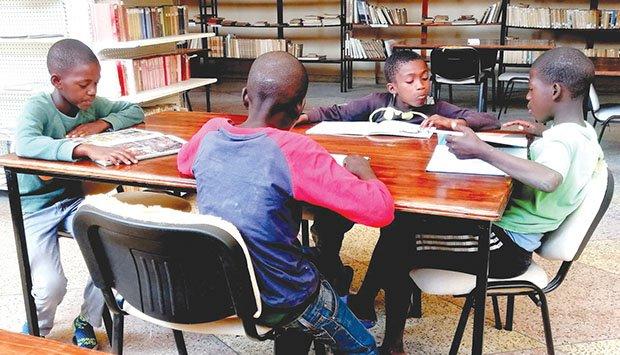
Anxious, some walk around the children’s book shelf. They choose the copies with colored covers. Satisfied, they sit at table number 5, one of the 11 available in the reading space. They occupy four of the 38 chairs that are no longer comfortable due to wear and tear caused by antiquity. They are the only readers in the Huíla Provincial Library.
The silence of the environment encourages reading. They open the books and leaf through the pages. whisper. Illustrations are shown. “Look at this doll!”, shows one of the boys, while laughing at the less than perfect appearance. “Have you seen this cartoon from my book?”, shows another boy to the others.
Focus on your copy. It is clear that Ivanilson João and Edson Ca-lete “Dadi”, 11 and 10 years old, read without hesitation. José Cassinda “Petilson” and Pedro António “Anderson”, 12 and 11 years old, limit themselves only to leafing through the pages because they are illiterate.
The last three were invited to visit the Huíla Provincial Library by cousin Ivanilson, a student in the 6th grade. Enthusiastically, they accepted the invitation to see “the very interesting books”.
Ivanilson João has been to the Provincial Library several times. The first time was with colleagues. The study visit took place last year. That moment marked the future petroleum engineer.
Now, Ivanilson has become one of the assiduous readers. Whenever possible, he goes to the Library, alone or with others. This time, he “dragged” his cousins. The Catholic mission student in Lubango misses the library at his school.
“Our school doesn’t have a library or a bookstore. We only read textbooks there. We once visited this library with our teacher. Since then, I’ve been coming here to read other books”, explains Ivanilson, while reading “O Rei Catastrofe – Adalberto doesn’t stop quiet”, by Lewis Trondheime and Frabrice Parme.
Edson Calete “Dadi”, also an aspiring petroleum engineer, confirms the rich collection of the provincial library, especially for the options of children’s works.
“By the way, there are really interesting books here. Our cousin told us about it and when he invited us to come to the Provincial Library, we thought it was good to come here to see”, confirms “Dadi”, in the story of “The man who swallowed the Moon”, by the author Maria de Carvalho.
José Bonifácio Cassinda “Petilson”, a 4th grader at school nº 60, is eager to learn to read and write. Meanwhile, the future turner is satisfied and appreciates the illustrations in the book “Adèla e o Monstro”, by Witloof .
Pedro António “Anderson”, inserted in the models of school acceleration, dreams of being an agent of the National Police like his father. Anderson, who attends 4th and 5th grades at the same school, also wants to learn to read to decipher the content of the book “O fear flew through the window and the Semba of the colored legs”, by the Angolan author Cremilda de Lima.
On the way out, the boys were informed by the librarian that the entry of shorts and flip-flops is prohibited. “This one, we make an exception. For the next one, don’t wear flip flops and shorts anymore, do you understand, boys?”, he warned. “Yes aunt”, they replied in unison as they left.
Library Collection
The Provincial Library collection is a main archive controlled by the Office of Culture, Tourism and Youth and Sports. On the shelves and boxes arranged in the corners, it is possible to find books from various fields of knowledge, such as culture, science, religion and literature, among others.
The provincial library collection includes works classified by themes such as Generality, Philosophy and Psychology, Religion and Theology, Social Sciences, Statistics, Mathematics, Law, Politics, Technology, Ethnography, Medicine, History, Literature and publications such as different magazines and series of Diaries of the Republic.
The head of the Department of Culture, Arts and Historical and Cultural Heritage, Bernardino Hafeni Gabriel, stated that the Provincial Library has a bibliographic collection estimated at 12,000 different works. Bernardino Hafeni Gabriel said that from January to June the Library was visited by 702 people.
Francisco Pulo, a Psychology student, is one of the readers who uses the Provincial Library to read his academic manuals. “I always use this space. First to review my materials. Only then do I finish with a book, preferably a novel to relax my mind”, he said, before defending the modernization and updating of the bibliographic collection.
Washington Nascimento, professor of African History, researched documents and historical books to enrich the content to be taught, in the master’s course at the Instituto Superior de Ciências de Educação (ISCED) Huíla.
The Brazilian professor believes that the Provincial Library Collection has a tendency to be a historical archive because of the variety of books from the 20th century. “This library holds documentation and books significantly from colonial history. There aren’t many books on recent history. Therefore, it can be considered an archival library,” he said.
The university professor defends more investment for better organization and archival treatment of available books and documents. The academic suggests arranging the collection by typology, date, region and theme to avoid the accumulation of books in the boxes, a fact that makes research difficult.
“The lower part is organized. But the upper part needs better treatment to organize it by region or year. It is necessary to clean documents and books with suitable products, as they are sensitive to humidity. This rich collection needs conservation and digitization”, defended.
The Brovincial Library, located on the ground floor of the Education Office building in Huíla, has three employees. Bernardino Gabriel said that the Provincial Office for Culture, Tourism, Youth Sports presented to the government of Huíla the proposal for the construction of a provincial library and archive from scratch.
“If the proposal is approved and the Provincial Government, the Municipal Administration of Lubango will be responsible for indicating the place for its construction. At the moment, we control about eight municipal libraries and five reading rooms belonging to the Library Network national,” he said.
Bernardino Hafeni admits the possibility of digitizing the entire collection, as soon as there are financial, technological and human conditions.
For More News And Analysis About Angola Follow Africa-Press