Africa-Press – Angola. The water transfer system from the Cunene River, in the village of Cafu, to the areas of Ombala Yo Mungu, Namacunde and Ndombondola, in the province of Cunene, significantly improved the lives of the local population, who were suffering the effects of drought on their skin. , the director general of the National Institute of Water Resources told on Wednesday.
Manuel Quintino stressed that the situation recorded today in those localities is completely opposite to that experienced by the inhabitants, which was characterized by a drama caused by the effects of the cyclical drought that is registered in the southern region of the country.
“Before, when there was a drought, there was a great suffering of the populations, who were prevented from developing agricultural activities and giving water to the cattle”, said the official, remembering that the lack of liquid in those regions took the cattle ranchers to travel long distances, during the transhumance, in search of water for the watering of the cattle. “Today, the satisfaction on the faces of the populations is evident because they already have water close to their homes”, he stressed.
The director general of the National Institute of Water Resources said that the Program to Combat the Effects of Drought in Southern Angola (PCESSA) was created to give dignity to the people of that region who had long suffered from this problem.
“There is a great commitment by the Angolan Executive, through the Ministry of Energy and Water, in terms of finding solutions to combat the effects of drought, which is why, within the framework of the PCESSA, a set of structuring projects aimed at the combating the effects of drought for the populations of the south of the country”, he pointed out.
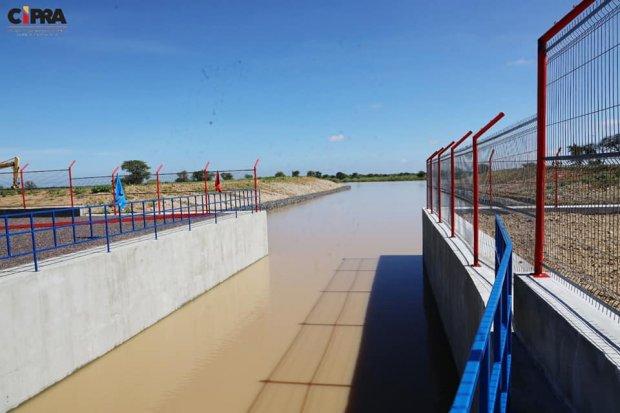
The Cafu Canal, which is not the only structural project created for Cunene province to combat the effects of drought, was inaugurated in April this year by the President of the Republic. It is one of the first concrete responses to the problem of drought in the province since the country’s independence in 1975.
Even before its existence, the problem was fought with water holes, having been opened, throughout the province, more than 70, which were unable to alleviate the suffering of the population, for, for the most part, they were negative. The transfer system is designed for a maximum flow of 6 cubic meters (six thousand liters) per second, but at the moment, due to the hydrological conditions of the Cunene River, it is only capturing two cubic meters per second.
The project, which started in 2019, has a pressurized pipeline with an approximate length of ten kilometers, a general conduit channel with a length of 47 kilometers and, immediately after, in lot 1, a bifurcation with two channels, with the East and the West. The East channel, which will take the water to Namacunde, has an approximate length of 55 kilometers. The West, which heads towards the village of Ndombondola, has an approximate extension of the first. In addition to the channels, the water transfer system also has 30 chimpacas (water reservoirs) and 93 drinking fountains for people and cattle. Each of the chimpacas measures 100 meters long, 50 meters wide, five to six meters deep and has a water storage capacity ranging from 25 to 30 thousand cubic meters.
On the day of its inauguration, President João Lourenço authorized the expansion of another five additional kilometers in the channel and a chimpaca, to benefit a community residing in Ndombondola. As a result, the channel network now has an approximate distance of 165 kilometers and 31 chimpacas. Budgeted at around US$136 million, the project is benefiting 235,000 people, 250,000 head of cattle, an area of approximately 5,000 hectares for irrigated agriculture and has generated 3,275 direct jobs.
It should be remembered that the Cafu project consists of a system for capturing and transferring water from the Cunene River to several villages, through a 160 km long water channel, along which 30 chimpacas (places for watering cattle) were built, with a capacity of 30 million liters each.
Huila, Namibe and Cuanza-Sul
The director general of the National Institute of Water Resources said that Cunene province will not be the only one to benefit from projects aimed at combating the effects of drought.
Manuel Quintino said that the provinces of Huíla, Namibe and Cuanza-Sul were also covered, but clarified that the projects created for these provinces will not be similar to those of Cafu, in Cunene, due to the fact that there are no rivers with permanent flow throughout the year. all.
This, he said, will prevent the collection from taking place, since, in order to pump, you have to have a permanent water course to, from there, define the quota, quantity or volume that will be withdrawn in the unit of time. “It is not possible to replicate the Cafu, especially in Namibe, because there are no rivers with a permanent flow”, he explained.
However, Manuel Quintino admitted that this can happen in other regions of the country, where there are areas with permanent flow, which allows the capture or transfer of the Cafu type.
For More News And Analysis About Angola Follow Africa-Press