Africa-Press – Angola. The first harvest of “white gold” begins this week, in the municipality of Kunda-dia-Base, 175 kilometers north of Malanje province and production can reach other locations in the region.
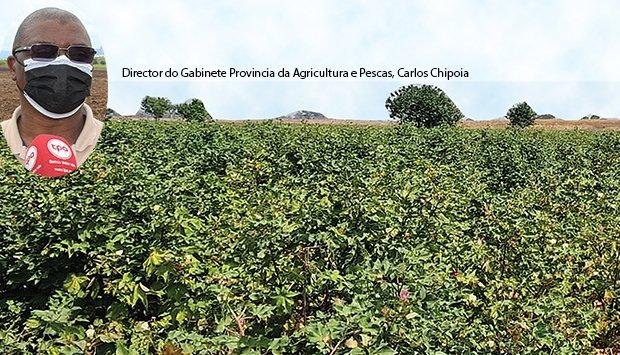
The historic region of Baixa de Cassanje, in Malanje, returns to producing cotton, 37 years later. The first harvest of “white gold” takes place this week, in the municipality of Kunda-dia-base, 175 kilometers north of Malanje province.
The director of the Provincial Office of Agriculture and Fisheries, Carlos Chipoia, said that Malanje is effectively starting to produce cotton, but it takes persistence and a good relationship with the farmers who accepted the challenge of starting this year, to produce this culture.
“Obviously it is not in the proportion that we wanted or that was initially established. We expected to produce over 1,500 hectares”, he said.
Carlos Chipoia stressed that the estimate of production areas had dropped to 350 hectares, but as the challenge was to sow and have cotton this year, it was then decided to proceed with the first 50 hectares, as a result of the delay in sowing, because it rained a lot.
This, he stressed, complicated the process a little, but even so, there is some expectation in what could be the yield of the first cotton production. The person in charge assured that the harvest is being prepared with some care.
The peasants are oriented to harvest the production and let the missing “buds” bloom and, consequently, harvest. August is the indicated month for harvesting, although it coincides with the elections, a “very busy” political moment, but it is harvest time and we cannot avoid it,” he said.
“People will receive rewards depending on the work that has been done. Obviously there was some reluctance, but the work was done, 50 hectares well sown, we had some difficulties because of the time to carry out the disinfestation, but everything was done satisfactorily and we can say that this year we are going to take out some cotton to sell to Textang II”, he said.
Carlos Chipoia said that the fifty hectares are the result of the work of family farmers, from the Kunda district, in the municipality of Kunda-dia Base.
The director of the Provincial Agriculture and Fisheries Office said that three regedorias had been prepared that should receive the cotton, but the delay in sowing meant that only one regedoria remained.
“The difficult thing is always to start, the perspective is good and with some engagement we aim for better results in the next agricultural year”, he reinforced.
Production Goes Beyond Baixa de Cassanje
Baixa de Cassanje is a historic area with a tradition of cotton cultivation. “We are resuming cotton production to see if we can rewrite history with better varieties. Both in terms of precocity and in terms of yields, this is a new era that we want to show,” he added.
Carlos Chipoia explained that cotton production will not be restricted only to the Baixa de Cassanje region, since, within the scope of the privatization of production units built by the State, there is a unit that is installed in Quizenga, which in principle may also in cotton production.
“These are the indicators we have. Obviously, first, the unit will test many varieties and produce on a large scale, but the biggest focus will be, in this first phase, in Baixa de Cassange”.
The director said that, if there is income, the producers will get involved and, consequently, the people’s standard of living will improve and the province will also gain, as it will contribute to the reduction of imports of raw material for the country’s textile industry.
Carlos Chipoia pointed out that the benefits, in addition to being generally for the country, are particularly for Malanje, as the families that are in the cultivation areas will help to bring an industry to the processing of cotton, mainly with regard to the ginning and shredding, generating employment for youth.
Production Flow
Investimentos e Participações (IEP), which owns the textile company Textang II, guarantees the purchase of the product. According to the director of the Malanje Provincial Agriculture Office, 50 families will be involved in this first phase and each one will have to cultivate one hectare, as opposed to the two hectares initially recommended.
Carlos Chipoia added that the cotton reactivation process will involve the promoting company and the Agricultural Development Support Fund (FADA). The perspective is to find mechanisms to trigger support for the families involved to benefit from FADA funding for cotton production. Asked about the difficulties that made the activity unfeasible during this period of experimentation, he argued that the beginning of a whole process is always difficult.
“We started the land preparation with some delay, because it was difficult to obtain the machines that the promoter would like to have. Even so, it had to resort to our local operators to do some land preparation work. After this phase, the rain in the Baixa de Cassanje didn’t help at all, because the land became muddy and in these conditions the machines have difficulties to work. later than January, which did not happen.
According to Carlos Chipoia, sowing only took place in early March. Another problem that is not directly linked to production, he said, has to do with the organization of the process in relation to the volume of farmers that were intended to be involved.
“We wanted to better organize the process with the legalization of at least two hectares per family, so that they would have the right to surface. This is a constraint insofar as they needed these elements to access the inputs, so we had to delay the entire process , download and do some work, put the technicians in the field to work 15 to 20 days to carry out the due survey. Today we are in better conditions, but we will see how we can close this matter so that next year we are not surprised.
Access Ways
The director of the Provincial Agriculture Office said that access roads are another element to be taken into account. This issue was addressed at the time when the resumption of cotton production was considered.
Of the main access roads that need rehabilitation, the road to the municipality of Cambaxe and the other that connects Quela to Cunda dia Base stand out.
The director of the Malanje Provincial Office of Agriculture and Fisheries said that the Cassanje region has an area of 250,000 hectares reserved for cotton cultivation and the production cycle varies between 120 and 150 days.
In a first phase, in the municipality of Cahombo, production would be carried out in the municipality of Cambo Sunjinje and in the region of Quela, it would be in the municipal seat and municipality of Xandel.
Reduce Raw Material Imports
The agronomic technical advisor of Investimentos e Participações (IEP), António Parsons, guaranteed last year, in the municipality of Kunda –Dia-Base, thatthe activity should have the involvement of 700 family producers in the municipalities of Cahombo, Kunda-Dya- Base and Quela.
The objective, he added, is to reduce imports of this raw material to supply the country’s three textile industries, namely Textang II, located in Dondo and two others in Benguela.
The official recalled that depending on imports, it makes the normal functioning of the factory unit difficult, hence the need for the IEP company to produce cotton in the Baixa de Cassanje region due to its tradition.
António Parsons guaranteed that producers will also have agronomic assistance to family farmers through the Agrarian Development Institute (IDA).
He added that family farming is capable of meeting the country’s consumption needs in the order of 95 percent. One of the mechanisms for the materialization of the project to reactivate cotton cultivation is, necessarily, the implementation of the Field Schools, a successful production methodology adopted by the International Fund for Food and Agriculture (FAO), as António Parsons made a point of mentioning.
The cultivation areas began to be prepared in October 2021, he said, adding that just over a ton of cotton would be enough to pay for the labor and generate income for the families involved.
António Parsons also said that, in the short term, Angola could become one of the biggest cotton producers in the world, producing 40 million tonnes and surpassing Argentina, which currently grows 28,000 hectares of cotton for a harvest of 50 million tonnes a year.
The increase in production must necessarily involve training Angolan technicians, he stressed.
The official said that cotton cultivation will rely on the rotation of other food crops such as corn, beans and soy to guarantee soil fertility.
The production surplus will be used for animal feed and then the production of oil by other companies will be considered.
14 Million With Cotton Imports
António Parson revealed that Angola spends around US$12 to 14 million annually on cotton imports. Each thousand ton should be around 2 million two hundred thousand dollars, according to the price on the international market.
In turn, the head of Sociedade Algodoeira de Angola (SOPREMA), dedicated to the production and industrialization of the product, Emanuel Duque, said he had negotiated with the government for the concession to develop the activity that involves the rotation of other crops. He added that within the scope of the company’s social responsibility, technical assistance will be provided to agricultural communities to then purchase cotton and other products. “We embrace these challenges to join the Government’s efforts to reactivate cotton cultivation in Baixa de Cassanje,” he said.
He underlined that after ginning, the weighing is carried out and, consequently, the transport of the cotton to the Angolan textile industry, which has three units with large capacities and which will need a lot of cotton. According to Emanuel Duque, a small ginning plant will be installed in Cahombo, with a capacity to produce 1,000 tons of cotton fiber. The idea is to reach, in a second phase, a production of 14 thousand tons of hybrid cotton and seven to eight thousand tons of fiber cotton, in five years.
The official estimates an investment of US$15 million, of which five million will be own capital and the rest will require other financing. This amount includes agricultural and industrial investment. In all, the project includes the cultivation of 6,000 hectares, but in the experimental phase, only 250 hectares will be cultivated, and this figure may rise to 1,000 to 2,000 hectares.
The initiative to start cotton production is part of the Angolan Executive’s vision with the aim of relaunching the textile industry and reducing imports of the raw material. The governor of Malanje, Norberto dos Santos, expects encouraging results in the current harvest.
“The orientation of the Holder of the Executive Power was that we find the fastest formula so that cotton could be produced on a large scale in Baixa de Cassanje”, said the governor. Cotton production in the vast region of Baixa de Cassanje, which includes the municipalities of Kunda-dia-base, Quela, Cahombo, Massango, Kiwaba Nzonje and Marimba, was interrupted during colonial times due to the barbaric massacre perpetrated by the Portuguese colonial army, with aerial bombings in which thousands of peasants were killed for demanding forced labor and low cotton prices on January 4, 1961, at the then Belgian Luso Company of Cotonang.
For More News And Analysis About Angola Follow Africa-Press