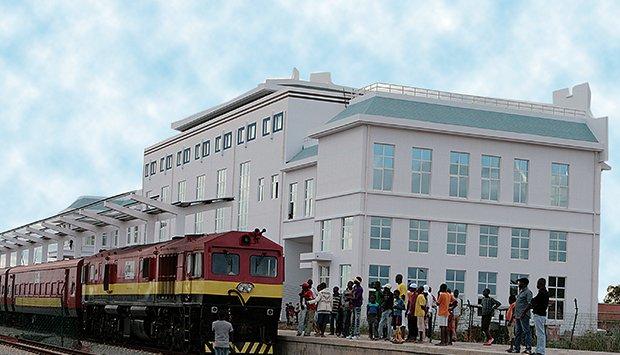
Africa-Press – Angola. The Moçâmedes Railway operates three weekly frequencies on the Menongue-Lubango route, on Mondays, Wednesdays and Fridays, and vice versa. It is a means of transport that has changed the lives of peasants, businessmen, entrepreneurs, farmers, street vendors and other people for the better.
The provincial delegate of the Moçâmedes Railway (CFM), Meque Dawel Chivangue, announced, in Menongue, the entry into operation of a new service, the express train, which, in addition to reducing travel time and providing greater passengers, will significantly increase trade between the provinces of Cuando Cubango, Huíla and Namibe.
The new service will bring multiple advantages, especially for business people, as it will shorten travel time, he stressed.
“Time is money, as they say in the slang and, currently, the regular train on the Lubango-Menongue route, a journey of just over 500 kilometers, can last between 9 to 10 hours, due to the delay that observes in the loading and unloading of goods at the 56 service stations”, he observed.
The intention of CFM, he explained, was to put the express train into circulation this August, but taking into account some technical and administrative issues, which are summarized in the preparation of the new locomotives and carriages that are already in Lubango (Huíla ), this service will only come into service before the end of this year.
Without advancing the number of weekly frequencies between Namibe and Menongue, passing through Lubango and vice versa, Meque Chivangue assured that the express train will respect the standards required internationally, namely air-conditioned carriages coupled with cabins, restaurants, music, television, among others. services that will give users a dream trip.
Currently, the regular CFM train runs three weekly frequencies, on the Menongue-Lubango route, on Mondays, Wednesdays and Fridays, and vice versa. It is a means of transport that has changed the lives of peasants, businessmen, entrepreneurs, farmers, street vendors and other people for the better, who travel with their goods at a cost within the reach of any pocket.
Meque Chivangue said that the route is ensured by two locomotives that each transport more than 580 passengers from Lubango and around 40 to 50 tons of diverse goods, including farm products, dried and fresh fish, chickens, cattle. cattle, swine and goats, construction material and other equipment that are sold in the markets of the city of Menongue.
CFM operates from Lubango to Menongue with a regular mixed train (passengers and goods) every Monday and returns on Tuesday. There is also a passenger train that runs on Wednesdays and returns on Thursday and a third, also for passengers and freight, on Fridays and returns on Saturday. Ticket prices range from 2,830 for third-class passengers to 5,405 for second-class passengers.
According to the CFM delegate in Cuando Cubango, the route between Lubango and Namibe is, at the moment, the most used for trains carrying heavy loads, for example, the ore for the manufacture of pig iron that is being extracted in Cutato (Cuando Cubango), fuel, marble stones, as well as other types of goods at the service of the national business community.
The train is, in Meque Chivangue’s view, the main means of transportation for people who want to visit family members and friends residing in these regions, as well as for commercial exchanges, because, in addition to providing a comfortable and safe journey, traders can obtain good profits on their sales, due to the low cost of transporting the goods.
The Moçâmedes Railway starts in the Port of Namibe and ends in the city of Menongue, covering 756 kilometers, along which 56 stations were built for the embarkation and disembarkation of passengers and goods that have contributed to the good -being of communities.
At least 145 workers are responsible for the nine stations that make up the territory of Cuando Cubango, distributed in different areas.
Profitable Business
Since the resumption of train circulation, in 2012, after a stoppage of almost 36 years, due to the armed conflict in the country, the province of Cuando Cu-bango is no longer the same, due to the traders, entrepreneurs and street vendors. who see in CFM a window of opportunity to grow their business, considered the CFM delegate.
From Lubango to Menongue, the train’s freight wagons often carry construction material, various livestock, chickens, a wide variety of rural foodstuffs, national or imported Namibian furniture, fish, seafood and other household goods. and consumption.
In the opposite direction, businessmen mainly carry bombó to make fuba, corn, beans, macunde, massambala, massango and many other products that are produced on a smaller scale in Huíla.
“For those who travel to the city of Menongue, the difference is enormous between the past and the present. The business market is much more attractive, customers have more purchase options thanks to the investments that the executive made in the rehabilitation of the railways in Angola, which also counts on the road transport competition”, said Meque Chivangue.
Satisfied Population
Citizens of Cuando Cubango province are satisfied with the regular circulation of the train, through the Moçâmedes Railway (CFM), which has allowed the free movement of people and goods, at a reduced cost.
In a round carried out by a reporting team from Jornal de Angola, it was possible to see joy in people’s faces. When questioned, they pointed to the movement of the train as the reason for their satisfaction. Since its entry into circulation in 2012, they say, the CFM has facilitated trade between them. Better than that, they emphasize, is the fact that the price is four to five times lower than those charged for private road transport.
Ana Maria, a chicken seller at the market adjacent to the Menongue station, said that the train’s circulation had brought great benefits to the population of the provinces of Namibe, Huíla and Cuando Cu-bango. Thanks to this means of transport, she underlined, her business has been very profitable, with the income being used to support her family.
“I have my fixed residence in the province of Huíla, but I live practically between the train and the city of Menongue, where I stay four to five days to dispatch the large quantities of chickens that constitute my main business and return to work.
origin with bombó fuba, which is very popular in Lubango. And so goes my life”, said the saleswoman, the only one who guarantees her livelihood at home.
Eugénia Tchalinga considered that the movement of the train between the three provinces was a blessing from God. With that means, she is able to transport different furniture, acquired in Namibia and which she sells by order to several clients in Menongue. “The business thrives, thanks to the peace we live in,” she said.
Domingas Chongolola, a 25-year-old young man, said that he uses several products that he buys from the greengrocers who leave Huíla. He said with the profits from sales, which he has been developing for three years, he is able to cover his expenses and that of his daughter. Domingas reconciles zunga and studies and, in the next academic year, intends to finish high school, in order to enter a university in the next year.
“Today I am selling chicken here, but I have also been selling dried fish, tomatoes, onions, cabbage, lettuce, fruits, among other products, which come from Huíla , by train. thousand kwanzas”, said the saleswoman who said she was not ashamed of what she does to survive.
Domingas said that, with the circulation of the train, the prices of products, especially from the countryside, had reduced a lot. “There is no reason to sell products at an exorbitant price, because merchants also pay a low price for transporting the goods,” he said.
Elias Domingos, a seller of pigs, goats and oxen, said that the train only brought benefits to his life. As a result of this work, he is able to support his four children and pay for school, health and other basic needs.
The 35-year-old seller chose to sell animals due to the lack of a steady job. “I do my sales normally and I condemn the reprehensible attitude of several young people who find themselves in the world of delinquency or prostitution and point out the lack of employment as a justification”, declared Elias, supporting the thesis that there is always something to guarantee survival. .
Not having found a job, either in public or private institutions, Elias Domingos saw in the sale of animals the “dignified and honest way” to earn income, “without harming, hurting or killing someone to get what he wants”.
Vandalization Of Equipment
The Moçâmedes Railway (CFM) has, with some concern and on a recurring basis, noticed the vandalism of its service equipment, such as the breaking of the windows of the stations, theft of metal sleepers and rails.
The CFM delegate in Cuando Cuando attributes such acts to bad-faith citizens who are attracted by easy profit.
Meque Chivangue said that, until now, the population residing along the section, especially teenagers and children, when they see the train passing by, throw stones and other objects at the composition, causing damage to the windows of the locomotives’ carriages.
That person in charge believes that it is an attitude with no end in sight, because the CFM has already talked to some local leaders, but the situation persists.
He also disapproved of the attitude of several citizens who cross the railway line in inappropriate places and sometimes when the train is already close. This situation, he said, has culminated in the death of people. He appealed, in effect, to the population to refrain from such practices, since along the railway line there are properly signposted areas for crossing.
Chivangue also said that the CFM has also suffered from the theft of screws, sleepers and ballasts from the railways.
“These are extremely serious situations because they can cause the trains to derail, an evil for which the CFM Board of Directors has been fighting, but the vandals act in the dead of night and the railway line has, from Namibe to Menongue, 756 kilometers extension”, he lamented.
Completion Of Branch
Despite the enormous benefits that the train has brought to the lives of populations, there is still a lot of work ahead, with emphasis on the completion of the rail branch accessing the oil derivatives storage center and another access line to the future dry port , an area that is sorely lacking for the unloading of containerized cargo and the loading of other goods.
The CFM delegate in Cuando Cubango referred to the fuel plant, which has a capacity to store around five million liters of diesel, gasoline, Jet-A1, oil and more than 200 tonnes of cooking gas. He said they were huge quantities and that the CFM train would be able to keep stocks up to date, given its enormous capacity to transport this type of products.
The appropriate means for the transport of this type of products exist, Meque Chivangue assured, for whom only the conclusion of these important railway lines for access to the storage center and another to Porto Seco, both works paralyzed for more than five years, for reasons techniques.
He said that the construction of a branch for the Cutato mine and another for the pig iron factory in Cuchi was also in advanced studies.
The CFM delegate informed that the company’s Board of Directors is working hard so that, in a short space of time, the construction works of the railway branches are completed, to leverage the development of the province of Cuando Cubango and generate more income for the state coffers, through the CFM.
For More News And Analysis About Angola Follow Africa-Press