Africa-Press – Angola. At 78 years old, Adriano da Silva is a living library that is available to young scholars interested in discovering the political, economic, cultural and social intricacies of the province of Huíla. Adriano da Silva says with satisfaction he keeps memories of António Agostinho Neto, who defended a united Angola, with the slogan “From Cabinda to Cunene, one people and one nation”.
According to Adriano da Silva, these are watchwords that still mark Agostinho Neto as a politician and statesman committed to his people. Former combatant and former leader, Adriano da Silva, currently on loan to an administration area of the Moçâmedes Railway (CFM), despite squirming with pain in one of his feet, made a point of receiving the reporting team from Jornal de Angola to open the memoir and talk about Neto, on this centenary of his birth, celebrated on the 17th of September.
To situate himself in time and space, Adriano da Silva says that he joined the ranks of the MPLA in 1974, during the Transitional Government, after the Carnation Revolution of April 25, 1974, which overthrew the fascist regime of Marcelo Caetano in Portugal. .
“My involvement in self-defense and raising awareness among the population of the localities of Capunda Cavilongo and Cangolo, in 1974, was crucial to counteract the movement of elements from UNITA, FNLA and the Chipenda Faction, which were intended to deploy in Lubango, capital of Huíla. At the end of 1974, recalls Adriano da Silva, Carlos Rocha “Dilolwa” arrived in Lubango, mandated by Lúcio Lara, to reorganize the structures of the MPLA in Huíla province and stifle the divisionist pretensions of the Chipenda Faction, which invented the removal of President Neto at the Lusaka conference and the election of Daniel Chipenda as the leader of the liberation movement.
At the time, Adriano da Silva says that he was part of the self-defense organization that was preparing the arrival in Luanda of President Neto. “We closely followed the news on the Official Broadcaster of Angola, currently Rádio Nacional de Angola, because we did not have the resources to travel to Luanda,” he said.
With the arrival of Agostinho Neto in Luanda, he explains, preparations began for the proclamation of National Independence, but to prevent the consecration of this greater good for Angolans, South African racist forces invaded, with tanks and heavy artillery, the south of the country, specifically the provinces of Cuando Cubango, Cunene and Huíla.
Adriano da Silva recalls that in one of these attacks, in the vicinity of the commune of Arimba, on the outskirts of the city of Lubango, the self-defense forces were forced to retreat, due to the disadvantage in war and military material in relation to the South African invaders. .
From this retreat, Adriano da Silva laments the death, in combat, of Commander Dack Doy, right at the entrance to Arimba. “We were retreating, all running in clip form and with some distance, to avoid being hit by the enemy’s bullets, but Commander Dack Doy did not escape”, he says sadly.
He emphasizes that it was thanks to the support of the Cuban contingent and its respective weapons that the attempt by the then internal enemies, supported by the racist South African regime and a swarm of mercenaries, from the town of Ebo, province of Cuanza-Sul, to Cahama, in the province of Cunene, who did everything to prevent the proclamation of National Independence on November 11, 1975.
Grandson in Lubango
Adriano da Silva says that it was in mid-1976 that President Neto’s governance began to be felt, when he appointed Emílio Brás Caniminimi as provincial commissioner of Huíla.
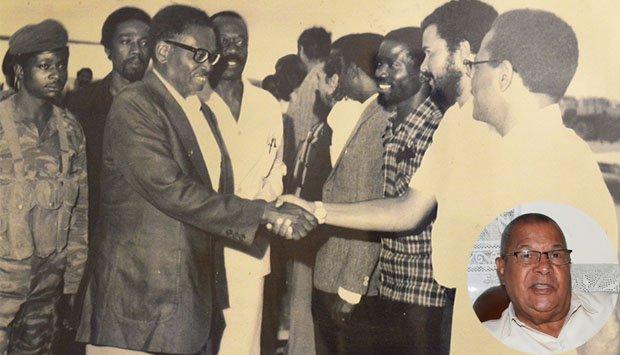
“It was at that time that I met Agostinho Neto here in Lubango, where I shook his hand for the first time, and we exchanged impressions about the province of Huíla, its socio-cultural values and the need to strengthen the defense, taking into account the southern border. , from where the racist troops left for armed incursions into Angolan territory”, he said.
In addition to Emílio Brás Caniminimi, President Neto also later appointed commissioners Belarmino Van-Dúnem and Nazaré Vital. “I am one of the people who has always been with President Neto, on the several times he has come to Huíla province, because he considers it strategic, militarily and economically”, he stressed.
He also recalls that whenever President Neto was in Huíla, he never tired of expressing the affection he felt for Terras da Chela, constantly expressing words of encouragement in private meetings, as well as in mass political acts.
The rallies were held in the “Comandante Calofe” square, where a bust in his memory is today. “It was there where, with much applause, the slogan “From Cabinda to Cunene, one people and one nation”, as well as “The most important thing is to solve the people’s problems”.
Adriano da Silva says that whenever he passes through the Comandante Calofe square, which was renovated with the materialization of the Obras Integradas do Lubango, which lasted three years, he remembers fondly those mass political acts and Agostinho Neto’s futuristic vision of the reconstruction and development of the country. Neto thought the country’s development with a focus on the Angolan man as the primary reason for governance, he said in closing.
For More News And Analysis About Angola Follow Africa-Press