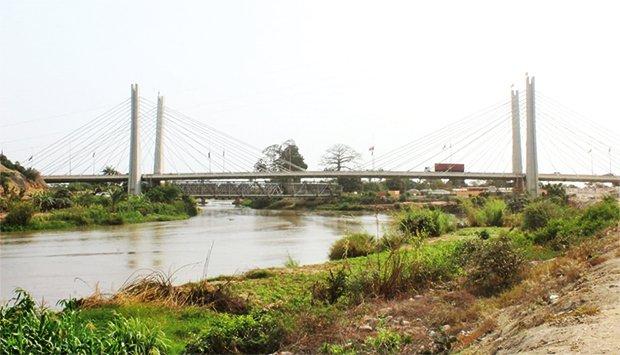
Africa-Press – Angola. The municipality of Catumbela is rich in water resources, the result of the well-known river that meanders through the mountains, valleys and plains of the territories of Huíla, Huambo and Benguela. However, its source is controversial.
One current argues that it has its source in the municipality of Caconda, province of Huíla. While another that is shared by the technicians assigned to the Administration of Catumbela makes the apology that the river starts from the Cassoco mountain range, in Huambo. However, they converge at the mouth, that is, it flows into the Atlantic Ocean, south of the city of Lobito, covering a length of about 250 kilometres. Its main tributaries are the Kuiva (Huambo) and Cubal (Benguela) rivers, of great historical symbolism along the Lobito Corridor, as they are sources of irrigation for the planting of eucalyptus, the main raw material for the production of paper, in Cellulose, in addition to the functionality of the Kamakove and Mala train steam engines.
The potential of the Catumbela River extends to the fact that it is the only source of water supply for the cities of Lobito, Benguela and Baía-Farta, in addition to the village and surroundings of the youngest municipality in this southern coastal province. In recent times, it has been faced with the problem of silting, along its flow, a fact that greatly influences the constant breakdowns in the pumping system, much of which calls for immediate replacement.
At the mouth, sandbanks were born, populated by migratory birds, such as pelicans, herons and other species, creating a unique and spectacular landscape in the place. A lagoon, very close to the delta, completes the scenic area of the Catumbela river profile.
For More News And Analysis About Angola Follow Africa-Press