Africa-Press – Angola. The Angosat2 satellite is put into orbit today by the “Proton-M” rocket, about 50 meters high, from the Baikanur Cosmodrome, Kazakhstan, around 20:00 local time, 16th of Angola.
The Angolan delegation, which visited the facilities of the Cosmodromo de Baikanur yesterday, is confident in the success of the operation. There, he received detailed explanations about the launch and behavior of the satellite, and learned that, after being in orbit, Angosat2, weighing two tons, will have a wingspan of 22 meters when opening the solar panels.
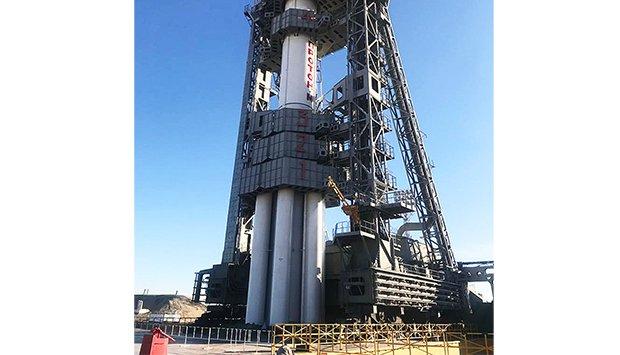
The view that one has of the satellite, from the launch pad, is that one is in the presence of an imposing work, a fantastic creation of space exploration engineering. After being in orbit, the monitoring and control center, on the ground, will have to wait for the satellite signal to confirm its operability.
The specialists who are handling the launch said that the waiting period for the satellite’s reaction is approximately three months. Then follows a test phase to verify the movements and operation in orbit, in a time that varies between 60 and 90 days. To reach its operational position, the satellite needs, in continuity, at least ten days.
The technical director, Alexander Madzar, made it known that all the technical procedures in preparation for the launch were carried out in accordance with the operating standards, a fact that guarantees the success of the operation. He said that according to the schedule, the satellite separation from the acceleration block is scheduled between two and four tomorrow.
The director general of the ISS-Russian Space Industry, Evgeniy Nesterov, provided more information during a short meeting with the minister of Telecommunications, Information Technology and Social Communication, Mário Oliveira, which culminated in the signing of a Memorandum of Understanding between Angola and the Russia.
At the end of the meeting, after the visit to verify the level of preparation for the launch of the satellite, the minister Mário Oliveira, addressing those responsible for the ISS, made a point of emphasizing that the expectation of Angolans around the launch of the satellite is great.
“Angolans are looking forward to today”, he stressed, adding: “We believe that the work done offers guarantees that the launch operation, placement of the satellite in orbit and its operationalization will be successful”.
Mário Oliveira highlighted Angosat2’s provision of telecommunications service, as the objective of the mission. Confronted about the impact of the satellite, he said that it will revolutionize communication in the country, in general.
Angola, he continued, is a vast country and needs coverage throughout its territorial extension, in order to offer quality communication services to the population, thus allowing its development. With this step, “Angola has just entered the space world, which is in constant development”, said the minister.
Regarding the possibility of the country acquiring more satellites in the future, a curiosity of the local press, Mário Oliveira said no, justifying, by the way: first “we are going to explore Angosat2, and, later on, analyze the need or not to if you acquire another satellite”.
As for the use of Angosat2, the minister said that the operation is fully planned, and as soon as the technological procedures are fulfilled, another set of procedures is planned. On the occasion, Mário Oliveira also expressed the intention of the Government to continue working with Russia in the field of Space Science.
“This chapter is never exhausted, as we will continue to work with Russia”, he said, stressing that it is a world power in space science, stating that the country wants to “be on the side of the best”.
When commenting on cooperation with Russia, he made it known that the space area is very vast, and, in this regard, the parties have been cooperating for some years, especially in the training of staff. Mário Oliveira, who is accompanied by high-level technicians, highlighted the work carried out with the Russian authorities, mainly among the technical teams, which allowed the development of the project.
“It was a period marked by hard work, which demanded commitment from both teams, the result of which culminates with the launch of the satellite, today”, he underlined. From a technical point of view, he stressed, there are guarantees of success in this mission.
Memorandum of Understanding
At the end of yesterday, representatives of the two delegations signed a Memorandum of Understanding, called “Launch Readiness Review”, which, among several issues, reflects the steps that were taken until Angosat2 was placed in orbit.
This phase is linked to the technical procedures for verifying the preparation of all the elements necessary for the launch, especially the rocket and the satellite. The document also presents, in its content, the work of the State Commission coordinated by the Russian Space Agency.
Construction
New satellite at no additional cost to the State
The construction of Angosat2 did not bring any additional cost to the Angolan State, as the contract worth more than US$300 million, signed with the Russian side for the construction of Angosat-1, provided for the construction of a new one, in case of disappearance. or destruction of the satellite.
As a High Transmission Rate (HTS) satellite, Angosat-2 will provide 13 gigabytes in each illuminated region (satellite signal range zones) and will be based on the Eurostar-3000 platform and have a 15-year lifespan. .
Thus, the satellite will be placed in geostationary orbit, at a distance of about 36000 km from the Earth’s surface. It is recalled that Angosat-1 was launched into space on December 26, 2017, from the Baikonur Cosmodrome in Kazakhstan. Contact with the device has been lost until now.
Control Center
The National Space Program Management Office (GGPEN) guarantees that all the technical elements for operating Angosat-2 in orbit are already assured, namely the Satellite Control and Mission Center (MCC), located in Funda, in Luanda, KA band antenna for in-orbit tests, already installed at the MCC, and the training and qualification of human resources.
The institution also mentions that the Angosat-2 project has two control centres, one in Luanda (main) and the other in Russia. Both are fully operational, equipped with equipment and operating software that ensure readiness for launch, in-orbit testing phase and subsequent operation.
The Satellite Mission and Control Center was designed to operate uninterruptedly, 24 hours a day, 7 days a week, and is equipped with engineering systems that make it possible to receive, process and send information to the satellite.
In July, an antenna of 7.5 meters in diameter was installed at the aforementioned centre, in Luanda, which will be used for the in-orbit tests of Angosat-2. The GGPEN clarifies that the infrastructure arises as a result of the update carried out in Angosat-2 and used in the 17 to 30 GHz frequency band.
Human Resources
For the operation of Angosat-2, around 25 specialists from the Management Office of the National Space Program (GGPEN) were trained and certified by the construction company. The training was on the architecture, design and functionalities of the platform and payload, as well as practical training on the use of operating software.
Angosat is the name of a structuring project that includes not only the construction, launch and operation of Angolan satellites, but also the creation of national capacity in human resources and infrastructure, within the scope of the National Space Strategy 2016 – 2025.
In this regard, Minister Mário Oliveira stressed that Angosat does not appear in isolation, it is part of a program that includes the National Fiber Optic Network and the Submarine Fiber Optic Network. “Angosat is a component of this ecosystem with a view to improving the country’s communications”, he explained. The Ministry of Telecommunications, Information Technologies and Social Communication of Angola and the Russian consortium responsible for the construction and launch of the first Angolan satellite, agreed, April 23, 2018, the start of construction of Angosat-2, without additional costs for the Angolan side.
In addition to updating the satellite and to compensate the Angolan State, Russia provided capacities in other satellites, at around 288 MHz, during the construction period of Angosat-2, used for Internet, television service for TPA, Telemedicine, telephony, among others.
For More News And Analysis About Angola Follow Africa-Press