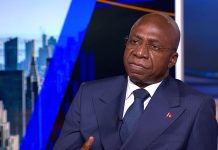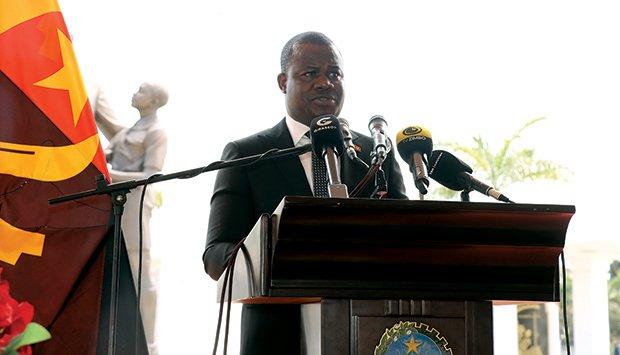
Africa-Press – Angola. The Minister of Territorial Administration, Dionísio da Fonseca, declared, Friday (11), in Luanda, that the Executive has many challenges that it intends to continue to implement with the active participation of all the living forces of the Nation, within the framework of a dynamics of consultation and comprehensive consultation with a view to consolidating national cohesion.
For Dionísio da Fonseca, who led the central act of National Independence, representing the President of the Republic, João Lourenço, these challenges can be overcome if everyone walks together. “Building a prosperous and developed Angola is our purpose. It is a task that we will be able to achieve walking hand in hand”, he underlined.
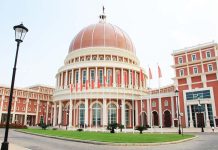
Dionísio da Fonseca, who was speaking at the special public act to celebrate the 47th anniversary of national independence in Praça da República, under the motto “Angolanos, from Mão Dadas para o Futuro”, advanced that the desired joint action will be centered on seven axes strategic issues, namely the consolidation of peace and the Democratic State of Law, the reform of the State, Justice, Public Administration, the Media and freedom of expression and civil society, the promotion of balanced and harmonious development of the territory, the promoting the development of human capital and reducing social inequalities.
He also indicated paths such as modernizing and ensuring more efficiency in the country’s infrastructure and preserving the environment, promoting sustainable, inclusive and private-sector-led economic diversification, guaranteeing the defense of sovereignty, integrity and national security. and the promotion of Angola’s image and role in the regional context. For the minister, governing is planning and, therefore, he announced that sectoral development plans and territorial development plans are being prepared, the latter supported by the Integrated Intervention Plans in the Provinces and Municipalities, as a result of a comprehensive diagnosis. and inclusive of the main problems of each territorial circumscription.
The actions included in these plans, he added, will be included in the General State Budget each year, whose approval is the responsibility of the National Assembly within the scope of the principle of interdependence of functions between the sovereign bodies.
These plans, said Dionísio da Fonseca, will make it possible to increase the Human Development Index (HDI) of the population, by increasing the number of schools, health centers and municipal hospitals, water supply and electricity supply. , improvement of basic sanitation, construction of primary, secondary and tertiary roads, as well as those that ensure connections between Angola and neighboring countries.
According to the minister, these planning and budgeting exercises will generate results insofar as they will improve productivity: “That is, if families, companies and the State are able to work in a committed and hard way to increase national income and develop the country”.
Dionísio da Fonseca wants more democratic dialogue and participatory governance. One of these mechanisms, he pointed out, are the Community Auscultation Councils that operate regularly in the country’s 164 municipalities and 18 provinces. Another example, according to the minister, is the Participatory Budget also implemented in the country’s 164 municipalities, whose funds are managed directly by the Municipal Budget Management Committees, made up of citizens chosen by the communities.
The Councils and Residents’ Commissions, totaling 20,239, also fulfill this vision of giving focus to government action, “which must also occur downstream through the presentation of results and the impact generated by public policies and programs ”.
The minister spoke of the institutionalization of the Municipal Accountability Forum, through which Municipal Administrations must publicly present the results of their governmental action to the municipalities. “This is a dynamic that allows us to consolidate the democratic process and lay the foundations for the institutionalization of Local Authorities in a responsible and rigorous way”, he maintained. He said that the Executive does not intend to seek perfection with the process of institutionalization of Local Authorities. ” For this, when attainable, occurs with practice. We are, indeed, in search of a process that observes the law, is implemented with rigor and responsibility and that effectively results in the creation of bodies closer to the citizens and more capable of implementing the principle of good administration”, he assured.
The minister declared that implementing the Local Authorities, as an investment in the consolidation of the democratic process, with bodies more responsible for the governmental action they exercise, requires the consolidation and deepening of the administrative and financial deconcentration process, the approval of the necessary and essential legal instruments for the implementation and effective and full functioning of municipal bodies, as well as the training of human capital and the creation of infrastructural and technological conditions to install the services of Local Authorities where they do not exist or are insufficient.
Stages of Independence
The conquest of national independence, peace, national reconstruction, the consolidation of the democratic process and the country’s development are stages of the historical process that guarantee that, hand in hand, the present and the future can be better, said the minister. of the Territory Administration.
For Dionísio da Fonseca, all Angolans must walk together “because history shows that union and cohesion were fundamental for the conquest of national independence”. “It was with the intertwining of our hands that we conquered peace. It is hand in hand that we are rebuilding and developing our country. And it is, of course, joining our hands that we must walk and build a bright future for Angola and for the Angolans”, said the minister.
Independence, he added, reflects the affirmation of Angola as a sovereign nation, subject of international law, with its own personality and legal capacity, with powers to lead its own destinies and contribute to the construction of a peaceful, more balanced, inclusive and sustainable world. .
For the official, the 47 years of Independence are even more special as the year of the birth centenary of the first President of Angola, António Agostinho Neto, Founder of the Nation and National Hero, to whom the noble mission fell to proclaim independence to Africa and the world on 11 November 1975.
The minister did not fail to recognize the bravery of all the heroes and heroines who on the most diverse battle fronts contributed to the liberation of Angolans from the bitterness of colonialism.
He indicated that the foundations for the future of Angola were laid by the President of the Republic: “Angola that we have is an Angola of peace, in which, in general, security and order reign on our borders. An Angola in which rights and freedoms are guaranteed. An Angola with a people committed to work and to the economic and social development of the entire national territory”.
For More News And Analysis About Angola Follow Africa-Press