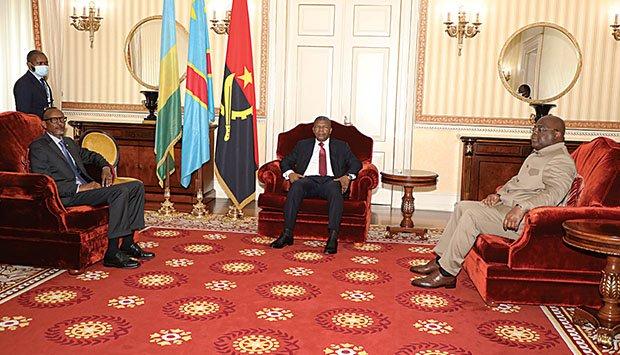
Africa-Press – Angola. The Summit for the approval of the Peace Plan in the DRC and the re-establishment of good relations with Rwanda, initially scheduled for Monday (21), will take place tomorrow in Luanda, according to a new schedule.
The meeting’s agenda will be to look for ways to overcome the crisis between Rwanda and the DRC, generated by the resurgence of the armed rebellion of the M23, in the east of the Democratic Republic of Congo.
The Luanda Summit was convened by the President of the Republic, João Lourenço, as Champion of Peace and Reconciliation of the African Union (AU), in charge of the DRC-Rwanda conflict.
To participate in the meeting, João Lourenço invited his counterparts Paul Kagamé (Rwanda), Félix Tshisékédi (DRC) and Évariste Ndayishimiye (Burundi), and the former Kenyan Head of State, Uhuru Kenyatta, as a peace facilitator appointed by the Community of African States East (EAC).
Burundi is one of the neighboring countries of the DRC, which, since last August, has deployed a military contingent in the Congolese province of South Kivu, within the framework of the EAC regional force, created last June to help fight armed groups in territory Congolese.
The Action Plan to be approved at the next meeting results from a proposal by the Angolan mediator to adapt the Luanda Peace Roadmap to the new reality registered on the ground since the end of last October, with the intensification of fighting in the Kivu region. North.
The proposal was presented by João Lourenço to Rwanda and the DRC, during his last trip to these two countries, between 11 and 12 November this year, following the worsening of violence on the common border, with the resumption of military actions by the M23 .
The latest reports on the ground point to an advance by the rebels of the March 23 Movement (M23) towards Goma, the provincial capital of North Kivu, after violent clashes with units of the Armed Forces of the DRC (FARDC) and the seizure of new locations by the rebels.
The same reports place the battle for control of this Congolese commercial hub about 20 kilometers from Goma, close to 76 square kilometers in area and 250,000 inhabitants on the border with Rwanda.
The clashes have already killed and injured several civilians, as well as hundreds of thousands of displaced people and refugees in neighboring Uganda, in the midst of a serious humanitarian situation.
According to the UN Office for the Coordination of Humanitarian Aid (OCHA), an estimated 262,000 people have been displaced and 7,000 refugees since the start of fighting last March between the FARDC and the M23 rebels.
Tension between Rwanda and DRC
Hostilities between the two countries go back a long way, starting with the Great Lakes refugee crisis, triggered by the exodus of more than two million Rwandans to neighboring countries, including the DRC, following the 1994 genocide.
The humanitarian aid effort would have been compromised by the presence, among the refugees, of many of the Hutu individuals, responsible for the genocide, who used the refugee camps as bases to launch attacks against the new Government of Rwanda, led by Paul Kagame.
The refugee camps thus became particularly politicized and militarized, leading humanitarian organizations to withdraw their assistance on the understanding that this aid was being diverted to pursue the objectives of the genocides in Rwanda.
M23 was created by elements of a former rebellion made up of individuals of Rwandan Tutsi origin, the ethnic minority targeted in the 1994 genocide, along with so-called “moderate Hutus”.
Its founders are also former members of the FARDC, who would have deserted at a time of strong divisions within the Armed Forces between the troops of the two ethnic groups, raising speculation that they were acting under the influence of the Rwanda regime, whose leadership is also of the ethnic group. tutsi.
Under the command of General Laurent Nkundabatware, they took refuge in Rwanda, from where they later returned to the country, this time led by General Bosco Ntanganda, and decided to rejoin the FARDC on 23 March 2009.
Three years later, the group resurfaces as an anti-government movement, adopting its current name (M23), and goes to war against the FARDC, until 2013, when it was defeated by an international force, before taking refuge in Uganda. Several rounds of negotiations followed for his reintegration into the FARDC, without success, until he reappeared, at the end of 2021, in the east of the country.
With its resurgence in force, in December 2021, political-diplomatic relations between the DRC and Rwanda deteriorated, after Kinshasa accused Kigali of supporting the M23 in its new military campaign in eastern Congo.
Luanda itinerary is at the base of the meeting
The new scenario imposed by the deterioration of the situation on the ground forced the mediator to travel to Kigali and Kinshasa to propose changes to the “Roteiro da Paz de Luanda”, aiming at adapting it to the new context that emerged in the theater of operations.
Signed by the heads of state of Angola, DRC and Rwanda, the Luanda Peace Roadmap was designed to normalize relations between the latter two and put an end to the new M23 rebellion, which is at the origin of the rise in tension between Kinshasa and Kigali.
Among other measures, the Roadmap provided for the immediate cessation of hostilities, followed by the withdrawal of the M23 from positions occupied in Congolese territory, the reactivation of the Joint Commission between the DRC and Rwanda, the creation of an Ad-Hoc Verification Mechanism and the institutionalization combating the illicit exploitation of natural resources in the region.
According to the Angolan Minister of Foreign Affairs, Téte António, the “Roteiro de Luanda” is recognized in the region and by the UN Security Council as a political mechanism that must complement the Nairobi Process, which determined the creation of a regional force of the Community of East African States (EAC).
The Nairobi Process also takes care of organizing direct negotiations, in the Kenyan capital, between representatives of the Government of Kinshasa and about 30 armed groups, who agreed to lay down their arms in the DRC, with the exception of the M23.
For More News And Analysis About Angola Follow Africa-Press