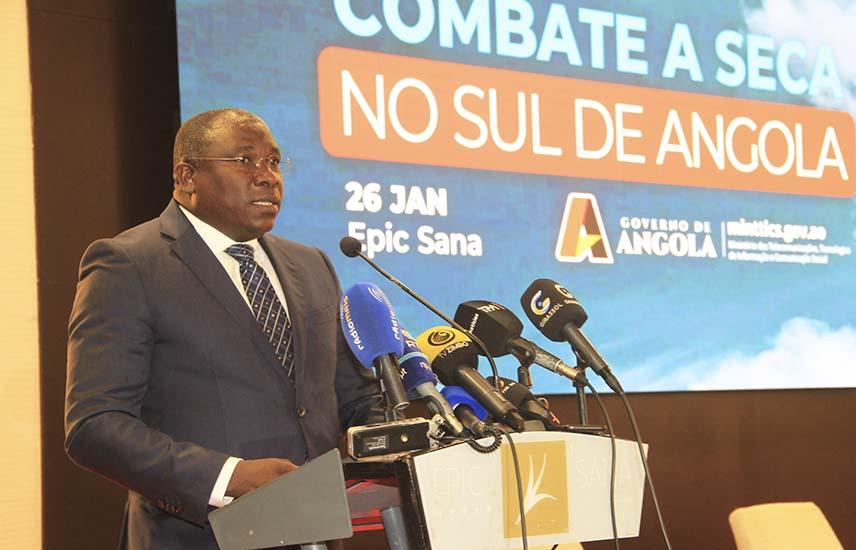
Africa-Press – Angola. The fight against drought in southern Angola is reinforced with the new satellite data collection and transmission system on water resources and on the location of the most vulnerable population settlements in the country presented today.
The method, known as the “Support System for Policies to Combat Drought in Southern Angola”, works with three North American satellites specialized in radiography of the soil, particularly in the assessment of water resources.
The initiative, budgeted at 550 million dollars, is financed by the American Space Agency (NASA).
The objective of this project, which lasts for three years, is to provide the Angolan Government with data on the state of water resources and the location of the most vulnerable populations to the impact of the drought.
Using space technology, this system will also provide information on the ideal locations for the implementation of structuring projects, such as Canal do Cafú.
Thus, the “Support System for Policies to Combat Drought in Southern Angola” will serve as a source of information to support decision-making on policies in the short, medium and long term.
At the presentation of the referred project, the manager, the North American Danielle Wood, said that it is already in operation and being developed with Angolan staff, particularly from the National Space Program Management Office (GGPEN).
The American specialist said that a software (snap) will provide data that will generate precise information that will help solve the problem of cyclical drought in the south of the country.
According to the project manager, it will be possible to estimate the intensity of the drought, based on the assessments made on the ground, by the three satellites, on the quantities of water in the soils of Angola.
In turn, Osvaldo Porto, project manager at GGPEN, said that in this project it will not be possible to use Angosat2 due to its characteristics centered on telecommunications.
“We are not going to use Angosat2 because it is an exclusive telecommunications satellite and not an Earth observation satellite. For this purpose, remote sensor satellites are being used that gravitate in an orbit lower than that of telecommunications”, asserted the expert.
For this reason, clarifies the Angolan scientist, Angola was forced to outsource this service to NASA because it needs high resolution images and a telecommunication satellite does not provide.
On the occasion, the Secretary of State for Telecommunications and Information Technologies, Pascoal Alé Fernandes, considered the project as an important platform for the collection, organization and sharing of systematic and permanent information.
“This project is an initiative of the ICT sectors, in partnership with the North American engineering institute “Massachusetts Institute of Technology (MIT), which joins other initiatives of the Angolan Government, in the sense of significantly reducing the impact resulting from the cyclical drought situations, particularly in the southern part of Angola.
According to the official, in 2019, Angola suffered the worst drought in the last 40 years, the pluviometer index was below 65 percent of normal levels, leaving more than 1,300 people from the provinces of Cunene, Huíla and Namibe, with high financial losses, as well as the worsening of the social problems of the local populations.
The Secretary of State said that initiatives of the kind catapult Angola to position itself among the emerging countries in the world space area and Africa. At the moment, Angola is among the 11 African countries that in the last 10 years have made the most advances in the space sector, a fact confirmed by the Angosat2 satellite.
The provincial director of the office for infrastructure in the province of Cunene, Édio Gentil, considered that the “Support System for Policies to Combat Drought in Southern Angola”, launched this Thursday, will help in decision-making linked to the droughts and floods that plague Cunene.
At this time, there is a contrast with the numbers observed in 2019, normally, the province only receives rain between the months of February and March, but the province has been suffering from floods since the end of last year and with families being relocated.
For More News And Analysis About Angola Follow Africa-Press