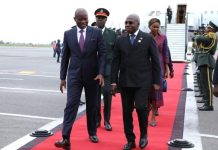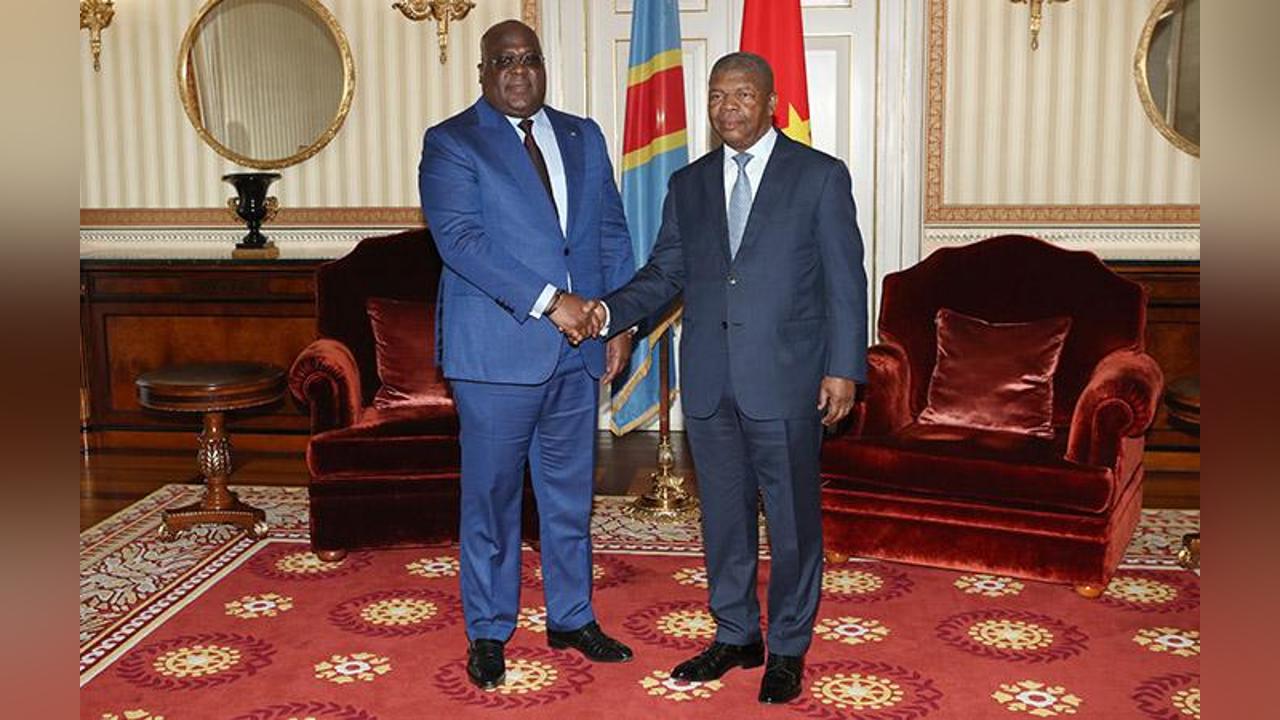
Africa-Press – Angola. The president of the Democratic Republic of Congo (DRC), Félix Tshisekedi, is making, this Saturday, another working visit to Angola.
It is expected that the trip will serve for new consultations with his Angolan counterpart, João Lourenço, on the security situation in the east of his country.
Tshisekedi’s new visit to Luanda coincides with the approval, by the Angolan Parliament, of sending a military contingent to participate in peacekeeping operations in eastern Congo.
In an extraordinary session devoted exclusively to a presidential request for the deployment of the mission in question, the Angolan deputies voted unanimously in favor of the proposal, this Friday, 17.
The resolution was welcomed with satisfaction by the Congolese authorities, for whom Angola demonstrates, with this gesture, that it is “effectively concerned” with peace in the DRC and in line with the aspirations of the Congolese.
Very early on, Kinshasa undertook to clarify national and international public opinion that the Angolan troops in the DRC “will not have an offensive mandate”, but that of guaranteeing the withdrawal of the rebel forces of the March 23 Movement (M23) from the occupied territories. .
According to the Congolese Minister of Foreign Affairs, Christophe Lutundula, the Angolan force “does not come to attack or fight”, but to ensure that the decisions already taken on the withdrawal of the M23 are respected.
The peace mission was proposed by the Angolan head of state, João Lourenço, as acting president of the International Conference on the Great Lakes Region (IRGL) and mediator of the African Union (AU) in the crisis between the DRC and Rwanda.
The military unit to be deployed in eastern DRC will have the mission of “securing” the areas where the M23 elements are stationed and “protecting” the personnel of the Ad hoc Verification Mechanism, led by an Angolan general and headquartered in Goma, capital of the province of North-Kivu.
According to the Angolan Presidency, the deployment of the military contingent is part of the decisions taken at different regional summits on the peace and security process in the DRC, in line with Angola’s responsibilities as a mediator.
The mission will last for 12 months, and it is expected that this period will coincide with the conclusion of the withdrawal and cantonment process of the M23 forces.
The initiative was preceded by the announcement of a new ceasefire, earlier this month, in Luanda, at the end of negotiations between the Angolan mediation and the leadership of the M23, to take effect from 7 March.
But the first reports from the field reported the continuation of fighting between the M23 and the Armed Forces of the DRC (FARDC), before a timid return to calm.
In recent days, the beginning of the withdrawal of the M23 from some of its positions now controlled by the East African Regional Force has been confirmed.
The continuation of the fighting, in violation of the last ceasefire, has greatly aggravated the humanitarian crisis in the region, with an increase in the flow of people displaced from conflict zones to the provincial capital, Goma.
In estimates by the International Committee of the Red Cross (ICRC), Goma currently hosts more than 300,000 internally displaced people, and that the humanitarian organization will reach the limit of its capacity to respond in terms of assistance, if these flows persist.
End of stalemate in the peace process(?)
Despite its “non-offensive” mandate, an Angolan military presence on the ground has come to be seen as a deterrent, to help end the impasse that persists in the peace process for the east of the DRC.
After several diplomatic initiatives launched within the framework of the CIRGL in coordination with the Community of East African States (EAC), military hostilities continued to claim victims among the civilian population “under the beards” of the international forces of the EAC and the UN.
Internally, the Congolese political class is already beginning to question the usefulness of the EAC Regional Force deployed on the ground since November 2022, after expressing its annoyance with the “impotence” of the force of the UN Mission (MONUSCO).
At the last AU summit, in Addis Ababa, João Lourenço was mandated to establish contacts with the leadership of the M23, in coordination with the former Kenyan head of state, Uhuru Kenyatta, as Facilitator appointed by the EAC for the pacification of the DRC.
Conceived to convey the decisions taken from a regional mini-summit on the DRC, in Addis Ababa, contacts with the M23, initiated at the end of last February, resulted in a commitment by the latter to the cessation of hostilities, as of March 7, 2023.
For many observers, the Addis Ababa decision represented the renewal of the African continent’s confidence in the Angolan head of state to successfully carry out his thorny mission of restoring peace to the DRC, after being designated AU Champion for Peace and Reconciliation.
The meeting in the Ethiopian capital was the latest in a series of diplomatic initiatives that have taken place, in recent times, in search of solutions for the east of the DRC.
All these meetings called for an immediate cessation of hostilities in the region and the unconditional withdrawal of the M23 from its positions in the region.
At the same time, they unanimously endorsed the Luanda Peace Plan, adopted on 23 November 2022 as the main base instrument for stabilizing the region and normalizing relations between the DRC and Rwanda, in complement with the Nairobi Process.
Still in Addis Ababa, João Lourenço stressed his solidarity with all countries whose peoples suffer the harsh consequences of instability on the continent.
Therefore, he reiterated his willingness to “honor” his mandate as Champion of Peace and Reconciliation, conferred by the AU, since May 20022, in Malabo, Equatorial Guinea.
For More News And Analysis About Angola Follow Africa-Press