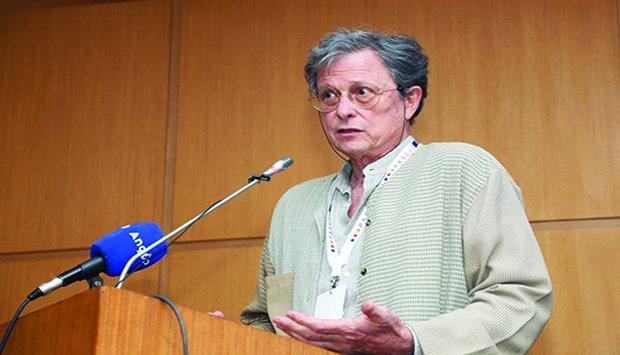
Africa-Press – Angola. The international researcher in municipal public policies, Yves Cabannes, considered the National Program on Participatory Budgeting, present in the country’s 164 municipalities, rare in Africa, mainly because it is being supported by the domain of public policies.
The French academic, who is in Angola teaching the Training Course for Facilitators on Participatory Budgeting, aimed at technicians from municipal administrations, provincial and municipal Finance delegations, GEPE and members of civil society organisations, said that one of the great challenges of this type of national program is its implementation throughout the territory and on time.
“This is essential for participation and, therefore, I find the National Program encouraging and unique in Africa, supported by public policy. This makes a huge difference”, highlighted Yves Cabannes, who was a professor of Urban Planning at the Harvard University Graduate School of Design and regional coordinator of the UN-Habitat/UNDP Urban Management Program for Latin America and the Caribbean.
Yves Cabannes pointed out that this program will be an added value for the country when the first municipal elections are held, insofar as the participatory budget will act as a reinforcement of the citizen’s position to vote in a conscious and informed way. “It has this role of raising awareness, which is very important for the elections”, he stressed.
The specialist made it known that the training course for facilitators on participatory budgeting will allow participants to better dialogue, strengthen the instruments that can be used today to facilitate this participation in each municipality.
“And this is a course for participatory budget facilitators and the people who participate in it are the future trainers, who will multiply the teachings”, he clarified.
Route by Yves Cabannes
Yves Cabannes is an expert in urban planning and Emeritus Professor of Development Planning since 2015, Chair of Development Planning (2006–2015) at the Bartlett Development Planning Unit (DPU), University College London. He was previously Professor of Urban Planning at the Harvard University Graduate School of Design and regional coordinator of the UN-Habitat/UNDP Urban Management Program for Latin America and the Caribbean, and worked for many years with local governments, NGOs and social movements. society in several countries. He has already been awarded the United Nations Best Practices award in 1996, along with other partner institutions, for his longstanding work in low-income housing and income generation in the Metropolitan Region of Fortaleza, in North East Brazil.
Yves Cabannes has been active since the late 1970s as a researcher, practitioner and teacher in municipal public policies, popular housing, urban agriculture and food sovereignty, collective and communal forms of land tenure, local currencies, participatory planning, participatory budgeting, systems microcredit and appropriate technologies for local development and has published on these issues. He is the author and co-author of several books and publications.
Democracy government mechanism
Speaking, Thursday, at the opening ceremony of the training course for facilitators on participatory budgeting, the Secretary of State for Territory Administration, Teresa Quivienguele, made it known that participatory budgeting, a governmental mechanism of democracy that allows citizens to Influencing or deciding on public budgets, through community participation processes, is already a reality in Angola and is present in 164 municipalities. “The Angolan legal system recognizes the role of the citizen in the management of public affairs and establishes several instruments that consecrate and allow the different local actors to manifest and externalize their ideas in relation to governance and public affairs”, she stressed, on the occasion.
Teresa Quivienguele stressed that it was still a recent experience, but already very consistent, whose implementation, as she made known, began in the 2021 General State Budget. , through civil society organizations, space to present their contributions in the process of drawing up the budget proposal in the 164 municipal administrations
On this matter, the Secretary of State for Territorial Administration referred that the Executive had, in 2021, the engagement of 36 civil society organizations, under the leadership of two larger organizations, that is, ADRA and IASED, which allowed conduct the participatory process of citizens at the level of municipal administrations.
Funds from municipalities
Regarding the municipal budget, Teresa Quivienguele recalled that they have an annual budget of 25 million kwanzas, managed through the technical committees of Participatory Budget Management, structures that have members of the residents’ committees.
He revealed that, so far, at country level, in the 164 municipalities, Technical Committees for the Management of the Participatory Budget have been set up, through which a portfolio of 2,700 projects is in progress, having already been executed, in the fiscal year of 2022, close to 2 billion and 400 million kwanzas.
Teresa Quivienguele clarified that these projects focus on public lighting, water access points and construction of mini-hydro plants, expansion of cultivation areas, land preparation, purchase of agricultural inputs and inputs, promotion of small rural industry, through mills, rehabilitation of schools, health posts and centers, creation of Internet points for young people, as well as other initiatives that are defined by the citizens, through the residents’ committees and channeled to the management committees of the Participatory Budget for proper implementation. “These initiatives have been revolutionizing the day-to-day life of communities and mark a fundamental leap in the strategies of engaging citizens in the management of public funds in preparation for local authorities”, she clarified. the Secretary of State for Territorial Administration admitted that there are still important challenges they are working on. Here, he highlighted the need to maintain the participatory budget cycle, as an institutional culture of the Angolan State, taking place in all economic years, to deepen knowledge about legislation and methodology, to improve the provision of this service by those responsible for the committees management technicians of the Participatory Budget, and increase the engagement of citizens.
On the list of these challenges, he said, he also included improving the definition of priorities and accountability and working on awareness and training, so that a budgeting process can be started at the level of households and communities in their various forms of organization.
“Because those who do not budget at home can hardly contribute to their municipality’s budget”, highlighted the Secretary of State for Territory Administration at the opening ceremony of the course on participatory budgeting.
The training of facilitators on participatory budgeting, which ends next Wednesday, is being organized by the Ministry of Territorial Administration, in partnership with the Support Project for Civil Society and Local Administration (PASCAL) and Development Workshop (DW) . The training action takes place on the premises of the National School of Administration and Public Policies (ENAPP), in Luanda. The training aims to support the Government and other sectors of Angolan society in the use of participatory tools in the process of designing, implementing and monitoring the citizens’ budget and the shared budget of the municipal administration, with a view to strengthening participatory democracy at the local level.
For More News And Analysis About Angola Follow Africa-Press