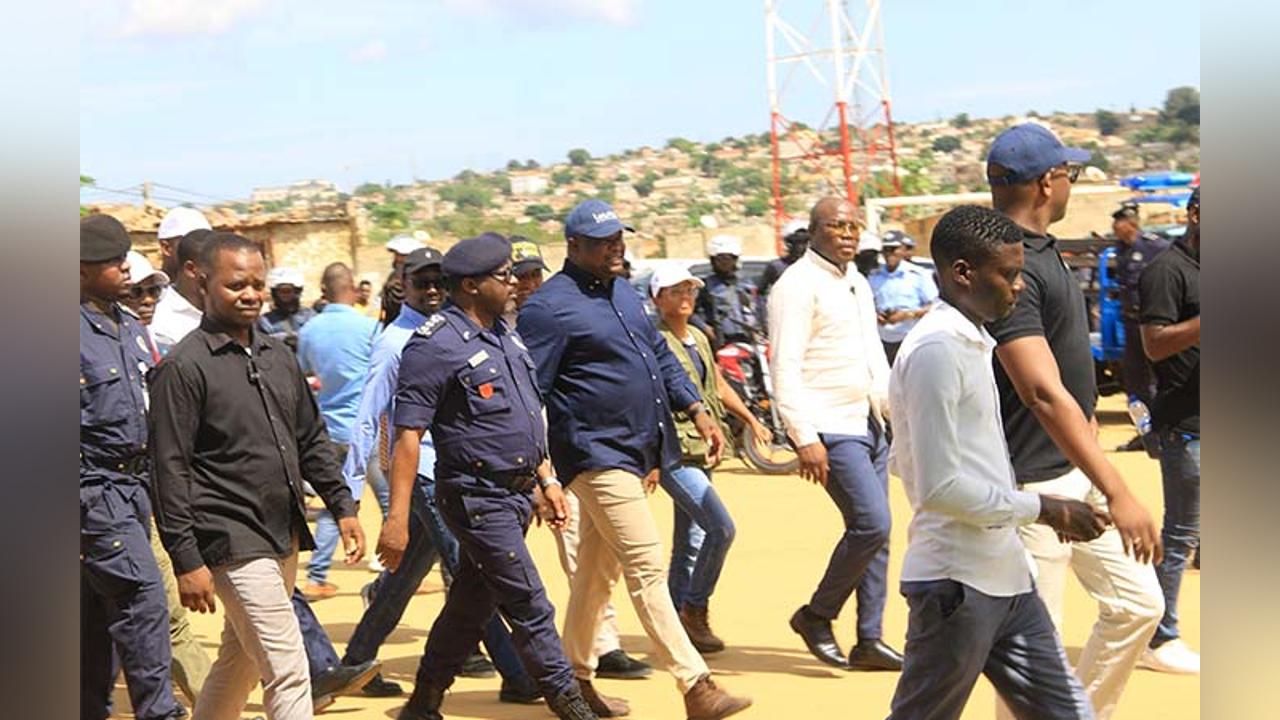
Africa-Press – Angola. The governor of the Province of Luanda, Manuel Homem, carried out during the last five days, a project of sounding out and surveying the levels of execution of social projects in this district.
The government official’s field work began last Monday (10th) with the consultation, where several residents presented the difficulties related to the locality.
Among the main constraints are the level of crime, lack of water, electricity, schools, hospitals and technical-professional training centres.
In response, Manuel Homem said that the fight against crime, including water mining, is the main action plan of the Luanda authorities for this district.
During his speech, the official added that police action in this neighborhood will be reinforced, improving the conditions of the staff operating in the region, as well as the construction from scratch of a police station in the Camassunda sector.
Administratively, Bairro Paraíso is part of the Urban District of Mulenvos, where, in total, more than 64 thousand people live, according to official data. The extension of the territory, the number of residents and the weaknesses in social services place this location in a scenario where the intervention of the authorities is urgent.
In this sense, Governor Manuel Homem and his work team visited and assessed the social conditions of the localities of Mulenvos de Baixo, Camassunda and Quarteirão 43. Although the points are different, they all share the same problems: lack of water
, electricity, schools, hospitals and security.
In these localities, the governor made it known that the local Administration has already registered in the Integrated Plan of Intervention in Municipalities (PIIM) several social projects, mainly for the construction of four primary schools in Quarteirão 43 and two hospitals in Mulenvos de Baixo.
As for public safety, the promise was made to build a police station in the vicinity of Block 6, in Bairro Paraíso, where a police station currently operates in precarious conditions, as report on the spot.
On the second day in Bairro Paraíso, Manuel Homem inaugurated the road and the lighting system in Bairro Paraíso and Caterpiral, over a length of more than 73 kilometres.
“The Paraíso neighborhood already has, public lighting and a literacy room, at a time when we continue to carry out civil registration, health and social assistance services”, he stressed.
Already on its third day of work, ongoing actions were continued and a space was identified where the library and community kitchen will be born in the coming days.
Several blocks of the neighborhood were covered and it was verified that the water pipe had been vandalized and that water miners had taken advantage of it.
During a walk, he visited the tanks built on the line of the conduit that takes water to the fountain, noting “in loco” how the garimpeiros illegally take over water sources and demand exorbitant sums from the people.
It found that there was a violation on the part of the administrators of the zones, who had vandalized the pipeline, obtaining benefits by selling water at a high price.
“He guided the local administration to take immediate action for the immediate reversal of these community tanks, allowing the same price to be practiced and greater availability of this precious liquid”, he guided.
On Wednesday and Thursday Manuel Homem held meetings with the churches present in the district of Mulenvos.
During these days of work, it was possible to allocate at least one hundred and twenty Identity Cards, as part of the free civil registration campaign.
The Paraíso neighborhood has more than 30,000 inhabitants, most of whom do not have an ID, according to the local administration.
According to the technician from the Ministry of Justice, Sandra Solange, the intention is to register a large number of citizens, but we are limited by the reduced technical staff on site.
In the locality, 70 motorcycle taxi drivers were registered, also in the same period, by officials of the Ministry of the Interior.
On Friday, the last day of the visit, the governor launched the first public transport urban ring road, within the scope of the Municipalities Integrated Intervention Plan (PIIM).
With a total of four buses, the routes now distributed in the municipality will, in addition to the Paraíso neighborhood, benefit the population of all the urban districts of Mulenvos de Baixo, Kikolo and the main district of Cacuaco.
Buses will start circulating from the entrance to the Cerâmica neighbourhood, passing through Pedreira, Paraíso and Kikolo Market, continuing along Avenida Ngola Kiluange until the intersection with Estrada Nacional n.o 120.
For the governor of Luanda, Manuel Homem, this decision came from the concern about mobility, presented by the inhabitants of the Paraíso neighborhood, leading the team to work on a mechanism to create conditions for safe transit.
On the other hand, the governor handed over rolling stock to the local police, in order to allow better patrolling of the neighborhood.
Manuel Homem recognized the need to improve policing, reinforcing it with means and conditions to guarantee public safety, acclaimed by the population.
“…the population cries out for security and, in fact, we see, at the neighborhood level, the need to improve. The police do their job competently, they need more reinforcements, more means and better conditions from the point of view of their installations. What was done was to identify a space for building a police station and also other police stations, considering the extension of the neighborhood”, he said.
In the same vein, he listened to the youth of the municipality of Cacuaco, who are calling for more training centers and multi-sports courts, as well as employment.
The official guaranteed the continuity of the projects for the creation of technical and professional institutes in the localities of the municipal seat and in its four urban districts.
As for employment, Governor Manuel Homem said that the municipality has received several private investment projects which, according to him, will create opportunities in this regard, but recalled that “training is the main pillar of development, especially in this municipality where several projects are born. ”
For More News And Analysis About Angola Follow Africa-Press