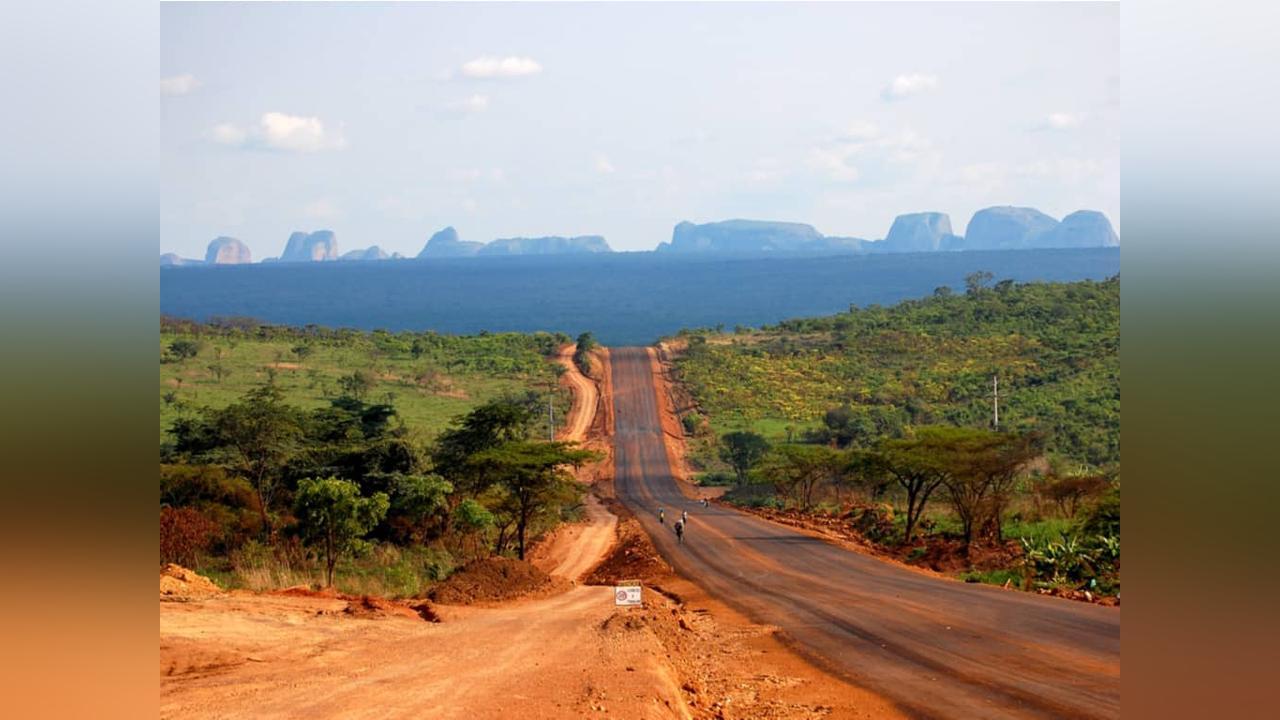
Africa-Press – Angola. The landscape stimulates the gaze and steals the attention of drivers and passengers. There is life along the approximately 601.7 kilometer road that connects Huambo to the country’s capital (Luanda). Those who travel this route delight in the vast cultivated fields, towering hills and long rivers.
A In the distance, the remarkable Mount Luvili does not go unnoticed. No one can resist gigantic monolith located in the commune of Alto Hama, municipality of Londuimbali. A mountain range, which measures around 2000 meters high, separates the basin from Kwanza River from the Cuvo-Queve River. Luvili hill is a space of beauty paradisiacal. A true spectacle to behold.
AND also in Huambo, south of Luimbale, in the municipality of Ecunha and approximately 42 kilometers southwest of the capital of the province, which is located on Morro do Moco, the highest point in Angola, 2,620 meters high and shaped semi-triangular. It is said that there, during the night, the presence of spirits that only traditional entities know how to deal with.
To the Along the route, travelers often stop to buy fruit, vegetables and tubers that decorate benches made of staff or wooden boards. But there is also a great diversity of products displayed on the floor, arranged in on top of burlap bags.
In at various points on the road, truck drivers park their long vehicles to rest, eat or date a little. Others are forced to stop the trip due to vehicle breakdown.
To the houses are mostly built with local materials, especially adobes and pau a pique, whose owners, residents of different localities crossed by National Road 120, do not let themselves be overcome by the force of the laziness and poverty.
They are men and women who fight for their lives. They work hard in the fields, with strength and determination, to guarantee the livelihood of their families. produce a little of everything.
At 26 kilometers from the headquarters of the municipality of Huambo, in the small open-air market, created by women from the Tchikendo neighborhood, in the Chipipa commune, the red onion, Reindeer potatoes, garlic, avocado, beans and veal meat stand out among the other products for sale on site.
That one “Pracinha” is a true repository of local production. It is very dependent on family farming. There are also those who buy from large farmers locally. from the area to resell and earn a tiny profit of 50 to 200 kwanzas on the sale of a certain product.
Second a 53-year-old saleswoman, Ângela Catchiumbo, if in dry weather she buys a kilo of butter beans worth 350 Kwanzas, to be resold at 400 or 450 Kwanzas, During the rainy season, products become more expensive.
“By For example, I can buy a kilo of beans for 1000 Kwanzas and resell them for 1500, while the bucket of sweet potatoes, which I buy worth 500 Kwanzas, I sell it for 1000”, says Ângela, who doesn’t know how to do anything else. He has been selling agricultural products since his childhood.
Others women like Anastácia Kawimbi, Ana Donana and Teresa, who also perform in that market, they say that the products they sell arrive from the mountains, from the do Sambalundo, and which is in the process houses, built along the road, where food is preserved.
To the three women live very close to the market. Arrive at the location from 5:00 am in the morning and only return to family life around 7:00 pm and 8:00 pm. Without electricity from the public network and drinking water, the Tchikendo neighborhood, according to salespeople, is lacking essential social services capable of ensuring the development of the locality.
To the residences are mostly built of adobe and wattle and daub, with some benefit from energy from a generator set installed in the zone. Due to the lack of fuel, the neighborhood is illuminated during the period between 6pm and 9pm.
One resident (Fátima) says that the water consumed by all inhabitants comes from cacimbas, especially when there is regular rain. “And in dry weather, the river has been the solution,” she adds.
For the number of unemployed, elderly and disabled people who require support or special care, the population of Tchikendo calls for implementation of the “KWENDA” Monetary Social Transfer program in neighborhood, where a little of everything is missing.
At via Huambo/Luanda it is possible to observe vast cultivation fields, small farms and markets. Within localities, that is, in municipal and communal headquarters crossed by Estrada Nacional 120 are hotel units and sanitary facilities, as well as restaurants and snack bars that satisfy the needs primary travelers.
O There is no shortage of food and drink stalls, canteens, little squares, and pharmacies whose walls were built using local materials. The young woman Rosalina, who was leaving Alto Hama towards Luanda, explained that during the trip it is only possible to make small purchases of water, soft drinks and cakes or biscuits in convenience stores installed at the city’s fuel pumps Sonangol or Pumangol.
At Quibala, there is an inn, restaurant and shop right next to the road, but the conditions are not the best. You can read what the sign says: “Guesthouse, Restaurant and Shop”. But, In reality, only the hosting area works.
You occupants pay 8000 Kwanzas per night and are forced to look for food outside of the location. The space, which has just six rooms, is one of the few that still resist time.
Upper Hama Market
In another mandatory stop, the cement countertops are in full supply at the Market Alto Hama Municipality. Nobody sells inside anymore. There is a lot that the movement of buyers and traders is no longer compared to what was recorded in the past.
To the Salespeople have seen better days. To force travelers to stop, they set up benches made of wood, wattle and daub, covered with grass and boards, where they expose their businesses.
Since In 2005, Rebeca Candjimba, 61 years old, sold dried fish that arrived from Benguela, the province where she lives currently with family. In Upper Hama, the elderly woman cultivates corn.
“The Profits from selling fish are not always fabulous. They vary according to the season.” explains Rebeca, adding that the main buyers are residents. “One or two travelers stop to buy fruits and vegetables”, she adds.
In the Bonga sector
António Cupupa lives just a few meters from the road, in the Bonga sector, in commune of Alto Hama, municipality of Londuimbali. It is a village with few residents and whose homes, built of adobe, do not have energy electricity and piped water. The houses are very far from each other. others.
O farmer, aged 27, highlights that in Bonga there is practically nothing Special. The young man, who lives in the locality with his wife and two children, highlights the figure of the soba as being the most important “thing” that exists in the area. Without unable to justify why, regrets the fact that there are a large number of children who remain without studying. They spend all day playing.
One One of the greatest difficulties faced by farmers in the region has to do with the process of acquisition of fertilizers and, as a consequence of this, the quality of agricultural food has dropped significantly. After harvesting, the fruits, vegetables and other products are sold locally. The local population consumes water from reservoirs and rivers. At Bonga, the best is still a long way away to happen.
Already in the Luvili sector, young producers and sellers of charcoal highlight the advantages of living along Estrada Nacional 120, where Thousands of travelers pass through every day, especially tourists and traders, who buy the bag at a price of 2000 to 2500 Kwanzas. The business stays exposed every day along the road.
Truck driver life
At the communal headquarters of Alto Hama, Paulo was forced to stop the truck of the company he works for to overcome a problem. It was 11 o’clock. The vehicle made strange noises when driving in the zone. “It’s the potholes’ fault”, lamented the truck driver, who left Luanda for around 7 pm, transporting basic food baskets to the province of Huambo.
“I am always on this path. It is a common route, despite the potholes being the main constraints, in addition to the lack of spaces for accommodation and a decent meal”, he says.
Account which, due to breakdowns, he often faced alone, at night or dawn, in the middle of nowhere, different situations, an experience he experienced again a few weeks ago, when he spent three days with the damaged truck on the road, at waiting for help. “I spend several nights in the truck. For example, on the trip I took At Cuando Cubango, I didn’t see places to stop to eat or sleep”, he laments.
At route, the circulation of trucks loaded with containers with merchandise is extremely reality apart. “Long vehicles” face several obstacles during route, such as holes and other constraints. There are many drivers are often forced to stop to check the technical condition of their vehicles or overcome breakdowns.
O route is long. Most truck drivers always try to find a spot to rest and eat something. The number of trucks damaged throughout the The road that connects Huambo to the country’s capital (Luanda) is considerable.
“Two Houses” at Waku-Kungo
Upon arriving at the commune of Waku-Kungo, municipality of Cela, in Cuanza-Sul, we found the market called “Duas Casas”. The name arises from the fact that the square be located close to two abandoned residences, built in the period colonial.
AND in this market where Olímpia Francisco, 26 years old, sells varieties of products since the age of five, and where onion, reindeer and sweet potatoes, in addition to sugarcane and carrots, they are the best sellers.
Despite Although the profits are not fabulous, the young woman insists above all on the business of the red onion, which forces her to leave her home, at the municipal headquarters of Cela, Monday to Saturday very early (before 6:00 am), to guarantee sustenance of children. She works in the square until after 4pm.
At locality, it is almost impossible to hear about robberies. As it counts Olímpia, for example, agricultural products, with the exception of potatoes, onions and garlic left over from sales remain exposed on the counters and on the floor, along the road. “The products are passed here at night and no one moves them. The rest we keep it in the grass, inside the forest,” he says.
In return to Luanda, after visiting some relatives, residents of the headquarters municipal town of Cela, Vitorino Manuel stopped at the local market to shop. Despite knowing that the prices of the products sold there do not differ much from those practiced in the 30’s market, in the country’s capital, the young man, accompanied by some friends, can’t resist the temptation to buy fruits, vegetables, tubers and citrus fruits during the trip. “I can’t resist this. They sell a lot here good thing to take home”, he highlights.
Lukala 3
In another mandatory stop, the Lukala 3 market, also known as the da Banana, where the vendors from Maria Teresa square, in Cuanza-Norte, go there looking for business, there is a wide range of products on display. The movement is biggest on Saturdays.
You travelers, coming from Huambo and Bié, almost all bound for Luanda, do not resist bread and table bananas produced in the area, as well as fresh corn and roast, musseque flour and vegetables. This is the case of Rufino Xavier, from Bié, who filled the van with various vegetables. The man that identifies himself as a farmer, passes through this route at least twice a week.
“I am almost always here. Tomatoes, okra and other natural products are accessible. But I really like to stop for a good banana or corn roast, with toasted ginguba”, he explains.
Dondo Rotunda
Authentic street restaurants are the stalls set up in the famous Rotunda do Dondo, in Cuanza- Norte, considered the point of convergence especially for those arriving from Huambo, Bié, Cuanza – Sul and Malanje.
O The place is very busy. Drivers and passengers sit at the same table and taste a variety of dishes, mainly typical of the North region of Angola, such as funge accompanied by pacassa, wild boar, beef, pork or goat, with herbs or beans. Each meal costs 1500 Kwanzas.
At the Locals also prepare fried cacusso with cassava, fried chicken and “pincho” of pork. And whoever wants to take the delicious food, don’t hesitate to ask packaging. Passers-by taste them during the trip.
At stall of the famous “Mana São” there is usually no shortage of funge calulu and smoked catfish. “We work from 8am until midnight. Here our Customers leave full and happy with the quality of our food. The funge does not may be missing. It’s the dish most requested by our customers”, saysee.
While Dona São was talking about her business set up in Rotunda do Dondo, young Agostinho I was getting off a mini bus from Huambo. He paid 7 thousand Kwanzas. O destination was the city of Malanje, but first I had to get to Ndalatando, in the Cuanza-Norte, to catch another vehicle.
No It is not easy to travel the 601.7 kilometers of road that separate Huambo from capital of the country (Luanda). The landscape is magnificent. But the journey is long and tiring.
JORNALDEANGOLA
For More News And Analysis About Angola Follow Africa-Press