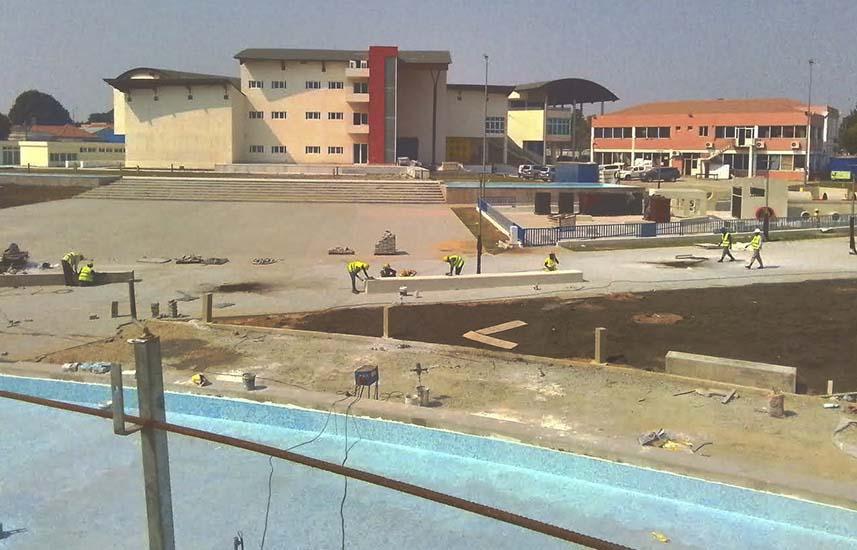
Africa-Press – Angola. The Huambo Cultural Center, under construction since 2011, is scheduled to open in the first half of January, announced the director of the provincial office of Culture, Tourism, Youth and Sports, Jeremias Piedade.
Located in an area of three hectares, at the confluence between avenues Norton de Matos, do Granja and the street that goes down towards Largo Deolinda Rodrigues, the infrastructure, whose works were committed in September 2011 and resumed in 2022, after five years into the shutdown, it will be “christened” with the name of the writer and author of the National Anthem, Manuel Rui Alves Monteiro.
Speaking Wednesday, the person responsible assured that all the work has been done so that the project can be made available to the population next January, as it is the month dedicated to National Culture.
He reiterated that the center, the first of its kind in the country, will offer users suitable spaces for recreational leisure activities and cultural development, with training rooms for atelier.
Jeremias Piedade said that the designation of the property, named after Manuel Rui Alves Monteiro, aims to pay tribute to a son of Huambo for his contribution to national culture and literature, in addition to being the author of the National Anthem of Angola.
In another aspect, the person responsible clarified that the removal, on site, of the statues of Norton de Matos, founder of this region, as well as his four virtues (Prudence, Justice, Fortress and Temperance) results from the fact that the center is, essentially, of national cultural and not historical.
He recalled that before they were implemented in the space where the Cultural Center was built, they were placed in Largo António Manuel de Arriaga, Praça Doutor António Agostinho Neto, where they were removed in 1975 and transported to the Huambo Regional Museum.
Therefore, he added, they will be returned to the Huambo Regional Museum, including that of Vicente Ferreira (architect of the city) and the city’s coat of arms, due to the fact that they are part of the historical and not cultural context, which constitutes the essence of the center.
Features of the center
The project will consist of three cinema theaters, with 500, 150 and 100 seats, respectively, two conference rooms, a space for the presentation of works of art, literature and music, two rooms for dance classes, an equal number for fine arts and crafts and one of exhibitions.
It will also feature 11 artistic and cultural specialty stores, two top-of-the-range restaurants, one of which is on the 2nd floor, overlooking the Upper part of the city, two cafes facing the Lower part of the city, support areas for actors and musicians during their performances on stage and two music classrooms.
The Center will have a bar, police station, a refrigerator, children’s playground, drinks store, two multipurpose rooms, an open-air restaurant, with a performance area and a covered pedestrian walkway, which will connect the infrastructure to the Culture Garden .
At the entrance to the center, whose roof is shaped like smoke coming from the chimney of a locomotive, in recognition of the contribution of the Benguela Railway (CFB) in promoting social, economic and cultural development, the user is faced with with the first waterhole in the city of Huambo, 25 meters deep, built in colonial times.
Brief information from Manuel Rui Alves Monteiro
An essential figure in Angolan arts, Manuel Rui Alves Monteiro was born in the city of Huambo on November 4, 1941.
He completed his primary and secondary studies in his home province, moving on to Portugal, where he studied Law at the University of Coimbra until 1969.
As a student, he was a cultural activist at the Casa dos Estudantes do Império, participated in literary and political events, and was arrested for two months in Portugal. He practiced law in Coimbra and Viseu.
He published, among others, the works “O Regresso Adiado”, “Memória de Mar”, “Sim, Comarada!”, “Quem me Dera ser Onda”, “Crónica de um Mujimbo”, “1 Morto & Os Vivos”, “ Rio Seco” and “Da Palma da Mão”.
For More News And Analysis About Angola Follow Africa-Press