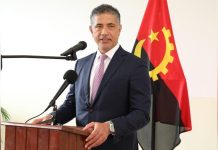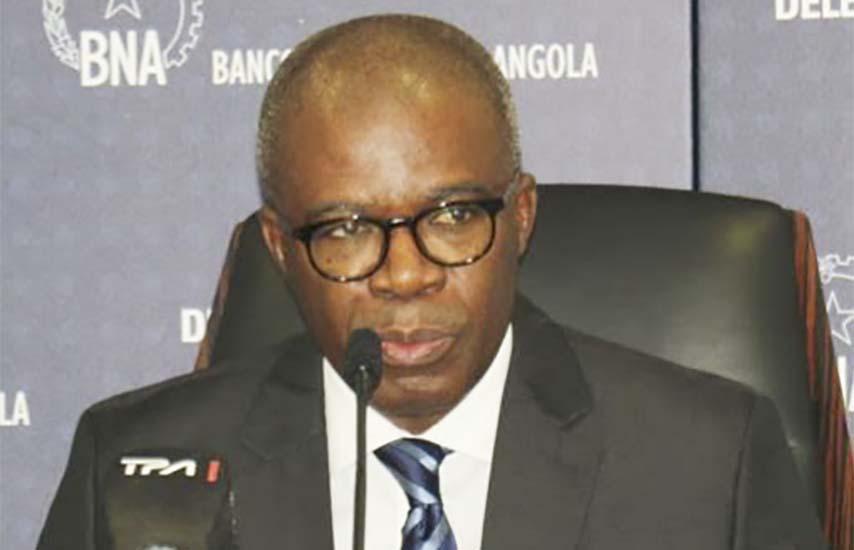
Africa-Press – Angola. The governor of the National Bank of Angola (BNA), Manuel Dias, stated, this Monday, in Menongue, capital of Cuando Cubango, that the expansion of banking services is fundamental as it contributes to greater integration and participation of the population in services.
Manuel Dias was speaking to the press, at the end of the courtesy meeting with the governor of Cuando Cubango, José Martins, as part of his inspection, assistance and control visit to the BNA Regional Delegation.
The BNA governor, for whom financial literacy levels can be improved with greater financial inclusion, considered that the expansion of banking services can also contribute to the formalization of the country’s economy and economic development itself.
According to the manager, studies carried out at the BNA level allowed us to conclude that levels of financial literacy, especially through the population’s banking system, are still extremely low in the country, around 30 percent.
These levels, explained Manuel Dias, can be improved with greater financial inclusion, which is why, at country level, work is being done on a financial inclusion strategy that, over the next five years, will contribute to greater monetary insertion, which it also constitutes one of the objectives pursued by the institution, within the scope of its strategic plan for the period 2023/2028.
The governor recalled that, for a long time, the kwanza was introduced as a payment instrument at the national economy level and has gone through several periods, characterized by ups and downs, with changes including in the denomination itself.
In this regard, he said that, despite the less good periods that characterized the economy, the kwanza continues to be considered “a national symbol, a currency with liberating power at a national level and accepted by all citizens of the country.
According to Manuel Dias, the BNA’s commitment, as an institution that monitors price stability in the economy, is to do everything to preserve the value of the national currency.
Asked about the assessment of the currency’s performance and what is being done to bring the kwanza close to the largest circulating currencies in the world, he stated that, in addition to the liberating power in Angola, the national currency is accepted in neighboring countries.
“We believe that, with the effort of everyone, both the BNA and the economic agents, with more stability, especially in prices, we will be able to have an increasingly stronger kwanza capable of responding to the desires of the Angolan population, especially with regard to fundamental functions of the national currency”, he highlighted.
Regarding the Angolan Executive’s challenge in maintaining inflation at 15 percent throughout 2024, he said it was everyone’s concern, despite the BNA having increased responsibilities, reiterating that price stability in the economy essentially depends on increasing the production of goods and services.
Cuando Cubango with bank coverage in five municipalities
At the level of Cuando Cubango, only Menongue, Cuito Cuanavale, Mavinga and Calai have banking representations, from Banco de Poupança e Crédito, while Dirico has from Banco Sol.
On the occasion, the governor of this province, José Martins, requested the intervention of the governor of the BNA in order to appeal to the other banks so that they could provide services in the municipalities of Cuangar, Cuchi, Nankova and Rivungo, at a time when only the Bank Sol opened a service station in November 2023.
He admitted that the lack of banking services in those municipalities has created constraints for the population and for professionals in the health, education, local administration and defense and security services sectors, who even leave their jobs to move to Menongue, with the aim of carrying out financial operations.
The governor predicts that the presence of banking services in all municipalities could allow the population to have greater economic comfort.
He clarified that the difficulties in accessing municipalities, due to the lack of access roads, have negatively influenced the population’s cost of living, as trips between Menongue, the capital of the province, and other municipalities can cost up to 36 thousand kwanzas, on the outward/return route.
For More News And Analysis About Angola Follow Africa-Press