By Miguel Neto,
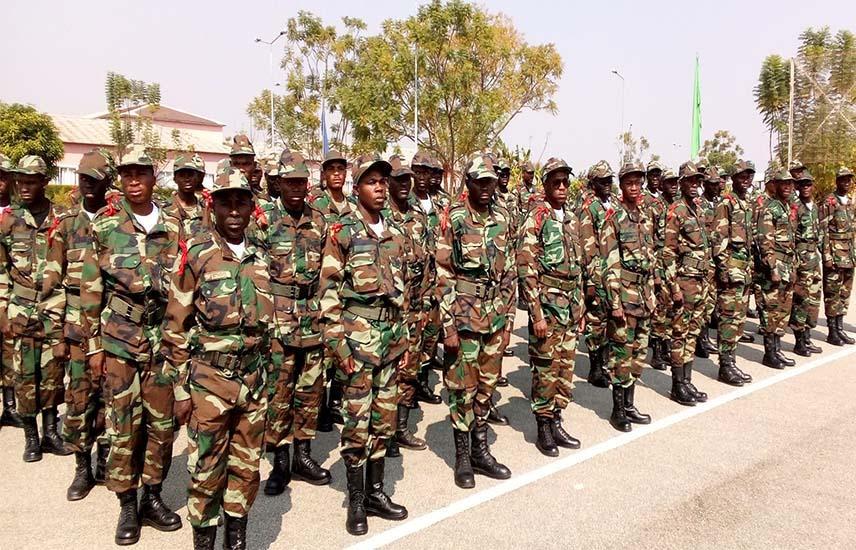
Africa-Press – Angola. The definitive peace achieved, on April 4, 2002, allowed the Angolan Armed Forces (FAA) to begin a process of restructuring and modernization, at all levels, to become more capable of facing the new challenges of the global situation.
The Peace Agreement of April 4, which celebrates its 22nd anniversary this Thursday, put an end to 27 years of fratricide that monopolized the attention of the military institution and the State, focused on guaranteeing the defense of the country’s soil against multiple attacks, internal and external.
The silence of the guns meant that the Angolan State finally began to pay increasing attention to the need to strengthen the FAA, with the implementation, from 2018, of a broad strategic program aimed at this aim.
The project encompasses, among other actions, the resizing, modernization of technical means and equipment, permanent renewal and training of its staff, in the country and abroad.
The beneficiaries are the staff of the three branches of the FAA (Army, Air Force and Navy), in order to exemplarily fulfill their constitutional mission of preserving the peace, sovereignty and territorial integrity of the country.
Within the scope of this program, the FAA has improved the selection process for new personnel, bringing into its ranks younger personnel capable of carrying out major missions from a tactical and intellectual point of view.
Likewise, they have acquired sophisticated military resources and equipment and built important infrastructures necessary in the process of consolidating the Angolan military institution and the National Security and Defense System of which they are an integral part.
The first Military University was also created to prepare personnel to face atypical situations in the service they perform with prudence, resilience and determination.
The University will train, above all, troops with strong temperament from the point of view of patriotic, civic and legal consciousness.
Army
The Army has been given privileged attention to enhancing and modernizing technical equipment and infrastructure to give greater dignity to personnel in their specific mission and social needs.
The branch has invested in training its staff, improving working methods, to strengthen the principles of the military hierarchy.
The measure aims to raise the quality of the combative, operational, educational and patriotic preparation process of troops and increase the combative readiness of their units.
Furthermore, Army units have participated in the demining process, in the construction of bridges, in helping populations victims of natural calamities, as well as in search and rescue actions.
Air Force
The National Air Force (FAN)’s main mission is the defense and surveillance of national airspace, with a view to guaranteeing the territorial integrity of the Nation.
As part of the program that aims to make the FAN more modern, strong and disciplined in favor of strengthening the country’s security and defense system, the Angolan Government has paid special attention to the acquisition of various technical means, especially for the new generation.
The training of staff in the sector is another component of this program, with a view to ensuring the operationalization of the new technique by Angolan staff.
From this perspective, the agency received, in December 2020, the second batch of six K8-W type military instruction aircraft, acquired from China by the Angolan State.
The first six aircraft of this new model arrived in the country in January of the same year, with the aim of strengthening the pilot training and air transport capacity of the FAA’s land branch.
The K8-W is 11.60 meters long and has a wingspan of 9.63 meters, as well as 4.21 meters high, and can carry a variety of weapons, such as two aerial fragmentation bombs, four aerial training bombs, two aerial missiles, directed air, a 23-mm caliber 23-2G cannon and even rockets for training and combat.
On the other hand, the FAN has been reinforced with new Angolan pilots in the light aviation sector, graduated from the Escola Militar Aeronáutica do Lobito, in the central-coastal province of Benguela.
Navy
The Angolan sea is rich in oil and other natural resources, requiring greater responsibilities in the security of installations, at sea and on land, against acts of sabotage.
For this reason and within the framework of the rebuilding process, the Angolan Navy (MGA) is being equipped with new naval units (ships) of different categories, with the capacity to combat piracy and international terrorism in territorial waters and on the coast. national maritime.
From this perspective, the province of Zaire gained, in July 2023, a new Naval Base equipped with the most modern operational conditions, with the aim of contributing to strengthening the security of the Gulf of Guinea, an important maritime route for international trade.
Due to its geographical location, Angola, together with other States in the Central and Southern regions of Africa, must be prepared to contribute to the security of the Gulf of Guinea.
Therefore, since January this year, the province of Luanda has had a National Maritime Surveillance Coordination Center, which will guarantee the protection and exploitation of maritime resources and the security of communications.
Also within this framework, the construction of three modern corvettes and support vessels was ordered, as well as two Airbus C-295 aircraft from the Kingdom of Spain, equipped for maritime reconnaissance and surveillance missions.
With this FAA restructuring and modernization program, the Executive intends to achieve, by 2028, the degree of excellence in the military domain, to meet the new challenges imposed by the new world economic order.
The general view is that the current reality implies not only the training of men for national defense, but also the integration of forces in international missions, hence the need to create an army capable of standing alongside other foreign forces, in handling technique and military maneuver.
The FAA were created on October 9, 1991, as a result of the Bicesse Peace Agreements, signed in May of the same year, between the Angolan Government and UNITA.
Under these agreements, the FAA should, in principle, result from the merger between the Popular Armed Forces for the Liberation of Angola (FAPLA), as the government army, and the Armed Forces for the Liberation of Angola (FALA), then the military component of UNITA.
After the creation of its command body led by officers from both sides, the merger itself would be compromised by the desertion of officers leaving the FALA called to take up arms again after the return to war that followed the first general elections in 1992.
ANGOP
For More News And Analysis About Angola Follow Africa-Press