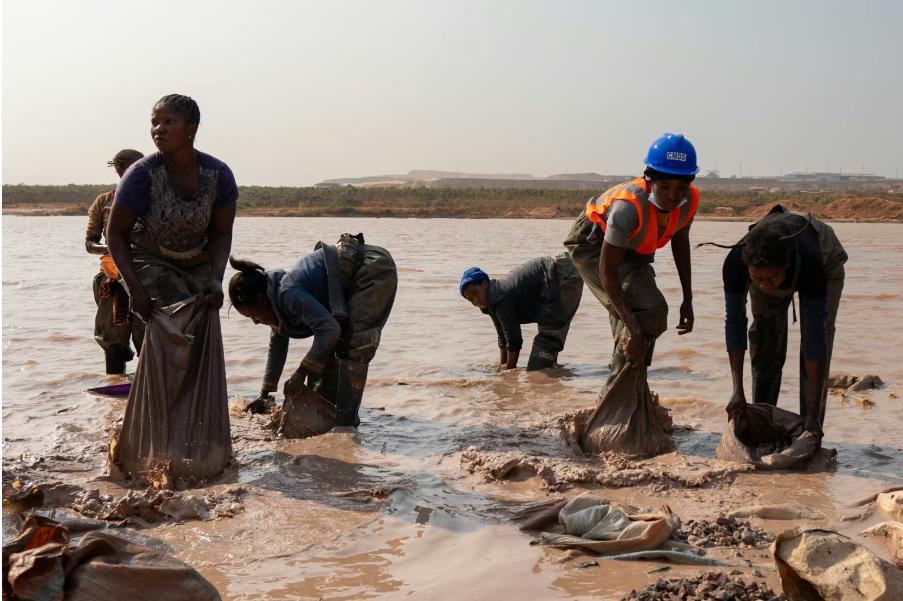
Africa-Press – Angola. As the world shifts to clean energy, minerals such as lithium, cobalt and manganese have become as important as oil once was. Africa holds large reserves of these critical minerals. Yet they are mostly exported as raw materials, returning as expensive green technologies made in factories overseas. South Africa’s G20 presidency set up a new critical minerals framework that aims to help Africa’s mineral-rich countries benefit more from local processing and manufacturing. Geoscientists Glen Nwaila and Grant Bybee explain what’s needed to extract the minerals safely and turn underground wealth into economic value in Africa.
What are critical minerals and how do they fit into Africa’s resources landscape?
Cobalt, manganese, natural graphite, copper, nickel, lithium and iron ore are all critical for building solar panels, wind turbines, electric vehicle batteries, and other green energy equipment.
Africa is home to large reserves of critical minerals. The continent has 55% of the world’s cobalt deposit. It houses 47.65% of all manganese globally and 21.6% of natural graphite.
About 5.9% of copper, 5.6% of nickel, 1% of lithium, and 0.6% of iron ore globally are found in Africa.
South Africa has between 80% and 90% of the world’s platinum group metals, and more than 70% of global chromium and manganese resources. These are essential in making components for clean energy technology and electronics.
The International Energy Agency predicted in 2025 that the demand for lithium would increase fivefold between 2025 and 2040. The demand for graphite and nickel will double. Between 50% and 60% more cobalt and rare earth elements will be needed by 2040. The demand for copper will rise by 30% over the same period.
What are the biggest challenges facing these precious resources?
In many African economies, critical minerals are exported in raw or semi-processed form, to be used in the production of various green energy technologies. African countries then import these technologies, missing out on the jobs and industries that could be created if they manufactured green energy components themselves.
Processing critical minerals and elements in Africa would create around 2.3 million jobs on the continent. It would raise continental GDP by about 12%. This would help address a chronic unemployment problem. For example, South Africa has an unemployment rate of 31.9%. For younger people aged 15 to 34, the unemployment rate is 43.7%.
What solutions are being proposed?
The G20’s new Critical Minerals Framework spells out clear rules and standards to make sure more value is added locally (like processing minerals where they are mined instead of shipping them out raw). This is known as promoting “local beneficiation at source” or “value addition and retention”.
The framework supports spreading mining, transport, processing and sales across different countries. This will reduce dependence on a single country or company. It will also support more reliable supply chains that don’t get disrupted easily.
The framework also proposes that critical mineral mining be done under strong and fair rules that protect people, economies and the environment in line with African countries’ own laws and policies.
It also aims to create a clear map (or inventory) of where all the critical minerals are located across the continent, so that exploration (especially in places that are under-explored) can be done without damaging communities or the environment.
It pushes for new ideas, technology, and training so people can gain the skills needed to work in green energy industries.
Although it’s a voluntary and non-binding document, it is crucial as a guide to best practice.
How is the role of geoscientists critical to this?
Geoscience shapes everyday life in ways most people never see. Hydrogeologists help make sure cities, farms and mines have reliable, clean water without damaging the environment. Geophysicists are able to “see” underground using specialised tools to find minerals. They also decide where it is safe to build roads, tunnels and power plants, and track natural hazards like earthquakes.
There are many fields within geoscience. Geometallurgists work out how to process mined rock more efficiently, using less energy and water and producing less waste. Geodata scientists turn satellite images and ground data into maps that are used to plan cities and adapt to climate change. Resource geologists estimate how much of a valuable mineral or metal can actually be mined, and at what risk.
Engineering geologists help keep buildings, tunnels, dams and mine waste facilities safe. Environmental geologists monitor soil, water and air to ensure development does not harm people or the environment.
Africa’s vast reserves of critical minerals can only create jobs, economic growth and sustainable development if countries have enough well-trained geoscientists to find, extract and process them. Their expertise is what turns underground resources into real economic opportunities.
Africa continues to graduate a large number of talented geoscientists. They work in critical minerals value chains and make valuable contributions. However, more advanced skills in geodata science, geometallurgy, predictive modelling, and strong leadership is needed. Currently, significant gaps remain in Africa.
To close these gaps, African governments, universities, industry partners, and international collaborators must urgently invest in targeted education and training programmes. These should focus on training in advanced geodata science, geometallurgy, predictive modelling, ore system science, and leadership development. Partnerships must be set up with private companies and students should attend international knowledge exchanges.
Mining companies must be given incentives to share knowledge so that African professionals are trained to do high-value geoscience and mining work themselves.
This would enable Africa to not only extract, but fully harness its subsurface mineral wealth for inclusive economic growth, job creation, and a just energy transition.
theconversation
For More News And Analysis About Angola Follow Africa-Press