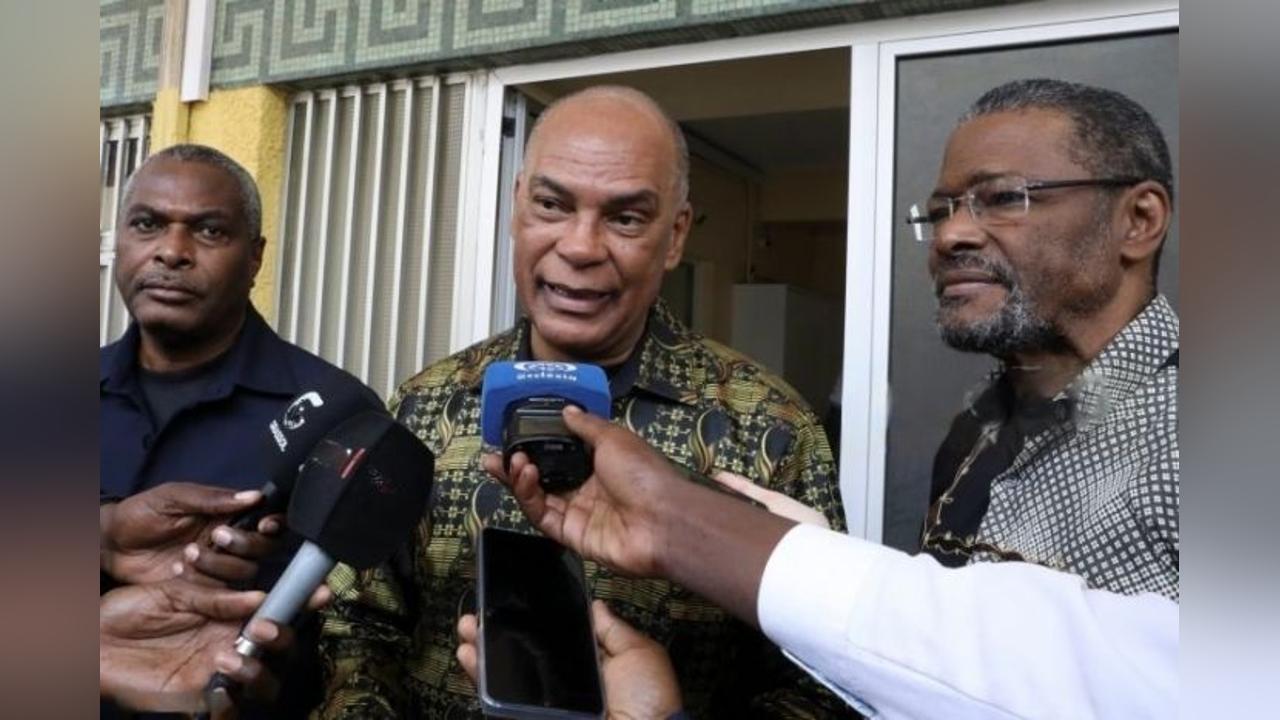
Africa-Press – Angola. Reactions to Adalberto Costa Júnior’s proposal to relaunch a “Broad Front” have exposed profound divergences among the main opposition actors. PRA-JA, the Democratic Bloc, analysts, and even leaders of UNITA itself present differing interpretations of the failure of the FPU, the future of the opposition, and the legal, symbolic, and strategic obstacles for 2027.
The intention of the UNITA president-elect to rebuild a broad platform to confront the MPLA in 2027 reopens a sensitive debate among the largest opposition parties and brings to the surface previously contained divergences. While PRA-JA accuses UNITA of rejecting the only legal path—a formal coalition—and of having “run out” with allies in 2022, the Democratic Bloc dismisses any possibility of extinction or aggregation and defends only a coalition within the terms of the law.Political analysts, such as Bali Chionga and Aniceto Cunha, warn that without the BD and PRA-JA, the new front may produce results inferior to those of 2022, due to internal resistance within UNITA, emerging new forces, and other structural challenges. For its part, UNITA assures that there is no ill-feeling within the party and that dialogue will resume, although it considers it premature to discuss coalition models or new symbols.
It is in this environment of uncertainty, mutual accusations, and internal pressures that the future of the Angolan opposition is being shaped two years before the general elections.
Lindo Bernardo Tito accuses UNITA of rejecting formal coalition and “running away” from PRA-JA
The current leader of PRA-JA Servir Angola, Lindo Bernardo Tito, reacted to the statements of the elected president of UNITA, Adalberto Costa Júnior, regarding the creation of a “Broad Front,” arguing that the current crisis in the Angolan opposition results from UNITA’s refusal to accept a formal coalition, which the formation led by Abel Chivukuvuku considers “the only viable model to unite political forces in 2027.”
In statements to the newspaper OPAÍS, Lindo Tito was categorical in stating that PRA-JA never left the United Patriotic Front (FPU), as it has.
This has been repeated by several digital platforms, but it was dismissed by UNITA and the Democratic Bloc (BD) “on the same day” that the party concluded its congress. “PRA-JA didn’t leave. PRA-JA was expelled. There are two statements that prove this,” he stated. According to the politician, the PRA-JA Servir Angola congress made two clear resolutions: namely, preparing the party to compete autonomously in 2027 and giving its leader, Abel Chivukuvuku, the freedom to dialogue with all opposition parties, provided that the understanding results in a formal coalition. Furthermore, Lindo Bernardo Tito accused UNITA of deliberately avoiding the formation of a coalition, defending instead a model of “aggregation” that, according to him, “destroys” the remaining opposition parties.
“UNITA doesn’t want a formal coalition. It wants aggregation. But aggregation requires the leaders and members of the other parties to resign from their own parties to join UNITA’s list.””UNITA doesn’t want a formal coalition. It wants aggregation. But aggregation forces the leaders and members of other parties to renounce their own parties to join UNITA’s list. Is that right? Is that fair?” he questioned. The leader exemplified this with the case of the Democratic Bloc in 2022, recalling that its then president, Justino Pinto de Andrade, had to resign from his position and membership to join the joint list.
“Isn’t that humiliating?” he asked, emphasizing that this practice causes “internal tension” and destroys the identity of the parties.
“UNITA violated the 2022 agreement,” Lindo Tito further stated that UNITA “never fulfilled” the agreement established with PRA-JA in the FPU, namely regarding the distribution of positions on the lists, provincial leadership, and institutional representation after the 2022 elections.
“It never gave PRA-JA what was stipulated. Not even 20% of what it should have. It violated everything.”
The politician also revealed that the Democratic Bloc is currently facing “deep internal divisions,” with one faction accusing the current leadership of “destroying the party” by admitting a new merger with UNITA.
Lindo Bernardo Tito explained that Angolan law does not allow aggregations, but only formal coalitions between parties, with common symbols only during the electoral period.
“Parties do not exist to preserve symbols, but to conquer and maintain power. After the elections, each one uses its own symbol. It’s simple,” he noted. According to Lindo Bernardo Tito, if there is no formal coalition, each party will go it alone.
“UNITA will go alone, PRA-JA will go alone, the Democratic Bloc will go alone. PRA-JA is prepared. We will not accept aggregation,” said the politician, insisting that the opposition could unite, but only through a real coalition, with clear rules and prior definition of the head of the list. “The problem is not with PRA-JA. It’s with UNITA. UNITA never wanted a coalition. It wanted to absorb the others and discard them afterwards,” he concluded.
BD guarantees its own strength to compete in 2027
When confronted about the possibility of the Bloc running alone, Mwata Sebastião showed complete confidence. “The Bloc is prepared. We are established in all provinces and in 92 municipalities. We don’t have state funding, but we have managed to expand through our own efforts. We have the strength and structure to contest the election,” he assured.
He further explained that running alone does not mean isolating themselves, as the BD intends to incorporate other sensibilities within the party, including civil society movements.
Regarding the controversy surrounding the creation of new symbols in a potential coalition – a sensitive point within UNITA – the secretary-general was direct: “If a national requirement forced us to abandon our symbols, the Democratic Bloc would say yes. National interest is above partisan interests,” he stated, and left a clear message: “UNITA should also understand this.”
Internal criticism? “It’s nothing but gossip,” says Mwata.When questioned about accusations from militants who accuse President Filomeno Vieira Lopes of “pushing the party into the abyss” or “selling the BD,” Mwata Sebastião completely downplayed them. “That’s nothing but gossip. If the party were for sale, they should say the price. Maybe I’d even buy it. It’s absurd,” he said, guaranteeing that the party is “in good health,” and that internal differences are normal in a democracy, and that the action presented by a group of militants to the Constitutional Court will be dealt with through normal channels, without impacting internal cohesion.
Politics: Liberal Party will run independently in the 2027 elections
The Liberal Party said that the Political Commission will analyze the challenge launched by UNITA regarding the creation of the Broad Front for alternation, replacing the former United Patriotic Front. This statement comes from the President of that political force.
Luís de Castro believes that the way the “Black Rooster” presents its model, based on aggregation, lacks the approval of that deliberative body. However, he stated that his point of view is that the Liberal Party should run independently, as it is a new political formation, and said he is “not in favor of an aggregation.”
The politician argued that the Liberal Party has the noble mission of bringing the party’s image to all Angolans; if it joins this aggregation, it could cut off the possibility of becoming known nationwide.
angola24
For More News And Analysis About Angola Follow Africa-Press