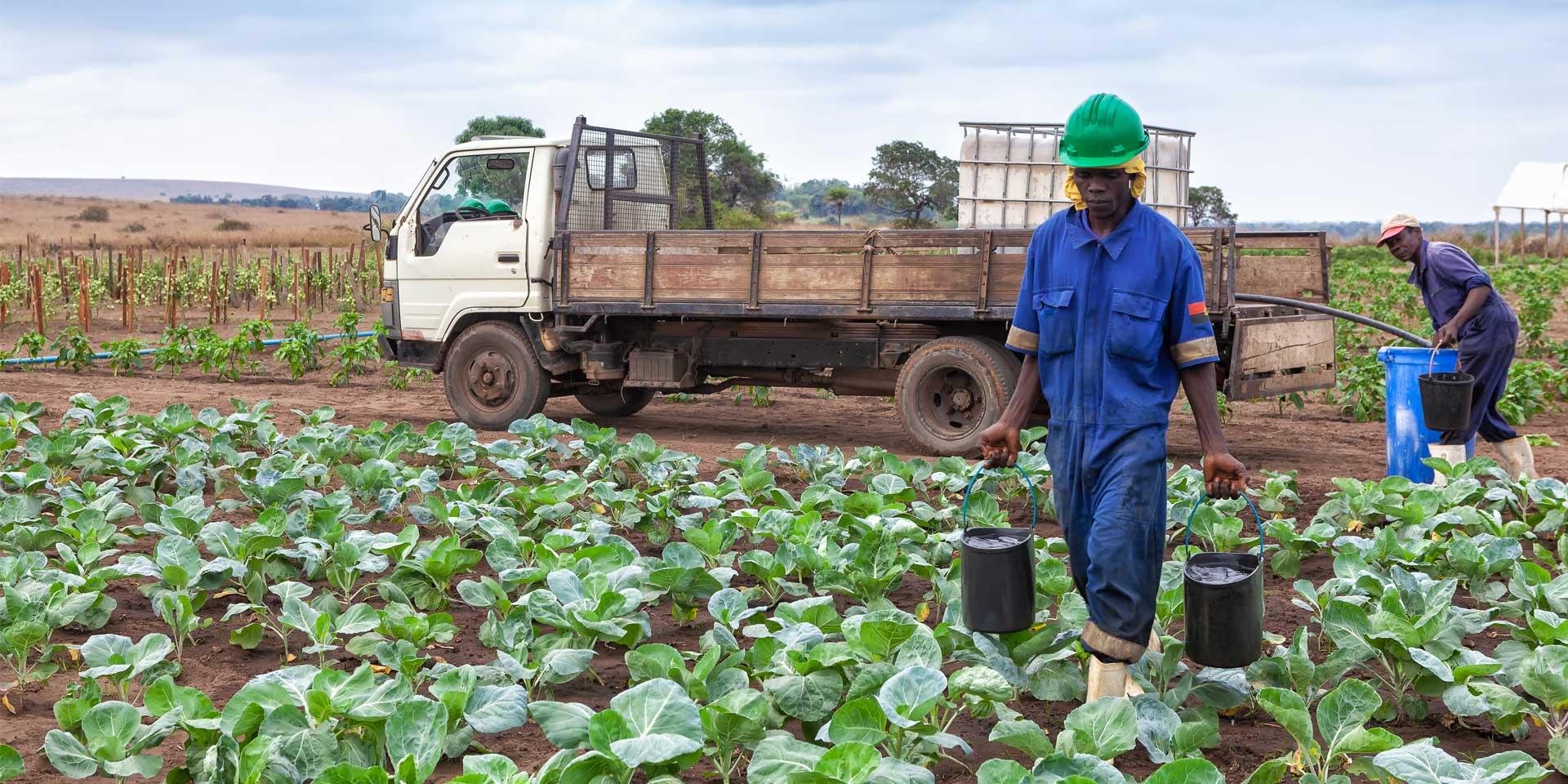
Africa-Press – Angola. The province of Cuanza Norte has registered 1,650 producers in the National Production Portal, dedicated to fruits, roots and tubers, a sample considered very low, to assess the potential of the region, which, however, has a business fabric in an embryonic stage.
In the second half of last year (2021), the second phase of registering producers to associate them with the portal was launched, an ongoing work, under the coordination of the Municipal Offices for the Promotion of Integrated Economic Development.
For the success of this program, the Ministry of Economy and Planning has around sixty young people, who work as municipal agents to support producers and the economy, within the framework of FACRA (Fund Activo de Capital de Risco Angolano).
This is a scenario in which the authorities of Cuanza-Norte are working to reverse the current situation of the productive sector and place the province at the level of other regions of the country, as the director of the Integrated Economic Development Office, Humberto Mesquita, explained to Jornal de Angola, in the city of Ndalatando.
Humberto Mesquita spoke of a province with a “specific characteristic”, in direct reference to the agricultural and mining sectors, considering these as still “asleep”.
However, mobility is highlighted, with “good rail and road networks”, proximity to Luanda (the country’s main market), as well as a vast hydrographic network, as factors that can allow the success of local agriculture.
As a man of the agricultural sector, Humberto Mesquita recognizes that one of the limiting factors is the relief of Kwanza-Norte, with few extensions of plains, for agricultural practice.
“We have some points where sustainable agriculture is carried out, specifically in the municipality of Cambambe and the Planalto de Camabatela”, he says.
In Camabatela, above all, the development of livestock is highlighted, due to the existence of favorable climatic conditions for pastoralism.
“Cattle don’t have to climb mountains, that’s a great asset,” he said.
Humberto Mesquita, for fourteen years, directed agriculture in Cuanza-Norte.
In the mountainous areas of Cuanza-Norte, traditionally producing coffee, the authorities are faced with the challenge of relaunching production, with some figures already signaling the way towards the recovery of one of the most important crops in the province.
At its peak, the region produced more than 93,000 tons, at a time when the municipalities of Bula Atumba, Dembos and Pango Aluquém were still part of Kwanza-Norte.
Humberto Mesquita says that with the government’s incentives, namely the distribution of coffee seedlings and technical assistance to producers, there have already been “very encouraging” indications, although still far from the figures of the colonial era and even in years after Angola’s independence. .
Economic Relief
The director of the Integrated Economic Development Office recognizes that the initial investments are very high and this hampers the development of agriculture, which is still dominated by the family sector.
To deal with the situation, the Government is betting on the organization of agricultural cooperatives, having already financed 17 agricultural cooperatives, in 210 million Kwanzas, following the measures to alleviate the negative economic and financial effects that the Covid-19 pandemic caused to companies. and families.
The economic relief measures are contained in a Presidential Decree and are being developed by the Development Bank of Angola (BDA), which launched a credit line valued at 13 billion and 500 million kwanzas, to support 324 cooperatives throughout the country. the country.
Kwanza-Norte, like other provinces, received 750 million kwanzas, with which 17 agricultural cooperatives were awarded, totaling 210 million, according to data shared by Humberto Mesquita.
He said it was an “experience”, which allowed the organization of peasants in cooperatives and the progressive attainment of positive results. However, the process is not free from some difficulties, arising from the experience itself.
“Sometimes, too, we are not very used to dealing with money management”, a strict requirement for the transfer of funds.
This experience, as Humberto Mesquita underlined, paved the way for the refinancing of some of the cooperatives.
“Of the 17 cooperatives, some received five million, others ten or fifteen million dollars”, he said, clarifying that those that received lower values even had better results.
Humberto Mesquita justifies the refinancing on the grounds that cooperatives that received lower amounts are getting better results.
“This is a criterion that was adopted by the bank itself, a situation detected in time. Hence the refinancing so that everyone can reach 50 million, which is the maximum ceiling”, he clarified.
Humberto Mesquita informed, however, that since the beginning in Cuanza-Norte, more than 786 companies and individual promoters have joined the Credit Support Project and the Production Support Program, Export Diversification and Import Substitution (PRODESI), being that some economic operators, who saw their projects approved, are already proceeding with the respective reimbursement of the monthly installments.
Here, Fernanda Alonsuns, Projecto Samba Cajú, Africa 2 000 Angola, Triases (Café Cazengo), located in the municipalities of Bolongongo, SambaCajú, Cambambe and Quiculungo, with a value that amounts to more than 417 million and 370 thousand kwanzas are mentioned. in the set.
The director of the Integrated Economic Development Office recognizes that there are organizational weaknesses of some economic operators to adhere to the various lines of credit available to the productive sector. Specifically, Humberto Mesquita referred to accounting.
“We found that the entrepreneurs are not organized. I have my business, but I don’t have accounts. I don’t have a tax number. The company doesn’t have a certificate from the Ministry to authorize the activity”, he stressed, defending, first, the organization of the base, with the involvement, above all, of business associations.
He regrets that some entrepreneurs present projects with incomplete documentation and when asked to do so, they do not return.
“They don’t want work. They think we’re complicating things”, he said, indicating that the solution involves training courses and training on something that has already started, through INAPEM (National Institute for Support to Small and Medium Enterprises).
Humberto Mesquita even refers to “less aggressive” entrepreneurs to access credit lines.
“Without wanting to hurt sensitivities, I could even say that we noticed that our entrepreneurs are shy. They are afraid. They are not daring”, he said.
Exploration Of Aggregates Counts In Priorities
In a province with a relief that presents many geological anomalies, the mining sector is at the top of priorities, due to the potential to bring wealth, especially with the exploration of sand, basalt, limestone and granite, for civil construction .
In Cuanza-Norte, prospecting for deposits of iron, marble and pink and green quartz is also highlighted, although Humberto Mesquita considers it to be still “asleep”.
Iron, above all, already has good indicators in the mountains of Kissala and Kitundo, where a mining complex is already set up.
At this time, ten mining companies are licensed, all in the municipality of Cambambe, which are required to take measures to mitigate the environmental impact, with soil replacement and reforestation and other actions, in accordance with the legislation on the matter.
For More News And Analysis About Angola Follow Africa-Press