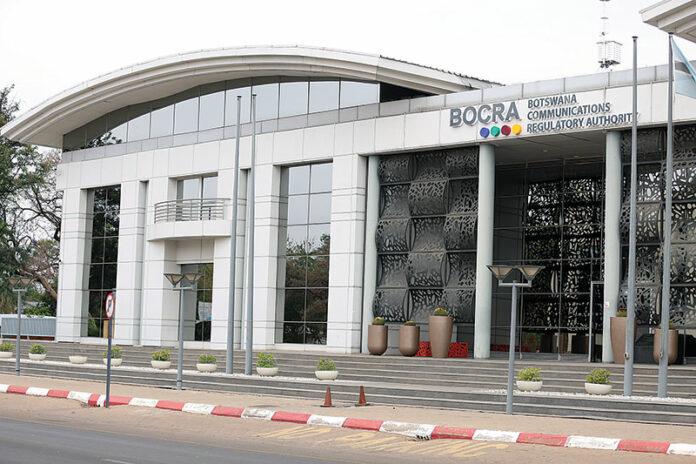
Africa-Press – Botswana. The Botswana Communications Regulatory Authority (BOCRA) crackdown on mobile phone operators’ service failures is believed to be a response to a biting research paper which portrayed them as counterproductive to President Mokgweetsi Masisi’s ambitious plans.
The long and short of the research paper is that poor network access and service quality may frustrate President Mokgweetsi Masisi’s plan to diversify Botswana’s economy and transform it into a knowledge-based one.
The research paper by Professor Hopeton Dunn, a Professor of Media and Communications at University of Botswana, states that, “ contrary to BOCRA’s 2015 User Survey, which indicated that almost 80% of internet users were satisfied with service quality, there appears to be deepening concerns about effective internet access and network service quality by a growing community of smartphone users.”
Prof Dunn quotes among other sources a 2018 story by Sunday Standard: “A February 4, 2018 report in the Sunday Standard newspaper said BOCRA, the regulator, had released a report on recent consumer complaints against telecoms service providers. The newspaper report said that, according to BOCRA, the complaints concerned, among others, billing, missing airtime and data bundles, faulty telephone lines, slow internet speeds, mobile money and termination of contracts.”
He points out that “one of the agencies that could help to drive the process of renewal is the Botswana Communications Regulatory Authority (BOCRA), whose function it is to oversee a converged ICT and Broadcasting environment – key building blocks of the digital, knowledge-based economy. BOCRA’s roles include oversight over the electronic media, regulation of internet service provision and promoting the broader telecommunications network systems that are needed to power the development of data intensive services.”
Presenting a background to his findings, Prof Dunn explains that over the last decade, Botswana invested extensively in infrastructure to support the vision of a digital-enabled development, with USD 32.3 million pumped into the Trans-Kalahari Fibre Network. The network was intended to deliver 2,000 kilometres of optical fibre across the land-locked country’s southern regions and to link into nearby countries such as Namibia and South Africa.
Another fibre-optic loop links the capital, Gaborone, in the south, to the northern population hub of Francistown. The country is also linked to the rest of Africa through the Eastern Africa Submarine Cable System (EASSy) and the West Africa Cable System (WACS).
Against the background of these major investments, Botswana’s ICT policy and regulatory arrangements were to be repurposed to help translate this elaborate infrastructure into advanced levels of corporate communication, citizen access and high-speed connectivity for national development. The current national strategic masterplan, dubbed Vision 2036, aims to realise these goals by transforming Botswana from an upper middle-income country to a high-income country by 2036. Its implicit aim is to use ICT as a transformational tool towards creating a knowledge-based society.”
The research paper further states that Statistics Botswana indicates that while mobile broadband subscription was at 3 per 100 of inhabitants in 2000, this had grown to 67 per 100 of inhabitants by 2017. Despite this dramatic growth in mobile cellular subscription, there are complaints that prices on mobile airtime and on data bundles are challenging for lower income users, including students and some educators who have been forced to migrate online in the face of the Covid-19 pandemic’s effect on educational service delivery.”
The research paper maintains that “in light of these challenges, a key question for policy-makers is how regulation of internet prices and mobile service quality will be carried out in order to facilitate innovation among youthful ICT enthusiasts and digital business ventures. Should there be more consistent oversight over mobile termination rates and more aggressive monitoring of service quality?
Professor Dunn states that while the broad provisions of the strategic plan remain relevant and admirable, it is evident that a foundation of technological transformation was not explicitly embedded in the Plan’s published descriptors. A dedicated ICT pillar, as a necessary component of the sought after knowledge society, seems to be missing. While there has been progress in implementing such laws and policies as the Cyber Crime and Computer Related Crimes Act (2018) and the Botswana National Cyber Security Strategy (2020), other approved policies and laws remain in abeyance. These include the Data Protection Act, which was approved by Parliament in 2018 but has not yet implemented. This is because the establishment of some key institutional structures and regulations are awaited. The same is true for Botswana’s controversial Media Practitioners Act 2008, which is now facing revocation and a possible re-write.
If the noble objectives in Vision 2036 are to be realised, Botswana’s policy and implementation structures will need to be more agile in order to meet the commitment for a knowledge-based society. This goal will also remain challenging given the economic setbacks caused by the Covid-19 pandemic.
He further states that despite the high levels of infrastructure investment, there is little evidence of an expected incoming flow of ICT-related foreign direct investments, or of innovative local investors preparing to build out digital platforms and offer new creative services. It is these initiatives and hoped-for investments that would generate the increased employment levels for Botswana’s youths “such as those in content development services, animation, film production and digital design appear slow to emerge, but are necessary catalysts. Hopefully, the expected early fruits of the vast infrastructure investment in an intended diversified knowledge economy will emerge soon.”
For More News And Analysis About Botswana Follow Africa-Press