By Douglas Rasbash
Africa-Press – Botswana. Why Development Feels Slow
The bruhaha of Budget 26 recedes, leaving an unnerving sense of déjà vu. This is not criticism of the effort, but a feeling that much of it has been heard before. Development fatigue is often described as exhaustion among funding agencies, governments, and citizens. In Botswana, it surfaces in quiet conversations and public debate. Vision follows vision. Plans follow plans. Each promises transformation. Yet diversification remains elusive, youth unemployment persists, and the digital economy has yet to fully emerge.
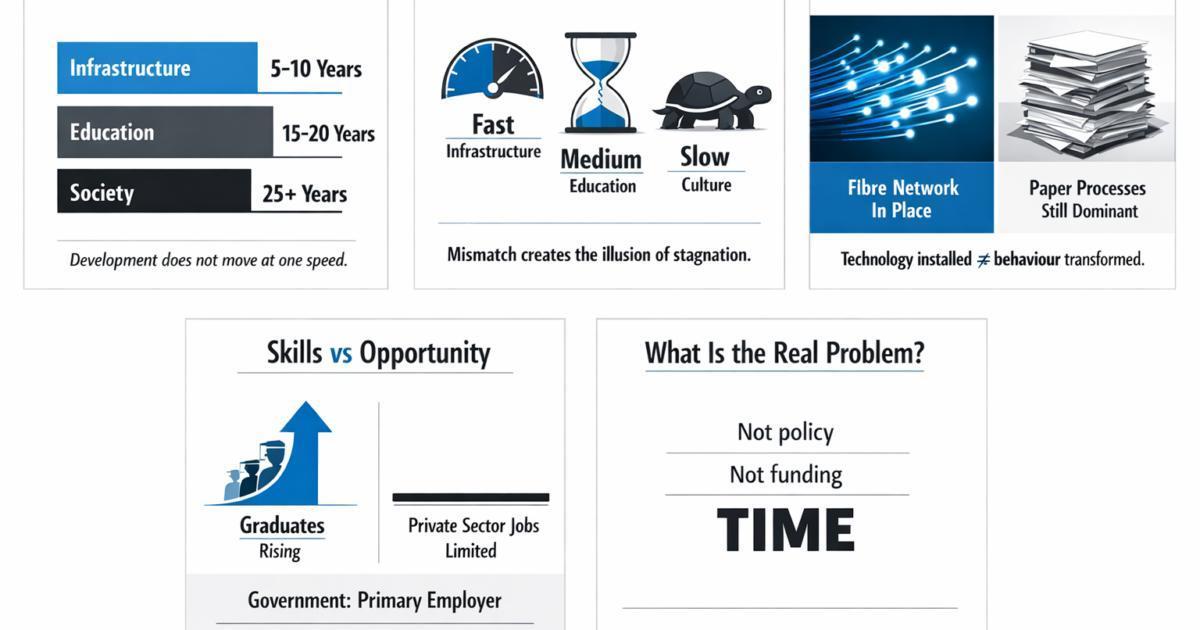
The natural question arises: why does change feel so slow? The answer lies not in failure of intent or shortage of resources, but in a misunderstanding of time itself. Development does not unfold on a single clock. It unfolds on three fundamentally different clocks: infrastructure, education, and society. These clocks do not move at the same speed. When they fall out of alignment, development appears to stall even when progress is real.
THREE CLOCKS
The fastest of these clocks is infrastructure. Physical infrastructure can be built within a political cycle. Botswana’s transformation since independence illustrates this vividly. In a few decades, the country constructed thousands of kilometres of paved road, modern airports, power stations, and telecommunications networks. More recently, fibre-optic cables have been laid across the country, connecting Botswana to the global digital economy. These achievements were accomplished within years, not generations.
Yet the presence of infrastructure does not automatically produce its intended effects. Botswana’s digital infrastructure is now comparable in physical terms to more advanced African economies. Yet Botswana lags countries such as Kenya, Nigeria, and Rwanda in digital economic activity. Government processes continue to require physical paperwork and signatures. The cables are in the ground, but the habits of mind formed in an earlier administrative era remain dominant.
INFRASTRUCTURE GAP
The same pattern is visible in transport. Botswana’s highways are modern and extensive, yet road fatalities remain stubbornly high. This is not a failure of engineering. It reflects the time required for social norms around speed, alcohol, and enforcement to evolve. The road was built quickly. Road culture is changing slowly. Infrastructure creates possibility. It does not guarantee assimilation, business creation, or jobs.
The second clock moves more slowly: education. Educating a person requires consistency over nearly two decades, from early childhood to adulthood. Botswana recognised this early and invested heavily in human capital. The result is one of the most educated populations in Africa. University graduates now enter the labour market in large numbers, equipped with modern skills and global awareness.
EDUCATION GAP
Yet many enter an economy that has not diversified at the same speed as education expanded. Government remains the dominant employer, and private sector absorption is limited. This creates a sense of dislocation. Education prepares individuals for a modern economy. The modern economy itself is still emerging. This temporal gap is deeply consequential.
While conventional wisdom often focuses on individual capacity, the issue is largely systemic. Education can be expanded within a generation. The economic ecosystems required to absorb educated populations take longer to develop. South Korea offers an instructive example. In the 1970s, it rapidly expanded education, producing engineers and scientists faster than its economy could employ them. For a time, many worked in lower-value roles. Over subsequent decades, as industrial ecosystems matured, that same population became the foundation of globally competitive industries.
Botswana today stands at a similar juncture. The skills exist. The capacity is present. But the economic structures that can fully utilise them are still evolving.
SOCIETY
The slowest clock of all is society itself. Society is not transformed by infrastructure or education alone. It is shaped by culture, by norms of trust, authority, risk, and cooperation. Culture evolves over generations. Botswana’s digital lag illustrates this clearly. The technology exists. The infrastructure exists. The educated population exists. Yet digital economic behaviour remains tentative.
Businesses prefer physical verification. Institutions rely on paperwork. Citizens prefer personal reassurance. These preferences are not irrational. They reflect habits formed over decades in an analogue world, where physical presence was the foundation of trust.
CULTURE GAP
Trust operates on a generational timeline. Botswana’s success since independence has rested heavily on institutional trust. Citizens trust government. Investors trust contracts. This trust was built slowly, through consistent experience. However, trust in new systems, particularly digital ones, must be rebuilt. It cannot be legislated. It must be lived.
This generational dimension is visible in public administration. Botswana’s civil service is highly educated and capable. Yet the time required to formulate, approve, and implement policy can stretch into years. This is rarely due to intellectual limitation. More often, it reflects an inherited administrative culture in which caution is rational and mistakes carry high personal cost. Procedure becomes protection. Decisions are deferred. Progress becomes incremental.
Training alone cannot change this, because the behaviour does not originate in knowledge. It originates in norms that evolve across generations. As younger cohorts, formed in a faster and more digital world, assume responsibility, this administrative tempo will change. But like all cultural change, it cannot be compelled.
DATA AND GOVERNANCE
A similar transition is visible in the move from experience-based judgement to data-driven governance. Modern states rely on statistics to guide policy, from labour surveys to productivity measures. Yet statistics represent abstraction, and abstraction requires trust. In systems shaped by observation and experience, quantitative evidence may feel less authoritative.
The result is not absence of data, but hesitation in fully subordinating judgement to it. Statistical signals may be balanced against political narrative or public expectation. This reflects a society navigating the transition from governance by experience to governance by measurement. Over time, as statistical systems prove reliable, this balance will shift. But like all cultural transitions, it unfolds gradually.
ENTREPRENEURSHIP
The same dynamics shape entrepreneurship. Botswana’s economy has long been built around mining, agriculture, and public administration. Risk-taking outside these domains was neither necessary nor widely rewarded. Encouraging entrepreneurship therefore requires more than funding or policy support. It requires a cultural shift in attitudes toward risk, failure, and initiative.
Such shifts unfold over generations, not planning cycles. When these three clocks fall out of alignment, development fatigue emerges. Infrastructure advances rapidly, raising expectations. Education produces capable individuals. But society adapts more slowly, constrained by institutional memory.
DEVELOPMENT FATIGUE
This produces the paradox Botswana faces today. On paper, the country possesses modern infrastructure, a highly educated population, and stable institutions. Yet diversification remains incomplete and digital transformation uneven. This is often interpreted as failure. It is more accurately understood as temporal misalignment.
Botswana’s transformation since independence has compressed extraordinary structural change into a short historical period. Infrastructure can be accelerated through investment. Education can be expanded through policy. Social adaptation, however, cannot be compressed indefinitely.
TIME
International experience reinforces this. Singapore’s transformation took two generations. South Korea’s industrial culture took decades. Even established economies evolved over centuries. Botswana’s progress, by comparison, has been rapid.
Development fatigue arises when expectations fail to account for these realities. Governments grow frustrated with slow behavioural change. Citizens grow sceptical of reforms whose benefits take time. Investors hesitate when institutional transformation appears incomplete.
Yet the constraint is not effort. It is time. Time for infrastructure to be absorbed into behaviour. Time for education to translate into economic ecosystems. Time for society itself to evolve.
CONCLUSION
Botswana is not failing to develop. It is developing on a generational timeline. The roads have been built. The universities have been filled. What remains is the slower work. The transformation of society itself.
Development is not simply the construction of modern systems. It is the alignment of infrastructure, education, and culture. And that alignment can only occur through time.