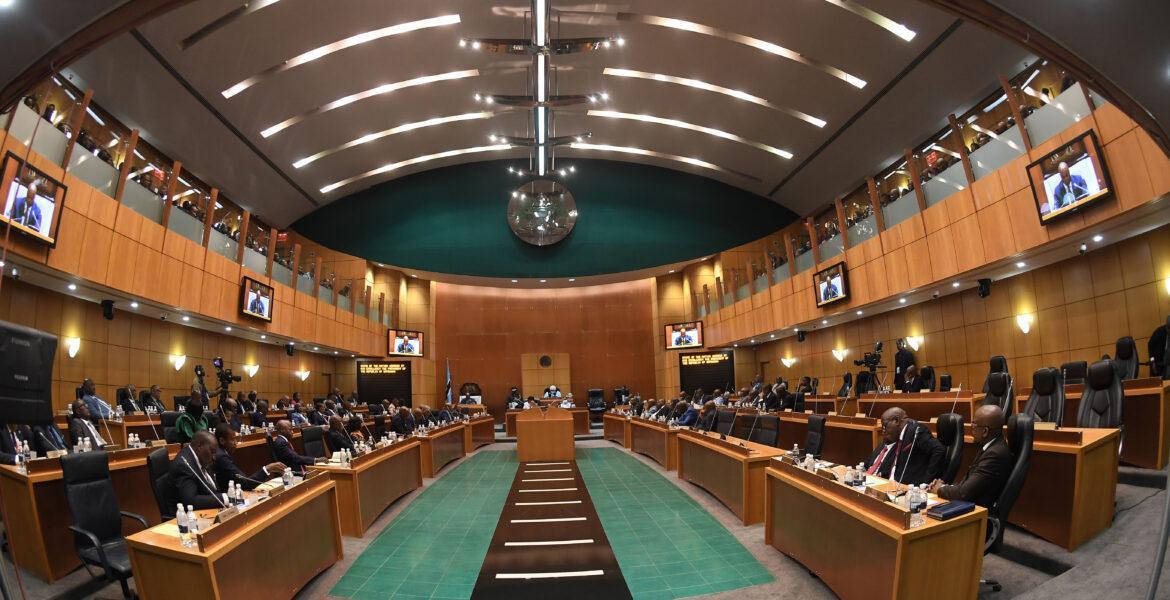
Africa-Press – Botswana. Parliament has been informed that the Land Information System shows that 687,486 people eligible in accordance with Botswana Land Policy of 2019, are awaiting land allocation, indicating the magnitude of national demand for serviced and titled land.
Responding to a question in Parliament on Tuesday on behalf of acting Minister of Lands and Agriculture, Assistant Minister of Trade and Entrepreneurship Mr Baratiwa Mathoothe said the ministry was aware of the significant backlog in allocation of residential plots.
Mr Mathoothe said the 100,000 plots campaign revealed that the challenge was not simply the number of plots allocated but the structural misalignment between allocation, surveying, servicing and Secure Land Title (SLT) production.
He said sustainable land delivery required that allocations were supported by surveyed, infrastructure aligned and legally registrable land capable of unlocking household and economic value.
He added that to deliver immediate improvement, on February 16 this year, the ministry operationalised the Secure Land Title War Room, bringing officers from Surveys and Mapping, Town and Country Planning, Deeds Registry, Geospatial Information Centre, land boards and the Department of Lands together.
He said the war room was actively monitoring end-to-end SLT processing, accelerating submissions to the Deeds Registry and solving workflow bottlenecks in real time.
“It is mandated to deliver 48 569 Secure Land Titles within three months, beginning with high pressure areas such as Mogoditshane, Ramotswa, Tlokweng, Palapye, Maun and Oodi,” he said.
Parallel with these rapid-response measures, the ministry is establishing the Land Lab under the Botswana Economic Transformation Programme (BETP) to redesign the entire land administration ecosystem.”
Furthermore, he said the Land Lab held its first coordination meeting on February 23 during which it reviewed the proposed terms of reference, aligned expectations, clarified institutional roles, considered technical feedback and defined short-term action items with assigned person-in-charge.
“The Land Lab will produce a fully costed and executed reform blueprint, covering end-to-end process redesign, digital integration, governance strengthening, investor facilitation and performance accountability,” he said.
He further said the ministry remained committed to reducing the clean waiting list, restoring predictability in SLT production and delivering a fair, transparent and efficient land administration system for all Batswana.
He indicated that the Land Boards were empowered to allocate tribal land while the deeds registry was responsible for registering all forms of land tenure including tribal, state and freehold as well as other non-land transactions that legally required registration.
He said the current arrangement where Land Boards prepared and submitted registration documents and the Deeds Registry executed the legal registration remained the most appropriate model by preserving institutional integrity while ensuring that land registration remained uniform, secure and legally sound across all tenure categories.
He said decentralising the deeds registry in isolation would not achieve the intended improvements unless all institutions within the land registration ecosystem were equally aligned and adequately.
Member of Parliament for Serowe West, Mr Onalepelo Kedikilwe had asked the minister to state the specific tangible strategies beyond standard policy announcements that could accelerate land allocation including measurable targets and timelines if he was aware of the significant backlog in the allocation of residential plots.
Mr Kedikilwe also asked if it was not viable for every Land Board to have a Deeds Registry to streamline registration process, reduce reliance on a centralised deeds registry and improve efficiency as well as the security of land tenure for citizens.