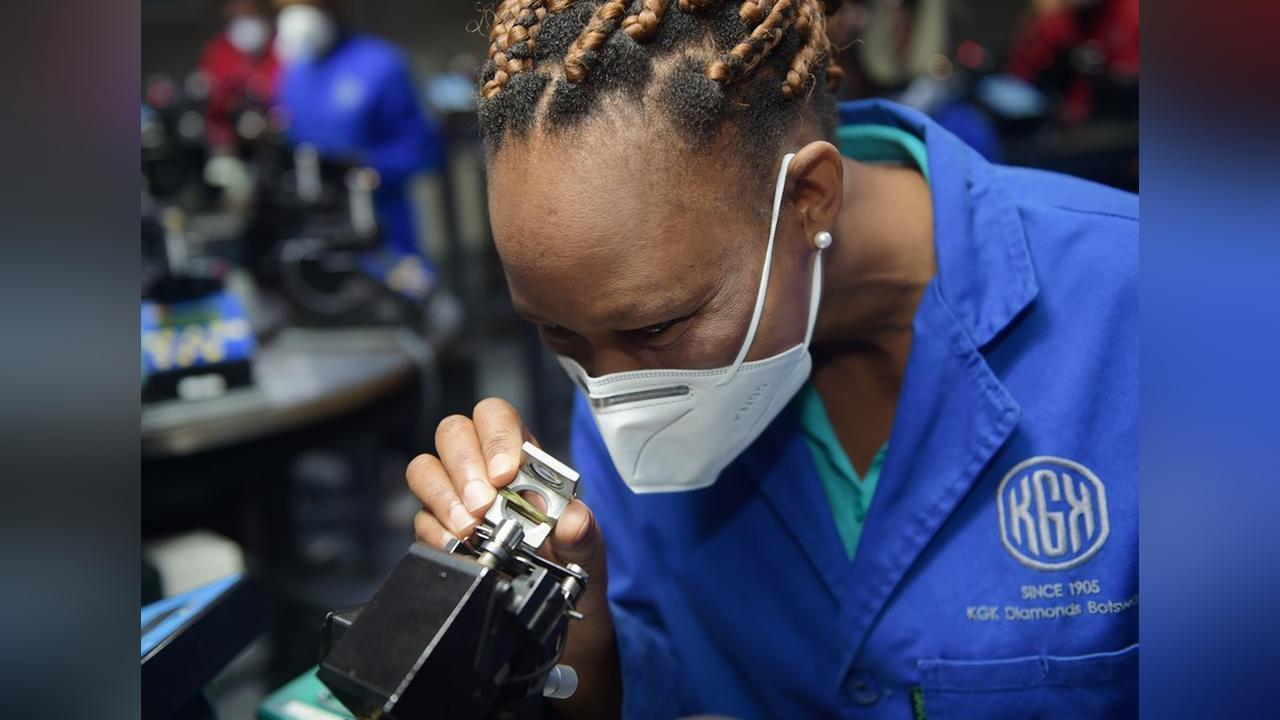
Africa-Press – Botswana. Government has launched a P13.2bn (US$100million) marketing and consumer education campaign to distinguish natural diamonds from lab-grown synthetics.
The initiative, arriving after a 10-year hiatus, is designed to protect Botswana’s primary export.
This was revealed in Parliament on Monday by Minister of Minerals and Energy and Specially Elected Member of Parliament, Ms Bogolo Kenewendo, during the 2026/27 budget debate.
Minister Kenewendo stated that the campaign aimed to reclaim the narrative of the diamond industry.
“This is a major strategic move that has begun to bring stability to how we produce, sell, and attract value. We were intentional and deliberate in managing the industry to ensure we retain as much value as possible within Botswana,” she said.
The minister added that government was now mandating that lab-grown stones be strictly disclosed as “synthetics” or “lab-grown”.
She emphasised the importance of storytelling to highlight the distinction between stones formed over billions of years and those manufactured quickly in factories. She noted that such efforts had already yielded significant shifts in the Indian market.
“Following the Indian President’s visit and engagement with President Advocate Duma Boko, the Indian government decided that the ‘diamond’ designation will be reserved exclusively for natural diamonds,” Ms Kenewendo informed the house.
The minister further noted that government had engaged the GIA to ensure that the 4Cs -colour, clarity, cut and carat, grading system remained exclusive to natural diamonds.
She indicated that the campaign, conducted in partnership with Angola and Namibia, with South Africa expected to join soon, was reportedly already stabilising the sector.
Despite production dropping from 17 million carats in 2024 to 15 million in 2025, the Minister indicated that government successfully cleared older stock from 2023 and 2024.
“This stock balancing has been vital in maintaining mine operations and preparing for market rebounds,” she said.
Additionally, she said the government-run Okavango Diamond Company (ODC) began selling 25 per cent of Botswana’s stock in 2025, successfully pivoting from auctions to contract sales.
“This shift included a significant investment in diamond traceability to ensure every stone sold carries the Botswana story,” she added.
Minister Kenewendo endorsed the 2026/27 budget, supporting the transition from mono-commodity dependency to a capability-based economy.
She noted that the budget aligned with global best practices in economic transformation, resonating with the principles of development economics, competitiveness and evidence-based policy.
Acknowledging the structural crossroads facing the nation, characterised by weakening diamond growth, narrowed fiscal buffers and high youth unemployment, she remained optimistic.
She said while GDP contracted by 2.8 per cent in 2024 and 0.4 per cent in 2025, a rebound was expected in the coming fiscal year.
“The budget’s diversification entails transforming the micro-economic outlook from dependency to a capability-building framework, supported by careful fiscal planning and targeted investments,” she said.