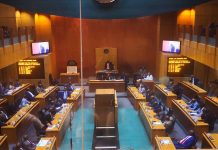
Africa-Press – Botswana. Botswana’s judicial system is set to experience a historic transformation following Parliament’s approval of Bill No. 14 of 2025, a landmark piece of legislation that establishes a dedicated Constitutional Court. The Bill, aimed at reinforcing the protection of fundamental rights and clarifying the validity of laws, passed with strong support, as 50 of the 66 legislators present voted in favour, 15 opposed, and one abstained. Initially gazetted in July 2025, the legislation proposes amendments to the Constitution that transfer constitutional jurisdiction from the High Court to the newly established Constitutional Court. This shift is designed to ensure that cases involving the interpretation of constitutional provisions are handled by a court with specialised expertise. The approval marks a major step toward enhancing the efficiency, transparency, and authority of Botswana’s judicial system.
The establishment of the Constitutional Court is intended to streamline the judicial process for constitutional disputes by providing a single, authoritative forum for the adjudication of fundamental rights issues. Previously, the High Court held constitutional jurisdiction alongside its general judicial responsibilities, which often resulted in delays and inconsistencies in rulings. By concentrating constitutional matters in a specialised court, the Bill aims to strengthen judicial checks and balances while improving the speed and quality of decisions. Legal experts argue that a dedicated Constitutional Court will provide clarity on complex constitutional questions and reduce the likelihood of conflicting interpretations. This reform also reflects a broader commitment to ensuring that Botswana’s legal framework evolves in line with modern governance and the demands of a rights-based society.
The new court will serve as the final arbiter on issues relating to the validity of laws, ensuring that all legislation complies with the Constitution. It will act as a safeguard against potential overreach by legislative and executive bodies, reinforcing the principle of separation of powers. The court’s specialised mandate will allow judges to focus exclusively on constitutional matters, cultivating expertise and consistency in jurisprudence. This development is expected to enhance public confidence in the legal system by providing a clear, reliable avenue for resolving disputes over fundamental rights. The creation of a Constitutional Court also aligns Botswana with international best practices, where many countries have dedicated institutions to oversee constitutional interpretation.
The passage of Bill No. 14 signals a transformative moment for Botswana’s legal landscape, with far-reaching implications for governance, civil liberties, and judicial efficiency. By removing constitutional jurisdiction from the High Court, the reform ensures that fundamental rights issues are treated with the attention and expertise they deserve. Legal practitioners and civil society organisations are likely to play a key role in supporting the transition, ensuring that cases are smoothly redirected to the new court. The Constitutional Court is expected to set precedents that will influence the interpretation of Botswana’s Constitution for years to come. Overall, the legislation represents a decisive step toward a more specialised, accountable, and effective judicial system.
The approval of Bill No. 14 of 2025 establishes Botswana’s first Constitutional Court, fundamentally changing the way constitutional matters are handled in the country. By centralising authority, enhancing judicial expertise, and strengthening checks and balances, the Bill positions the legal system to better protect citizens’ rights and maintain the integrity of the Constitution. The creation of this dedicated court ensures faster, more consistent resolution of constitutional disputes, providing clarity for both lawmakers and the public. This reform represents a landmark achievement in Botswana’s legal evolution and sets a strong foundation for the protection of fundamental rights and the rule of law. The Constitutional Court will serve as a critical pillar of justice, ensuring that constitutional interpretation remains precise, fair, and authoritative.