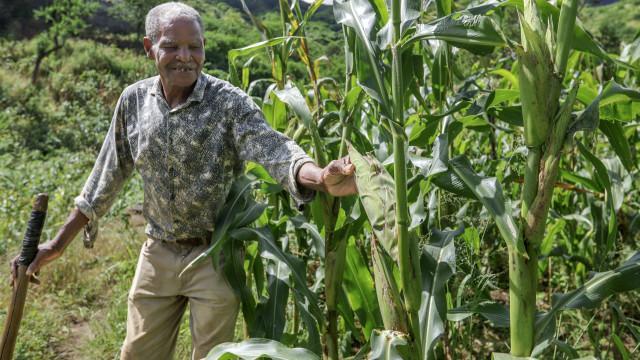
Africa-Press – Cape verde. João Cabral, 78 years old, has more corn in his garden to celebrate the November 1st holiday, which is celebrated in Cape Verde, than he had last year.
In Cape Verde, tradition dictates that All Saints’ Day is celebrated with an ear of corn roasted on the stove or cooked in a pan.
“There was a lot of rain in August and September” and production “is better than last year”, he says, while walking through a roadside cornfield in Órgãos Pequenos, 30 kilometers from the capital, in the interior of the island of Santiago.
But the specter of drought and aridity always hangs over the archipelago and the rain has already failed in October: despite the abundance compared to previous years, João may not be able to pick as many fresh ears for the holiday as he wanted.
You need to look for them in other parts of the island, as Sandi Tavares, 34 years old, and her mother do, known for their stall in São Filipe, surrounded by smoke from a stove, which spreads the smell of roasted cobs throughout the surrounding area.
Next door there is a large pan on the fire, on another pile of wood, where the corn is cooked.
“November 1st is the day of the year when we sell the most”, says Sandi, who is usually accompanied by her mother, who is not there today: she went to the interior to buy more corn, because the rain allowed a good harvest in rainfed crops — and this corn tastes better than that grown under irrigation, says the saleswoman.
At the price of 100 escudos (91 euro cents), he delivers a cooked cob to Francisco Mendes, 60 years old, resident in the capital, a Cape Verdean who has known that flavor since he was a child.
Now, as a driver, he buys an ear of corn whenever he sees it on the side of the road, with the understanding that, this year, “the rain helped” and that on November 1st there will be corn to fulfill the tradition, or In other words, everyone saves some money to buy it.
Driving along some roads in the rural areas of the south of the island, corn plantations are everywhere, showing how the crop is still part of the archipelago’s diet.
Maize production in Cape Verde recovered in 2022, after five consecutive years of drought, which led to insignificant production levels.
The average production of corn was 340 tons per year, between 2017 and 2021, but in 2022 the value grew to 4,178 tons and this year the prospects are optimistic, according to the latest report from the Global Information and Early Warning System (GIEWS , English acronym), a tool of the Food and Agriculture Organization of the United Nations (FAO).
Marta Furtado, 61 years old, resident in Órgãos Pequenos, maintains a family garden and shows how the corn leaves are embedded with caterpillar marks, almost completely destroying them.
“There are a lot of pests,” he says, showing that the rain brought more corn, but also more animals.
There is a lack of assistance and seed support from the authorities for small family farmers, such as Marta and João Cabral, says the latter, who would like to take advantage of the few months of water availability in their well (from September to January) to plant potatoes.
“Don’t you want cash support?” we asked. “No. Money is an addiction”, replies the producer, insisting on ordering seeds, because he could sell the potatoes with a good margin.
The two look at the slopes of the valley where they live and remember the times of their youth when all the land was cultivated, a time when there were people to work, but today, young people are not available to tend the land, a job that pays 1,000 escudos (nine euros) per day.
“I have no one to help. Young people no longer want to work in agriculture. Some are out there, others have gone to Lisbon and other places”, he says, in reference to emigration, “and the land remains abandoned”.
His own family is a reflection of what is happening: of his eight children, he has six emigrated to Portugal, Spain, Luxembourg and the USA, along with his grandchildren.
But neither João nor Marta will emerge from the slopes of São Lourenço dos Órgãos, ready to celebrate the 1st of November and count the days until the water dries up, leading them to say goodbye to the green landscape, which will give way to arid lands until the rain decides to return.
For More News And Analysis About Cape verde Follow Africa-Press