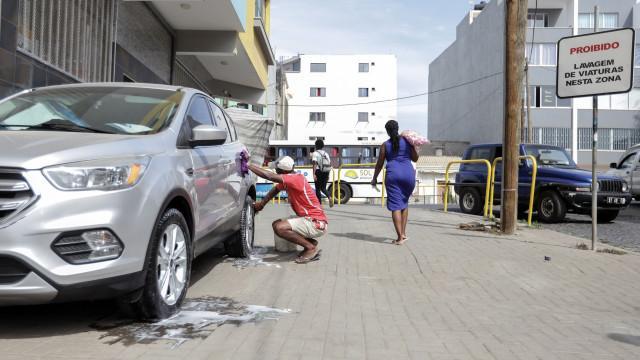
Africa-Press – Cape verde. Car washers are a constant presence on the streets of Praia, one of the informal activities that improvise ways of accommodating themselves along the city’s streets and roads, especially around busy places, such as markets.
“I’ve washed cars everywhere in Sucupira, because we have to eat, we can’t sit still”, the 40-year-old Cape Verdean describes to Lusa, as he washes the rims of a vehicle, until he leaves them shining — no despite the surrounding streets being dusty.
“Here I look for my daily bread, like anyone else”, because the basic needs are the same, for those who are salesmen or ministers, he says, guaranteeing: “I have little crime, but I have a lot of education”.
Paulo Tavares, a taxi driver for two years, reports cases of colleagues who lost what they had in the car during car washes, but says that he himself has never had any problems, because he has a washer to whom he is loyal.
“It is advisable to have your washer. When you arrive, wash and are confident, you can leave all your things in the car”, he describes, as if indicating the formula for success.
Washing costs 250 escudos (2.2 euros), “but not everyone wants to pay”. “They say they only pay 200 escudos and we can handle it”, “Mamadou”, a fictitious name, a Senegalese launderer who has lived in Cape Verde for 13 years, tells Lusa.
“We want to work, that’s better than nothing”, to meet the family’s needs and “not fall into the path of delinquency”, he explains.
“Someone with nothing, without work, can go down the path of aggression. I chose to do this work”, he says.
The rainy season has ended on the island of Santiago and both “José” and “Mamadou” thank the heavens.
While for the majority of the population the rain is welcome, because it is a rare gift, for those who wash cars it is the most difficult time and when – paradoxically – they use more water.
Mud and dirt affect the roads and “all kinds of rubbish gets stuck to the car”, making the task more complicated and expensive, describes the Senegalese washer.
As in any other profession, there is a list of essential materials: detergent, cloth, broom, brush and bucket are part of the basic set, complemented with other specific products that each driver requests.
“They don’t even last a month”, complains “José”, who counts the fixed expenses he has to pay.
Informal activity on the streets stands out to everyone, including those who study social relations in the capital.
“I think that washers should be seen differently”, says sociologist Henrique Varela, noting that “they do a decent job and, as such, deserve more respect”.
According to the sociologist, in these types of situations, “a little empathy is needed to reverse prejudice.”
Empathy can be the key to improving relationships, comparing the work to another that is done on the streets, that of a shoe shiner, which is also sometimes the target of prejudice, but which has survived for centuries, he pointed out.
The day is almost coming to an end and, around the Sucupira market, people are now busy looking for a ‘hiace’, light public transport, to take them back home.
Some of these vehicles have already passed through the hands of “Mamadou”.
While everyone rushes home, he remains at his washing place, where he spends 14 hours a day.
It’s time to gather three stones and firewood, set up an improvised stove where you’ll heat something to satisfy your hunger, before washing the next car, in search of a new loyal customer.
For More News And Analysis About Cape verde Follow Africa-Press