
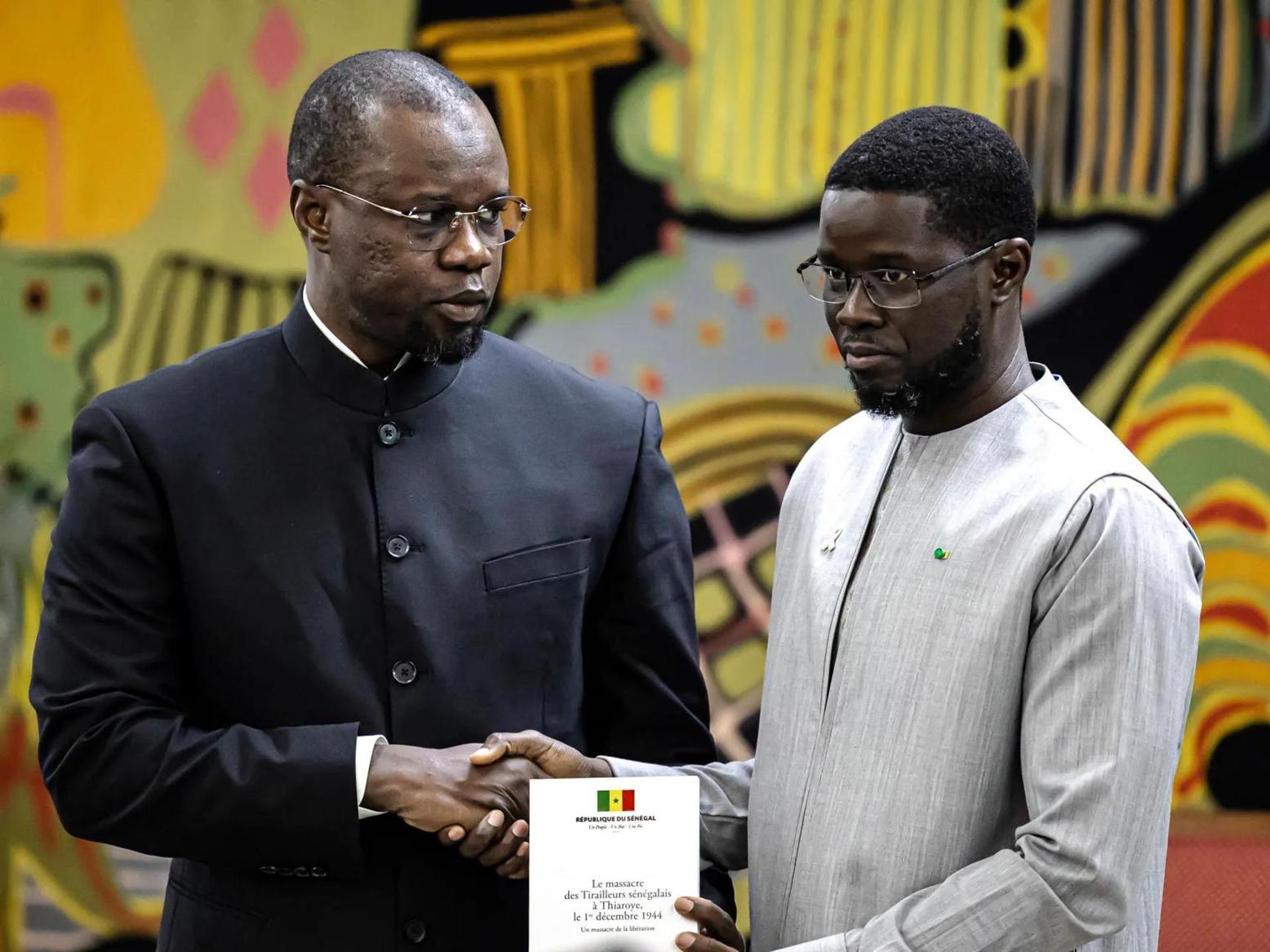
Africa-Press. Senegalese President Bassey Diumai Faye announced the dismissal of Prime Minister Ousmane Sonko and the dissolution of the government in a surprising move that capped months of escalating tensions and open confrontation between the former allies, exacerbating the political crisis in this debt-laden West African nation.
The announcement came late Friday night via a presidential decree read by the Secretary-General of the Government and Presidential Assistant Omar Samba Ba in a live broadcast on state television, confirming that President Faye “terminated the duties of Ousmane Sonko, and thus the duties of the ministers and state secretaries who are members of the government,” which automatically led to the dissolution of the government headed by Sonko.
The decision is viewed as a blow to the close alliance with Ousmane Sonko, who played a significant role in the rise of Bassey Diumai Faye himself, transitioning from the depths of prison to the presidency.
Limits of Populism
Senegal is experiencing an unusual political situation, as Sonko and Faye have been comrades in the struggle against the previous regime, having been tried and imprisoned for their efforts.
African affairs expert Hamdi Abdel Rahman stated that the decision “represents a pivotal moment in the modern political history of Senegal, not only because it ends a political alliance that led a wave of popular change in the 2024 elections, but also because it reveals the limits of reformist populism when it transitions from opposition to governance.”
Sonko was appointed Prime Minister of Senegal in early April 2024, just hours after Bassey Diumai Faye was inaugurated as president.
Faye was nominated from within prison as an alternative plan to compensate for Sonko, whose candidacy was rejected by the previous regime after the Supreme Court upheld his conviction for defamation.
Abdel Rahman believes that the two men succeeded in reaching power as two faces of a single political project, advocating for economic sovereignty, liberation from foreign dominance, and the redistribution of national wealth, particularly in the oil, gas, and minerals sectors.
The expert continues in his analysis that the rhetoric attracted a disillusioned young generation frustrated with traditional elites and what they perceived as a continuation of indirect French and Western dominance over the Senegalese economy. However, he argues that the experience of governance has proven that the transition from a language of mass mobilization to state management imposes more complex equations.
Crisis Among Comrades
The “African Patriots of Senegal for Work, Ethics, and Brotherhood” (Pastef) party achieved a decisive victory in the first round of the March 2024 elections after a fierce campaign against the ruling “Alliance for the Republic” party, led at the time by former President Macky Sall (2012-2024), relying on promises to bring about deep political change and combat corruption and mismanagement of government affairs.
Despite Sonko’s charismatic power and popular appeal—especially among frustrated Senegalese youth whom he addressed with a rhetoric embracing “African unity” and a firm stance against France—Faye possesses the constitutional authority and full legitimacy as president to dismiss his prime minister with a simple decree.
Regarding the structural disagreements and contradictions between the two men, Abdel Rahman clarifies that Ousmane Sonko has represented the “revolutionary spirit” of the Pastef movement, while President Faye has appeared more inclined toward pragmatism and appeasement, particularly in dealing with international financial institutions and the escalating debt crisis.
The expert states that “his dismissal may be interpreted by his supporters as a concession to the pressures of international institutions and traditional economic elites.”
Political Risk
While Sonko pushes for renegotiating energy and natural resource contracts and refuses to submit to the conditions of the International Monetary Fund, claiming to protect Senegal’s “economic sovereignty,” this approach—despite its popularity domestically—has raised concerns among international markets and external financiers, especially following the debt crisis and reports regarding concealing the true extent of the financial deficit.
Relations between the two parties have sharply deteriorated in recent months, as the dispute became public in early July when Sonko accused President Faye of “failure in leadership” for not providing him with adequate support against his critics, during a fiery statement he delivered to his party supporters.
In his first reaction following the dismissal decision, Ousmane Sonko posted a short message on the X platform, stating, “Thank God. Tonight I will sleep with a peaceful heart in the Kor Gorgi neighborhood.”
Observers view the president’s decision to dismiss Sonko as a significant political risk. According to Abdel Rahman, Sonko still enjoys a broad popular base, especially among the youth, and his removal could lead to a split within the Pastef movement itself, potentially resulting in a return to the polarization and protests that Senegal has witnessed in recent years.