Africa-Press. South Africa is facing a new wave of tensions related to immigration, as anti-foreigner protests escalate in several major cities, accompanied by violence and increasing political and public pressure on the government. While authorities pledge to contain the crisis and tighten immigration laws, human rights and regional organizations warn that social unrest could escalate into a broader wave of xenophobia that threatens internal stability and the country’s regional image.
In this context, South African President Cyril Ramaphosa, in a televised address, vowed to take action against the groups behind the rising violence against foreigners, emphasizing that the state will not allow the exploitation of public fears regarding illegal immigration to advance political or criminal agendas.
Ramaphosa stated that his government would act against “forces that exploit our people’s fears regarding illegal immigration to serve their political, personal, and criminal agendas,” adding that public concern about the influx of migrants should not turn into chaos, violence, or collective targeting of foreigners.
The South African president stressed that enforcing immigration laws is solely the responsibility of the state, warning citizens against stopping people in the streets or demanding proof of identity, referring to the growing phenomenon of “vigilante justice” that has begun to appear in some areas, where local groups organize informal inspections targeting migrants, especially from neighboring African countries.
Escalating Protests and Deadline for Departure
Ramaphosa’s statements come at a time when several cities, including Johannesburg, Pretoria, and Durban, are witnessing increasing protests against undocumented migrants, sometimes accompanied by violence, looting, and physical assaults, amid calls from anti-immigration groups demanding that foreigners leave the country within a specified timeframe.
Although the government asserts that the protests do not reflect the general mood of South Africans, their recurrence reflects the depth of the social and economic crisis facing the country and reveals the extent of tension related to competition for job opportunities and public services amid difficult economic conditions.
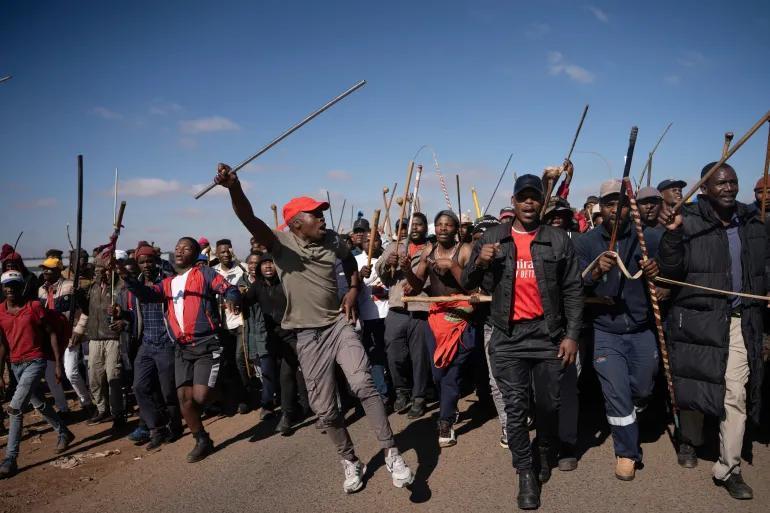
In recent developments, anti-foreigner protesters emerged in the areas of Boksburg and Benoni east of Johannesburg, rejecting proposed government reforms regarding immigration management. According to local reports, the protesters marched under police protection without registering acts of violence, but they carried clubs and whips, raising slogans demanding the departure of all foreigners, not just those residing illegally.
Who is Behind the Incitement?
Ramaphosa did not name the groups he referred to in his speech, merely indicating “forces that exploit fears of immigration,” but media and human rights reports point to a growing role of two anti-immigration movements, “Operation Dudula” and “March and March.”
The “Operation Dudula” movement – whose name means “forceful removal” in Zulu – is one of the most prominent organizations that has emerged in recent years, calling for the deportation of undocumented migrants and accusing them of taking job opportunities and contributing to rising crime rates.
Meanwhile, the “March and March” movement has organized a series of protests in major cities over the past months, including Pretoria, Johannesburg, and Durban, demanding the closure of businesses run by migrants and the deportation of those residing illegally.
However, human rights organizations warn that these campaigns often turn into collective targeting of foreigners, including legal residents and refugees, and South African citizens sometimes face harassment due to their different origins or accents.
Economic Crisis Fuels Tension
Observers believe that the rise in anti-foreigner sentiments is directly linked to the deterioration of social and economic conditions in South Africa, which has faced high unemployment rates for years, especially among youth.
Economic estimates indicate that the unemployment rate in the country has exceeded 43% according to some expanded indicators, among the highest globally, contributing to a growing sense of public frustration and widening social gaps.
In this climate, migrants have become an easy target for accusations related to rising unemployment, declining services, and increasing crime, despite several economic and human rights studies finding no conclusive evidence that migrants are the primary cause of these crises.
Experts point out that the informal economy in South Africa heavily relies on migrant labor, especially in small trade, construction, and services, making the issue more complex than mere calls for mass deportation.
Additionally, ongoing power outages, rising living costs, and weak economic growth are all factors fueling public anger, giving populist groups greater space to exploit social fears.
Human Rights Criticism of Authorities
In this context, Human Rights Watch warned of a new wave of attacks against foreigners from African and Asian nationalities, considering that the response from police and local authorities has been “weak or insufficient” in some cases.
The organization stated that the protests that occurred in the country during April and May in major cities were sometimes marked by deadly violence, urging the government to protect migrants and refugees and hold accountable those involved in incitement and attacks.
The African Commission on Human and Peoples’ Rights also expressed concern over the rise of hate crimes, calling on South African authorities to conduct transparent investigations and ensure justice for victims.
This crisis is not new to South Africa, as the country has witnessed repeated waves of violence against foreigners since 2008, resulting in the deaths of dozens and the displacement of thousands, particularly among migrants from Zimbabwe, Mozambique, Nigeria, Somalia, Ethiopia, and other African countries.
Increasing Regional Repercussions
Recent developments have sparked regional reactions, especially from countries that have a large number of migrants residing in South Africa.
Reports indicate that Ghana, Nigeria, Malawi, and Mozambique have begun repatriating some of their citizens caught in the midst of the protests, while Mozambique announced the deaths of five of its nationals during the violence.
Ghana has also lodged a complaint with the African Union regarding what it described as the mistreatment of its citizens and has begun to inventory the assets and properties lost by Ghanaian citizens, preparing for potential legal actions to seek compensation.
On the international level, the UN Secretary-General António Guterres expressed concern over reports of harassment, discrimination, and assaults targeting foreigners, calling for respect for human rights and the rule of law.
Amid Tightening Laws and Containing Tensions
In response to the crisis, Ramaphosa’s government asserts that it is working on two parallel tracks: the first involves tightening the enforcement of immigration laws and border control, while the second aims to prevent a slide into social violence.
The South African president announced a package of measures including reviewing immigration laws, enhancing coordination with neighboring countries to address the causes of illegal immigration, and establishing specialized courts to expedite immigration cases.
He also spoke about plans to replace paper identity documents with more secure biometric digital cards to reduce fraud and improve the management of resident data.
However, the biggest challenge facing the government does not seem to be merely legal, but also political and social, as it must balance responding to public concerns related to immigration while preventing these fears from turning into a wave of collective hatred that threatens public peace and places the country before a new human rights crisis.
As protests continue and divisions widen over the immigration issue, South Africa appears to be facing a difficult test: either succeed in managing the crisis within a legal and institutional framework or slip into a new cycle of violence that could extend its effects both internally and externally, impacting its African relations and its image as one of the continent’s leading democracies.