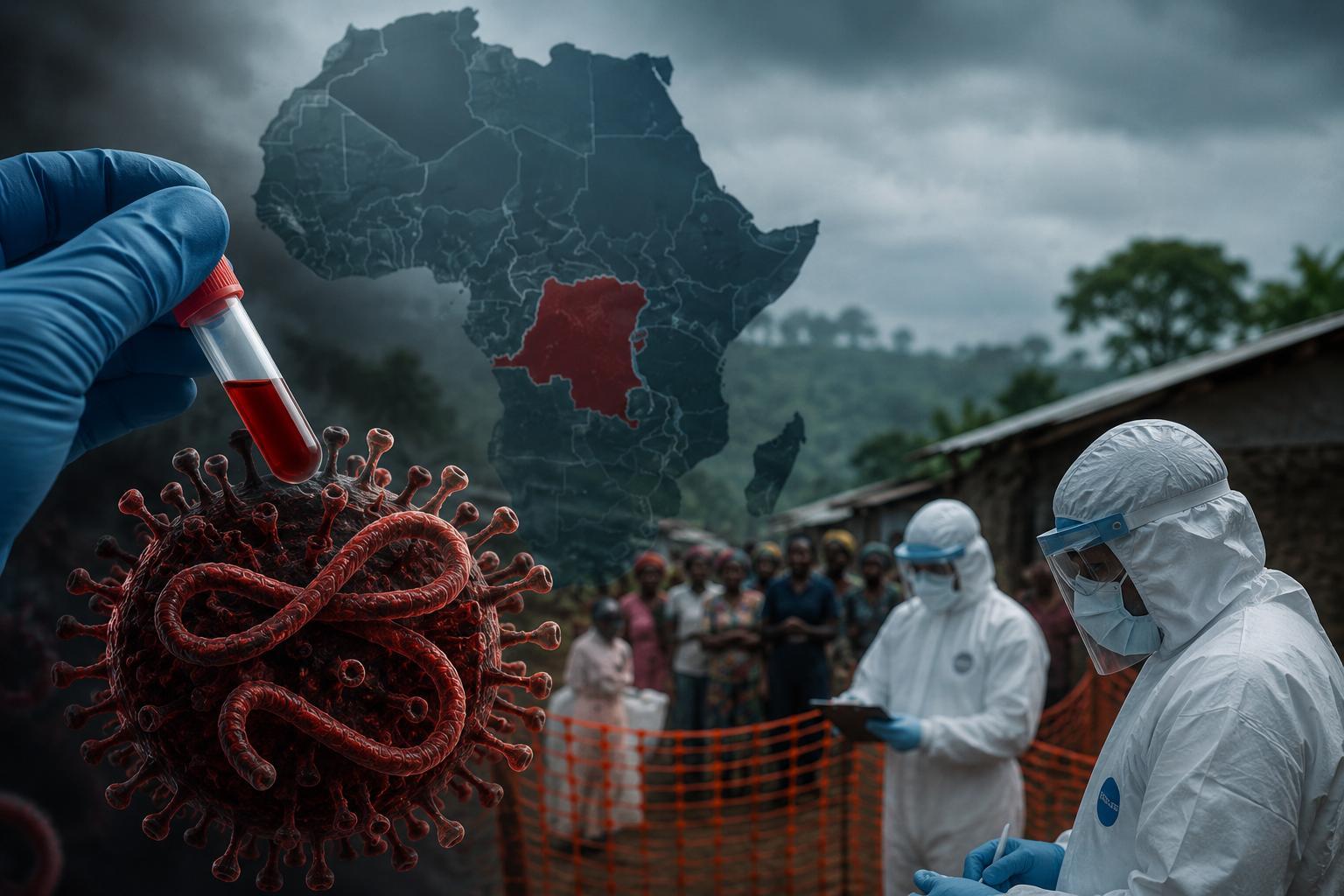
Africa-Press. The World Health Organization has raised the risk level of the Ebola virus outbreak in the Democratic Republic of the Congo to the highest degree, as the number of infections and deaths related to the disease continues to rise.
The organization elevated the risk level of the Ebola outbreak in the Democratic Republic of the Congo from “high” to “very high” nationally.
The WHO stated that the country has recorded 82 confirmed cases and 7 confirmed deaths as of Friday, in addition to approximately 750 suspected cases and 177 deaths suspected to be linked to the virus.
Experts believe that the virus has been spreading “silently” for some time before its official detection.
The organization clarified that the current outbreak is caused by the less common “Bundibugyo” strain of the Ebola virus, which currently has no officially approved vaccines or treatments available.
In the absence of direct treatment options, the WHO is prioritizing the testing of some currently available treatments to determine their effectiveness against this strain.
The Director-General of the WHO stated that the situation “presents a particular challenge,” as health workers race against time to track down infected individuals and their contacts in areas suffering from fragile security conditions.
He added during a press conference in Geneva, “We know that the scale of the epidemic in the Democratic Republic of the Congo is much larger than the number of confirmed cases.”
Regarding Uganda, he confirmed that the situation there is “stable,” following the registration of two confirmed cases of individuals who had come from the Democratic Republic of the Congo, along with one death.
He noted that intensive contact tracing efforts have so far helped prevent a wider spread of the virus within the country.
On Friday, the health ministry in Rwanda announced a ban on the entry of any foreigner who has passed through the Democratic Republic of the Congo.
In contrast, Rwandan citizens and foreigners with legal residency are allowed entry, provided they undergo mandatory quarantine according to established health protocols.
In Europe, Radboud University Medical Center in the Netherlands announced that it has received a patient suspected of having Ebola “at a low level,” who has been isolated while awaiting test results.
Additionally, an American citizen who contracted the virus while working in the Democratic Republic of the Congo has been transferred to Germany for treatment, while another high-risk American individual has been sent to the Czech Republic after coming into contact with infected persons.
The Director of Emergency Response at the WHO stated that the likelihood of the virus spreading rapidly is “very high,” considering that this has completely changed the nature of the crisis.
From the field, the organization’s representative in the Democratic Republic of the Congo confirmed that the number of infections will continue to rise until health response operations are completed.
She added that “the virus has been spreading silently and widely for weeks… we are racing behind the epidemic, and the spread is not yet under control.”
In the absence of vaccines and treatments, she explained that the only available means to stop the transmission of the infection currently is through contact tracing and isolating individuals for 21 days.
For his part, the regional director of the WHO in Africa stated that Ebola initially went through a “silent” phase, as its early symptoms resemble those of diseases such as malaria and typhoid, making detection more difficult.
She viewed the current increase in detected cases as a “positive sign,” as it reflects improved monitoring and active detection of infections.
The world has previously witnessed only two outbreaks of the “Bundibugyo” strain, the first in Uganda in 2007 and the second in the Democratic Republic of the Congo in 2012.
The chief scientist at the WHO stated that the organization is working to accelerate the testing of available therapeutic tools to combat the outbreak.
The organization’s technical advisory group recommended prioritizing two monoclonal antibody treatments for clinical trials:
It also recommended evaluating the antiviral drug “Obildesivir” as a preventive treatment for at-risk contacts.
She stated that preliminary results appear “promising,” as the drug may help prevent the progression of the infection in contacts.
She added that developing a vaccine specifically for the “Bundibugyo” strain could take between six to nine months, even with expedited procedures.