Africa-Press. The opposition Rescue Council announced the start of weekly protests in Mogadishu beginning June 4, to be held every Thursday until a political agreement regarding the country’s elections is reached.
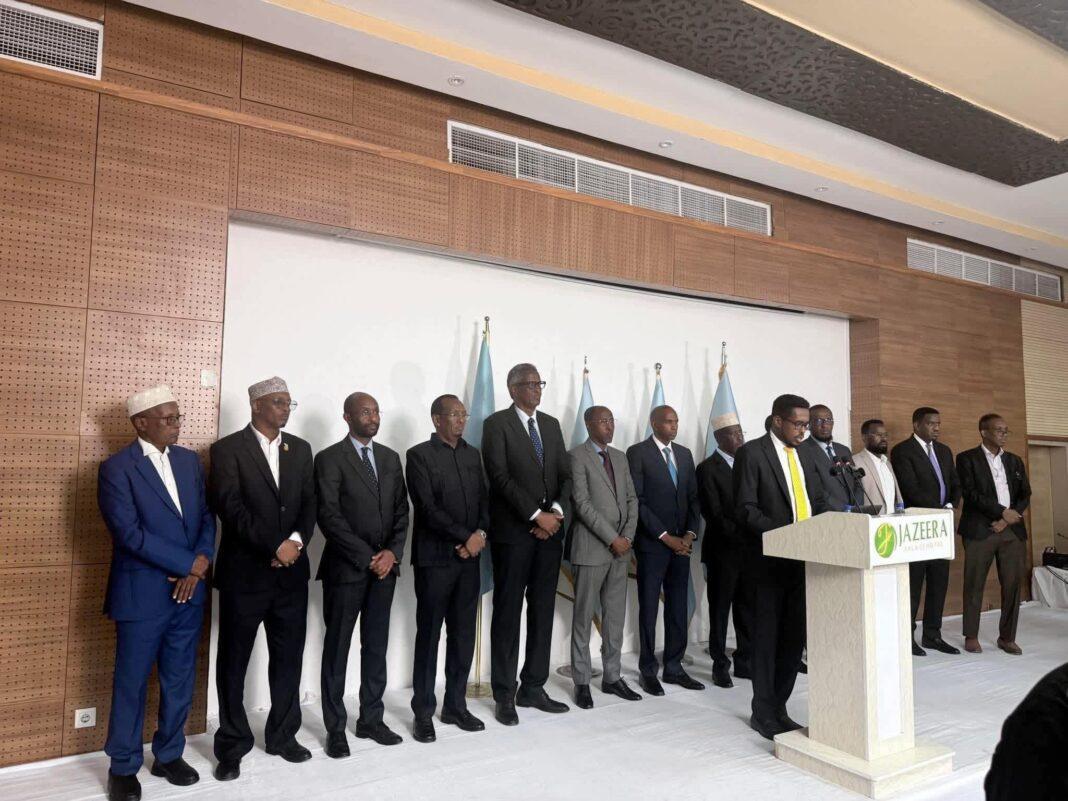
This announcement followed a press conference held by opposition leaders in Mogadishu, including former Somali President Sharif Sheikh Ahmed, Deputy Abdirahman Abdishakur, former Prime Minister Hassan Ali Khaire, and several opposition members.
Sharif Sheikh Ahmed stated that the term of President Hassan Sheikh Mahmoud, along with the government and parliament, has ended, emphasizing that any elections held without an agreement cannot be fully legitimate.
He added that efforts were made last week to reach an agreement on electoral issues, but these efforts were unsuccessful, stressing that elections cannot be managed by a single party; there must be consensus on committees, procedures, and timing.
Sharif Sheikh Ahmed criticized the recent elections in Mogadishu and Baidoa, stating that they revealed the level of corruption and political division that could arise from elections not based on an agreement. He also accused the government of sending troops to dangerous areas experiencing clashes and political tensions, which, according to him, led to the deaths of soldiers and officers.
For his part, Abdirahman Abdishakur stated that President Hassan Sheikh Mahmoud is now a “former president” due to the expiration of his constitutional term. He called on the residents of Mogadishu to participate in the peaceful demonstrations planned after Eid al-Adha, affirming that the opposition will continue its protests. The political crisis in Somalia is worsening following the failure of recent talks between the government and the opposition regarding the electoral mechanism and its nature.
The Somali federal government insists on proceeding with the implementation of the electoral program it has established, which is based on “one person, one vote,” while the opposition has rejected this proposal, demanding an electoral framework based on political consensus.