Africa-Press – Eritrea. In recent weeks and months, certain commentators and regional actors have continued their longstanding campaign of misinformation and disinformation directed at Eritrea. This politicized narrative has seeped into a wide array of topics, among the most recent of which concerns Eritrea’s education system and broader human-capacity development efforts. The resulting discourse has generated a distorted and often misleading portrayal that obscures both context and reality.
This article cuts through that noise. By examining Eritrea’s educational initiatives and its sustained investment in capacity-building, it offers a clarifying and more grounded perspective – one that illuminates the country’s actual trajectory rather than the caricatures often circulated about it.
From the late nineteenth century onward, Eritrea endured profound structural barriers to education under successive colonial administrations, from the Italian and British to Ethiopian rule. For decades, access to schooling was severely limited, and literacy rates remained strikingly low across the population, particularly among girls and women.
Under Italian colonial rule, formal education was confined to a narrow elite. Schools existed primarily to serve the administrative and economic interests of the colonial power rather than to cultivate an educated Eritrean society. As Trevaskis (1960) observed, Italian policy sought to “keep the Eritrean’s belly filled while keeping his brain empty,” effectively excluding the overwhelming majority from meaningful educational opportunities. Reflecting this neglect, a UK Parliament debate in 1951 noted that there were virtually no educational facilities in Eritrea prior to the British arrival in 1941.
The British Administration that followed was more open in principle but limited in execution. Demand for modern education among Eritreans grew rapidly, yet facilities, resources, and institutional capacity remained insufficient. As Teklehaimonot (1996) notes, “the high demand for modern education on the part of Eritreans in the face of limited educational facilities and resources had not been adequately met by the time the British left.”
Ethiopian rule did little to alter this trajectory. Educational access remained restricted, inequities persisted across regions and genders, and linguistic repression further constrained learning. Amharic was imposed as the official language, while local Eritrean languages were banned and books were burned. UNESCO data indicate that by the mid-1970s, approximately 95 percent of Eritrean women were illiterate. At independence, primary-school enrolment stood at roughly 30 percent, reflecting decades of cumulative neglect.
Eritrea’s engagement with education, however, did not originate only after independence. During the decades-long liberation struggle, the Eritrean People’s Liberation Front (EPLF) developed a parallel educational infrastructure aimed at populations systematically excluded under occupation. Schools and literacy programs were established for the children of fighters, refugees, orphans, women, nomadic groups, and rural communities in the liberated areas. Through mobile schools and community-based initiatives, education was treated not as a peripheral service, but as an integral component of national survival and self-determination.
It was against this historical backdrop that post-independence educational policy took shape. Education was designated a central pillar of Eritrea’s development strategy and made free of charge from the primary through the tertiary level. Efforts since independence have focused on rebuilding and expanding an educational system inherited in a severely depleted state. Hundreds of schools, learning centres, and libraries have been constructed or rehabilitated across both urban and rural areas. The number of schools has increased from just over 500 in 1991 to more than 2,300 today, while enrolment has risen from approximately 340,000 in the late 1990s to nearly 700,000 at present. Technical and vocational education has likewise expanded as part of a broader effort to diversify educational pathways and respond to labour-market needs.
Higher education reform constitutes a central yet frequently mischaracterized component of Eritrea’s post-independence education strategy. At independence, the country inherited a single university – Asmara University – that enrolled only a few thousand students, drawn overwhelmingly from urban, male, and relatively privileged backgrounds. As national demand for tertiary education expanded rapidly, this centralized and socially narrow model proved structurally inadequate. Eritrea therefore undertook a deliberate reconfiguration of its higher education system, replacing a single university with a network of specialized public colleges distributed across the country.
Today, six colleges provide tertiary education across distinct academic and professional fields, including medicine and health sciences, education, engineering, business and economics, agriculture, and marine sciences. While these institutions initially focused on diploma and undergraduate (BA/BSc) programs to address urgent national skills gaps, they have progressively expanded their academic scope. Several colleges now offer advanced postgraduate coursework, higher professional certifications, and master’s-level programs in selected disciplines, reflecting both growing institutional capacity and evolving national needs.
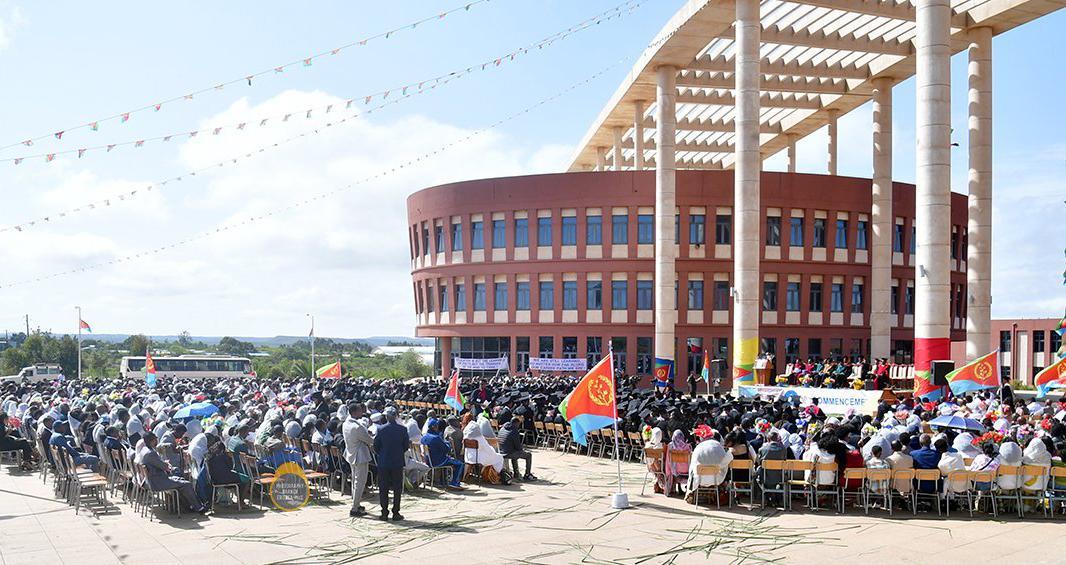
This transformation has resulted in enrolment levels several times higher than those of the pre-independence period, while fundamentally altering the social composition of the student body. Female participation, once confined to low double-digit percentages, now regularly approaches parity and in some years exceeds male enrolment. Students are drawn from all regions, ethnic groups, faiths, and income backgrounds, making the tertiary system substantially more representative of the nation as a whole than at any previous point.
In parallel, Eritrea has pursued targeted international academic partnerships to complement domestic postgraduate provision. Through cooperation agreements with institutions in other countries, Eritrean graduates have continued to pursue master’s and doctoral degrees in a range of fields, including medicine, engineering, natural sciences, education, and public policy. These arrangements have enabled advanced specialization while contributing to knowledge transfer and institutional development upon graduates’ return, reinforcing the domestic higher-education system rather than substituting for it.
The geographic dispersal of colleges reflects Eritrea’s broader development philosophy, which seeks to counter inherited urban and capital-centric biases and promote more balanced regional development. Beyond their academic function, these institutions serve as local economic anchors, generating employment, supporting service sectors, and injecting skills and resources into their host communities. Thousands of graduates from Eritrea’s colleges – at undergraduate and postgraduate levels – now contribute across public administration, health, education, engineering, and other priority sectors, reinforcing national capacity while fostering development at the community level.
Within Eritrea’s broader reconstruction of the education sector, particular attention has been paid to addressing historically entrenched gender disparities. Legislative measures prohibiting child, underage, and forced marriage – harmful traditional practices that had long constrained girls’ educational participation – have been enacted and enforced. These legal frameworks have been accompanied by community-level sensitization efforts and the establishment of boarding facilities aimed at reducing geographic and social barriers to girls’ schooling. In parallel, affirmative and compensatory measures have been introduced to improve enrolment, retention, completion, and performance among girls.
Civil-society organizations, including the National Union of Eritrean Women and the National Union of Eritrean Youth and Students, have complemented these efforts through free tutorial programs and academic-support initiatives targeting middle and secondary education. Taken together, these measures have contributed to the achievement of gender parity at the primary level and to a steady narrowing of gender gaps in secondary and tertiary education.
Broader structural policies have reinforced these gains. Investments in road infrastructure, public transportation, and bicycle distribution have reduced physical barriers to schooling, particularly in rural areas. Nomadic populations and other hard-to-reach groups, which remain an integral part of Eritrea’s social and cultural fabric, have gained access to education, often for the first time, through the establishment of mobile schools and boarding facilities in remote areas.
Today, close to 70 schools are serving nomadic communities, including over 10 boarding schools. In close cooperation with elders and respected community leaders, the Ministry of Education has also developed flexible academic calendars and learning arrangements designed to align with nomadic lifestyles and migratory patterns, enabling sustained participation without forcing social or economic disruption. Compulsory basic education, school-feeding programs in selected areas, and a mother-tongue instruction policy have further supported enrolment, retention, and learning outcomes across ethnolinguistic communities.
Alongside these institutional developments, progress in literacy has been substantial. Adult literacy rose from approximately 46 percent in 1990 to about 77 percent in 2018, while youth literacy increased from roughly 61 percent to around 93 percent over the same period. According to UNESCO’s Institute for Statistics, Eritrea has recorded one of the largest improvements in youth literacy worldwide over the past half-century.
Notwithstanding the progress outlined above, challenges remain. This is neither unexpected nor unusual. Comparative education literature consistently notes that expanding access and enrolment at scale often places pressure on quality, particularly in post-conflict or resource-constrained settings. Eritrea is no exception.
Against this backdrop, increasing attention has been directed toward strengthening quality across the system. Efforts have focused on teacher recruitment, training, and professional support, recognizing that sustained improvements in learning outcomes depend fundamentally on instructional capacity. Parallel investments continue in tertiary education and specialized training across a range of fields, reflecting the broader objective of building a diversified and skilled human capital base.
Engagement and cooperation with international partners have also been expanded, contributing to capacity development in priority sectors and supporting knowledge exchange. At the same time, steps are being taken to deepen the integration of information and communication technologies into education, with the aim of enriching teaching practices and expanding learning opportunities.
Additional attention has been given to inclusion. Formal education services have been established for children with disabilities, including those with visual and hearing impairments. Efforts are also underway to integrate children with developmental disabilities into mainstream schools through specialized classrooms and targeted support mechanisms. Taken together, these initiatives underscore an evolving approach to education policy, which increasingly emphasizes not only access and expansion, but quality, inclusion, and long-term sustainability within the constraints of a resource-limited environment.
In a nutshell, the record suggests a more complex picture: an education system rebuilt from decades of neglect, marked by expanded access, rising literacy, narrowing gender gaps, and increasing inclusion, alongside challenges common to many resource-constrained settings. Meaningful evaluation of Eritrea’s educational trajectory requires engagement with evidence and history, not caricature. Without this, misinformation risks continuing to substitute for analysis.
shabait