

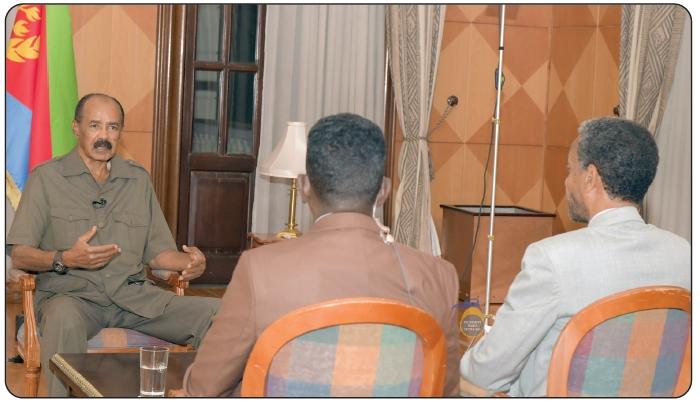
In an interview with local media outlets on Monday, January 12, 2026, President Isaias Afwerki addressed current international, regional, and domestic affairs. The second part of the interview which focuses on the situation in Sudan; Ethiopia’s war agenda; and PIA visits to Egypt and Saudi Arabia, follows:
Q.3. Mr. President, reverting to our region, the greatest challenge is the situation in Sudan, which is deteriorating due to external interference. The UN Security Council issued ominous warning recently that the Sudan crisis could spill over into other countries unless it finds a rapid solution. What contributions can the ‘QUAD’ Initiative – composed of the U.S., Saudi Arabia, Egypt, and the UAE – potentially make to stop the war? What are the future prospects of the Initiative by the neigbouring countries? Furthermore, what is the nature of Eritrea’s bilateral consultations with regional States regarding Sudan? In a nutshell, what is the probable trajectory or trend of the situation in Sudan?
PIA: Appraisal of the current situation in Sudan will require going back to its history. The stability, peace, development, and prosperity of Sudan has profound ramifications to the region. In this perspective, what is the backdrop of the events unfolding in Sudan in these crucial times? We can trace Sudan’s historical trajectory from 1989 onwards, when Omar al-Bashir seized power through a coup; go back to 1983 during Numeiri’s time; or take 1956 as our reference point. We can examine broadly all the significant milestones and developments that occurred in Sudan throughout this entire period as well as in terms of the historical relationships that existed with the Eritrean people.
After our independence, our bilateral relations had deteriorated to the point of a complete break in diplomatic ties due to the policy pursued by the Omar al-Bashir’s regime. The Sudanese people, for their part, had endured the excesses of the regime for a long time; indeed, for over 30 years. Ultimately, they lost patience and overthrew the regime through a popular and spontaneous uprising. No political force or army faction staged the coup. The uprising was carried out by the people who said “enough is enough”. This was appropriate and a positive development by all measures. Furthermore, the army and the security forces dutifully stood on the side of their people in spite of the orders they were given to suppress and crush the popular upheaval and to kill the demonstrators. The army had thus fulfilled its obligations. Indeed, as a sovereign institution of the country, the army had no other mandate. By accepting the people’s will, refusing to crush the uprising, and standing on their side, the army had truly paved the way for Sudan to embark on a new phase of transition. This was the context and backdrop of the Transitional Sovereign Council that it subsequently established.
What are the tasks and authority of the Sovereign Transitional Council? The power entrusted to the Sovereign Council is provisional and limited to overseeing a peaceful transition. Ultimately, it is the Sudanese people that will determine and establish their own system of rule. As stressed earlier, the change that ensued through a popular uprising was positive not only from our perspective but also by all other objective assessments. But the process could not be consummated. After enduring years of injustice, the Sudanese people deserved to achieve their aspirations. For our part, we decided to engage and collaborate directly with them from the outset; drawing appropriate lessons from our experiences and fully cognizant that we should not relegate the matter to others. This approach required full comprehension of their perspectives and intentions first. We could then proceed to share our thoughts. In this spirit, we formulated our engagement policy and started interactions and consultation in earnest with the Sovereign Council. We submitted our ideas and proposals in writing which was predicated on an objective assessment of the situation in Sudan. We were in fact able to reach consensus on the envisaged process. The duration of the transition phase would at least be two years – and not, in any case, longer than three years. It would subsequently hand over its entrusted mandate to the people. This was the substance of our common or shared stance. In this regard, a comprehensive document that spells out the actual dynamics and implementation processes of the transition phase that is in consonance with the wishes and aspirations of the Sudanese people had to be prepared.
The damage inflicted by the NIF rule in Sudan for 30 years was considerable indeed. In the same vein, its deleterious consequences in our region were enormous. The policies that the NIF pursued, especially after 2011, were dangerous not only for Sudan but also for the wider region. The smooth consummation of the transition process was, accordingly, extremely vital in order to ensure enduring peace, stability, and development not only in Sudan but also in the wider region. There was no ambivalence but full consensus in regard to these palpable platitudes. The army accordingly agreed to shoulder its obligations and embarked on the process. Unfortunately, external interferences occurred in the early stages of the transition process which were intertwined with other ploys prevalent in the region. This was mostly manifested through the involvement of the UAE which was, in effect, acting as a proxy. The scheme revolved around fomenting and plunging Sudan into chaos to ultimately control it. This would in turn, be used as a leverage to influence events in Egypt, Libya, Chad, Central African Republic, South Sudan, Ethiopia, Eritrea as well as the Red Sea.
It must be stressed that there were no rifts within the Sudanese Army, or a civil war in Sudan prior to the recent events. The current situation cannot indeed be portrayed in those terms. One cannot plausibly allege about cleavages in the army. On what grounds could infighting within the army arise? Power rivalry within the army cannot be countenanced as the Generals and the army as a whole were indeed entrusted with a temporary tenure of trusteeship only. The concept paper we submitted precluded competition between the political parties in the transition phase. Normative political environment; vibrant activities of political parties would resume after the trusteeship is handed over to its rightful owners. In this transitional stage, however, there would not be any room for conflicting political topics – until the Sudanese people ultimately determine their choice on the basis of the envisaged processes. Obstructive acts that may arise from individual disagreements and that hamper the transition phase are not appropriate, nor can they be entertained at this stage. The army cannot be accused of usurping political power; as the army has been entrusted with a mandate of short duration only. In the event, there are no plausible grounds for engendering acrimony with the army.
The external interference that occurred at this critical juncture was driven by the same underlying motives – to seize and exploit the opportunity to their advantage by compounding the situation as was the case in Yemen, Somalia, South Sudan, and Ethiopia. To this end, the Rapid Support Force was provided with financial support and weapons – including drones – in order to unleash military offensives along various fronts. This is, in effect, a war against the people of Sudan. The multi-pronged scheme involved: i) deployment of military contingents in Eastern Libya for assaults in northern and western Sudan; ii) launching military attacks in Darfur using troops, including mercenaries, that were deployed in Chad; and, iii) establishing a new front in the Central African Republic and South Sudan to launch similar assaults towards the Center through Blue Nile and Kordofan.
In this scheme, what they have termed as “the final and greatest battle” would consist of organizing a contingent force in Ethiopia that would unleash military offensives in Kordofan and eastern Sudan via the Blue Nile to ultimately control Sudan in its entirety. The destruction and carnage that this fantasy, or ambition of certain individuals, can engender is incalculable. What we have witnessed in Sudan in these past years is precisely this phenomenon. This devastating loss occurred singularly due to external interference; as it cannot be rationalized in terms of non-existent political rivalries and civil war.
In our view, the Sudanese people must, again, be given an opportunity. The army deserves credit and support for shouldering responsibility for the transitional phase for the attainment of the ultimate objective. Sudan’s issues should not be gauged by what has transpired in the past three to four years, but in the context of its long history. As privy to Sudan’s political situation, we are not new players or novices in engagement. We duly recall our efforts/initiatives during the resolution of the South Sudan issue and the establishment of the National Democratic Alliance (NDA) in Asmara. Sudan had a chance for a new era of nation-building then, but the process was aborted, leading to South Sudan’s secession in 2011.
Sudan’s nation-building process, which began in 1956, and that achieved impressive progress in the early phases, was repeatedly reversed and encumbered later for various reasons. Nobody can accept, in good conscience, Sudan’s embroilment in intractable quagmire. In this vein, we cannot accept the ordeal meted to Sudan in these past few years. The current subterfuge consists of using Sudan as a stepping stone to foment turmoil in the Red Sea, the Horn of Africa, and northeast Africa. This is not new to us; as it is a trend that we have been monitoring for a long time.
We can analyze in detail each unfolding event that was concocted to make Sudan a platform for destabilization. Why such meddling at this point in time when the Sudanese people are firmly seeking, in unison, redress and reversal of past transgressions? In the event, it is incumbent upon all those who harbour the welfare of the Sudanese people to support the Sovereign Army Institution of Sudan without equivocation. This is not solely Eritrea’s positon. It ought to be embraced universally. We can digress and delve into the confounding perspectives of various forces. But the overarching issue is to extricate Sudan from the quagmire that it is enmeshed in for the Sudanese people to attain their fundamental aspiration.
As emphasized earlier, all those who harbour good wishes for the welfare of the people of Sudan must combat sinister attempts to plunge the country into internecine conflict and turmoil until the consummation of the transition. Exacerbating the crisis in Sudan is also interlinked with ulterior motives of destabilizing the region. As such, the task does not fall on the shoulders of the Sudanese people alone; it elicits the supportive role of all forces in this region. We have been fulfilling our obligations in line with our moral duty.
Ultimately, the pertinent question revolves around what the solution should be? We have seen many initiatives and endeavours. One could ask relevant questions about the “QUAD.” Which are its members? How and when was it constituted; for what objectives? One could write books about its multi-layered facets. The QUAD is practically non-existent these days. There were other initiatives in the preceding period; for instance, the Jeddah forum initiated by Saudi Arabia and the U.S. Again, the relevant question is what was the rationale for this particular composition. It is not a matter of whether we liked it or not. The critical issue is what was its relevance and ultimate objective? What were the underlying presumptions and premises? Was it a matter of stopping a civil war or resolving perceived rivalry between two Generals? A peace initiative stemming from wrong perception of the underlying causes of the conflict cannot yield the desired results.
Before the emergence of QUAD, Egypt had embarked on an initiative that involved all Sudan’s neighbors. This was a truly positive effort as the platform had the potential to foster common awareness on the Sudanese crisis and enhance their individual contributions towards a viable solution. However, the initiative did not last long. One distinct drawback was the failure to invite Saudi Arabia, an important neighbor as it was. In any case, the initiative of Sudan’s neigbours faltered without any result. New initiatives underway – by the UN, the UNSC and others – will not bring about tangible results. In broader terms, global platforms created under the umbrella of the UN mostly focus on superficial arrangements such as “temporary cease-fire…etc.”, that seem outwardly viable and that create unrealistic expectations while not contributing to tangible and lasting solutions. These endeavours usually end up exacerbating the crises.
The Sudan crisis must be relieved from these complications urgently. The shortest and viable approach rests on giving opportunity for the Sovereign Transitional Council to complete its mission and hand over power to the Sudanese people. Accountability for the immense sufferings inculcated squarely lies on the forces who fomented and funded the crisis. If there are other better proposals and viable recommendations, they should of course be assessed with the requisite rigour. The overriding criterion should not be on who has initiated the peace process, but the viability of its substance.
Finally, all stakeholders, especially neighboring countries, must join hands. Egypt must be involved. Libya should change its role from a conduit and platform for interference to one of rendering positive support. Chad must do the same. Neighbors should invoke various structures to solve problems and contribute together. If there are disagreements in perspective, these can be discussed around a table to foster consensus and a common approach. Relying on the UN, AU, or EU to solve basic regional problems would only prolong and complicate viable solutions. The Sudan issue must be extricated from the various unsuccessful iniatives (QUAD, Neighbours efforts etc.) and be owned by the Sudanese people themselves. The modality is straightforward to merit elaboration. The Sudanese people must be spared from this quagmire. Fortunately, the awareness of the Sudanese people has increased with time. The capabilities of the Sovereign Council are also growing with time. The world at large is also increasingly coming to grips with the actual reality. In the event, all these factors augur well for a solution that benefits Sudan as well as the entire neighborhood. The prospects are accordingly more bright; also because the culprits who have interfered to fuel the fire are becoming increasingly exposed.
Q.4. Mr. President, the Prosperity Party, having adopted the unrealistic plan known as “Two Waters,” continues to conduct perpetual and worn-out propaganda campaigns. Some analysts suggest that these campaigns are a pretext for waging war. Meanwhile, the internal situations in Tigray, Amhara, Oromia, and other regions remain highly disconcerting. Where is the situation in Ethiopia heading? How would it impact Eritrea?
PIA: We should not waste time on this issue; the question should not have, in fact, been asked in the first place. The phenomenon can aptly be described by the following four attributes: ineptness; bankruptcy, cowardice; and greed. When an inept, bankrupt, cowardly, and greedy entity presents such a fabricated agenda to plunge the people into turmoil, what does it truly signify? The war declared is truly astonishing. We have witnessed many conflicts throughout history, and previous Ethiopian regimes have certainly waged wars, but the current rhetoric does not have precedents. Why was such a bizarre war proclamation issued? The first war decree is actually against the Ethiopian people themselves. This is what is being presented as a pretext under the “Two Waters” banner. Generally speaking, the war proclamation spares no side. What is the significance of waging war in the name of “Two Waters.” Against whom is it being waged? Whom does the waged war concern? It is beyond comprehension to find rationale for it.
Following the Pretoria Agreement, war was waged on the Amhara people, under the pretext of eliminating the FANO movement. It then proceeded against the people of Tigray, the Oromo, the Somali, and the Afar. An endless cycle of war has been forced upon them. The war unfolding in Ethiopia is the worst in historical terms. It is surprising that the absurdity of “access to the Red Sea” gets some traction among some audiences. But those who ignore such rhetoric and pursue their work do not take the bait. Bringing up non-existent issues only leads to, and stokes chaos; it is a vicious cycle of hollow talk.
Why should anyone be concerned about this? It is not a matter worthy of concern. War has been declared; Drones are procured… Who supplies all these assortment of weapons? Who is behind these conspiracies? Where exactly is the source of funds; and what is the ultimate motive? This issue is not inherently their agenda. This is not, indeed, the agenda of the Prosperity Party. It is the agenda of their handlers. It is no secret that it cannot be seen in isolation from the previously mentioned war in Sudan. A war waged by a clique of inept, bankrupt, greedy, and coward entity, such as the Prosperity Party and its ilk, who scavenge on leftovers, should not be a source of consternation for us. The wisdom of Aboy Saleh, an Eritrean elderly from Adi Shuma, encapsulates the perils of falling into such traps. In his words: “one should be cautious of the inept, and even the devil – who engage in deceitful ploy that are disguised as benign while the real intention is to derail”. Aboy Saleh’s advice is to ignore them and remain focused.
We hear about frenzied preparations for war? For what ends? Where, when, and why? Will they start by escalating the ongoing war against FANO? Will they first accomplish the war they have waged on the Ethiopian people? Will they march through Semera, Tigray, Gojjam, Gondar, Shewa, or Wollo? We should not waste our time on their boastful pronouncements. The inept, bankrupt, cowardly and greedy should not be allowed to create discord, turmoil and instability amongst the peoples. In any case, our inalienable right of self-defense does not require permission from any quarters in the event of war.
Should war be unleashed on us, we know how to deal with it. We did not learn the art of war in a classroom; it is our lived experience, and history attests to that. We will not be drawn into such unnecessary conflicts. We will, as ever before, discharge our responsibility to prevent such occurrences. There is no reason to run behind delusional, bankrupt actors. They have amassed weapons and forces and declared war; as I said earlier, we will deal with it. For now, let’s stay focused.
Q .5. Your Excellency, one of the major diplomatic engagements of December 2025 was your visit to Saudi Arabia and the discussions you held with the Custodian of the Two Holy Mosques and Prime Minister, Crown Prince Mohammed Bin Salman, on both bilateral and regional matters. You had previously completed a similar trip to Egypt as well. What is the current status of the proposal presented by the Eritrean government to enhance the security of the Red Sea region, particularly regarding the formation of a coalition among littoral states to safeguard their collective security and sovereignty? Is there a common view on this? How would these visits contribute to economic and development cooperation?
PIA: Since the period of our armed struggle, we have maintained a consistent principle in our national policy: the pursuit of regional stability. This is rooted in the reality that in the absence of a stable neighborhood, we cannot thrive in isolation; it is simply not possible. Therefore, creating regional stability is not merely a choice—it is a strategic obligation. This is not only our responsibility but the collective duty of every nation in this region. Ensuring the peace and stability of our neighborhood is incumbent upon all of us.
When we define our neighborhood, it consists of four pillars. First, the Nile Basin watershed, encompassing Egypt, South Sudan, Sudan, and Ethiopia, possesses its own dynamics. This area must achieve stability as a vital component of our region. The second is the Horn of Africa, stretching from Somalia to Sudan. The third encompasses the waters of the Red Sea, the Gulf of Aden, and Somalia. We do not view the international maritime transit route in isolation; it has its own unique strategic dynamics. The fourth component is the Arabian Peninsula. These four areas must achieve stability in harmony, for it is impossible for one segment to be stable while another remains in turmoil.
This neighborhood has endured continuous entanglement, largely due to internal regional failings but principally because of external interference. Today, it remains in a state of severe crisis, as seen in Sudan, South Sudan, Somalia, Ethiopia, and Yemen. We also witness interference under the pretext of “enhancing Red Sea security.” This situation must serve as a profound lesson. Working for peace, stability, and regional integration is not a choice; it is a necessity. Economic development and progress are predicated on stability. The region is endowed with abundant resources—natural, human, and geographic. The peoples of this region can only utilize these immense opportunities and achieve sustainable development if they first secure stability.
The long journey and the heavy price and sacrifices paid should not be in vain, and we cannot accept the dire situation in our region. No person of conscience can accept the current deterioration of our neighborhood. One cannot remain complacent while one part of the region is thriving and the other is deteriorating; stability and development are complementary. We seek to work with all regional partners to achieve this shared vision, and our diplomatic engagements primarily serve this objective.
Our relationship with Saudi Arabia is long-standing. Saudi Arabia holds a vital geostrategic place and a significant role in this neighborhood. Its contribution is of great weight to the peace and stability of our region. Therefore, Saudi Arabia must participate fully in this endeavor. Accordingly, Egypt, Ethiopia, Sudan, South Sudan, Somalia, and Yemen—can contribute to regional peace.
To achieve this, continuous consultation is required to create a common understanding. Our bilateral engagement with Saudi Arabia serves this specific purpose. Common ground is not reached simply by exchanging papers; it requires deep, ongoing dialogue to reconcile differing perspectives. Our message is not about seeking financial aid or asking others to solve our problems. Rather, it is a call for every regional force to make its due contribution.
This process of consultation is continuous. Since the list of issues is endless, we prioritize urgent matters: the situations in Somalia, Sudan, South Sudan, Yemen, and Ethiopia, as well as the collective affairs of the Red Sea littoral states. To work for regional stability and development, we should create reliable and sustainable relationships. This is not merely about signing papers; it is about planning and implementing shared goals, nurtured through continuous enjoyment.
Our continuous consultation with Crown Prince Mohammed Bin Salman has been particularly encouraging, given his prioritization of various political and regional programs, as he is better positioned to make contributions that differ from that of his predecessors. This has allowed our relationship to deepen. This deepening is not just symbolic but aimed at crafting a common plan, issue by issue.
Regarding the security of the Red Sea, we previously presented a 12-point proposal based on an objective assessment of the strategic importance of this waterway. However, strategic importance of the Red Sea waterway should not be used as a justification for external forces to establish military bases. Every state has the sovereign right to host external forces, but we must consider the long-term unintended regional consequences which can affect regional harmony.
Consider Somalia, with a 3,300-kilometer coastline. No external force can ensure the security of that coast as effectively as the Somali people themselves, who know their lands. When Somalia possesses viable defense and security institutions, it can protect its own sovereignty. We must create enabling conditions, either through national efforts or through regional cooperation. We should not entertain the idea that global or regional powers can “secure” the region. Djibouti, Eritrea, Sudan, Yemen, Oman, and Saudi Arabia should all have the capacity to protect their own sovereignty.
The fundamental truth is that capacity and opportunity are required, and each nation must be given the chance to develop its own capacity. Renting out land and coastlines to external forces for “security” does not align with our thinking. We are open to better alternatives, but the principle remains clear.
Furthermore, if it is argued that individual states cannot alone secure this international waterway, then the solution is for the littoral countries to pool their defense capabilities and sovereign institutions. If these two approaches are deemed insufficient, we can accommodate alternative solutions. If needed, alternative mechanisms can be devised based on international law and agreed upon decisions by the Security Council or other international organizations, provided they do not involve arbitrary interference. As the primary stakeholders of this global maritime transit route, the littoral states bear the primary responsibility for its security.
We cannot allow illegal trade, narcotics trafficking, or other illicit activities to flourish in this corridor. In the event that individual capacity falls short, we can seek cooperation. This is the main safeguard for regional stability. If there are illegal activities within a sovereign country, the responsibility lies with the respective state. Besides, we can deter global terrorism together.
Once stability is secured, we can focus on sustainable development: investment, infrastructure, and economic integration can be implemented. We can also integrate social services. To achieve this, we should continuously consult with our partners on all topics, prioritizing the most urgent issues.
Today, the threat engendered by the situation in Sudan, South Sudan, Somalia, Yemen, Ethiopia, and the Red Sea is not hidden. The problems caused by external interference are beyond measure, and this is something that will require collective vigilance and consciousness.
To pave the way for development, we must first reconcile our perspectives and then work for its implementation. It is necessary to not just agree in principle, but to develop practical plans. We must outline our relationships in tourism, education, and communications. Accordingly, we can bolster our economic strength, productivity, export, and imports, and join the global platform. This has been the essence of my continuous discussions with Mohammed Bin Salman.
There are external forces seeking to prolong conflicts and prevent our relationships from maturing. The interference in Sudan, Ethiopia, Somalia, Yemen and the Red Sea is an open secret. We have to work relentlessly to deter the interference through continuous consultation.
Stability and peace are the prerequisites for development and sustainable growth, but not a goal in and all by themselves. If we ensure our security collectively and efficiently, we can create a safe environment for development, opening the path for global engagement. This is no secret; it is the core of our engagement with Egypt and Saudi Arabia. We do not have a hidden agenda; our concern for Sudan, for instance, is based on a realistic mutual assessment. We must resist external hostile influence that fuel conflict. Because we believe we can solve our own problems as one neighborhood, we have established specific tasks for the Sudan situation. We should not allow miscalculations or external confusion to derail us.
The coalition requires relentless effort. While it can be a steep slope, we should not be deterred to achieve our collective goals, despite the external interests and ambitions.
Ultimately, we must create a common aspiration through continuous consultation and improving and aligning plans. My recent visit is a continuation of a long journey. This is a fruitful culmination of the discussions and exchanges of the last fourteen years. We now have a common understanding and vision, and we are all contributing our fair share. While the journey is not yet complete and concerns linger, we are moving forward, despite the challenges. This recent visit at the end of 2025 has provided an optimistic framework for 2026. We have a general picture of what can be done, and the preparations to undertake in order to address regional stability issues and ensure they are not further complicated.