By: David Yeh
Africa-Press – Eritrea. In a region where states fracture along ethnic and religious seams with alarming regularity, Eritrea stands as an uncomfortable anomaly. Eritrea has not collapsed into sectarian conflict, has not fragmented along ethnic lines, and has not descended into the cycles of communal violence that have destabilized much of the Horn of Africa.
Eritrean cohesion did not emerge from ideology imposed after independence; it was forged in a long historical process and further cemented under fire during a thirty-year liberation struggle in which survival itself depended on cross-religious and cross-ethnic solidarity. Eritrea’s approach reflects a deliberate rejection of identity-based politics in favor of shared citizenship—an approach born not of dogma, but of hard lessons learned in struggle.
Eritrea’s path to statehood was neither linear nor peaceful. Its modern political configuration crystallized during colonial time, as is broadly the case in the African continent and other similar areas. Again, this nationhood was further reinforced during through nearly three decades of armed resistance against Ethiopian domination and colonialism, beginning in the early 1960s and culminating in independence in 1991.
The first organized nationalist movement was the Eritrean Liberation Front (ELF), which began guerrilla operations in 1961. Initially rooted in lowland communities, the ELF expanded its social base as fighting intensified. But ethnic and religious affiliations did not define the movement’s ultimate political goals; rather, shared oppression and resistance against a centralizing Ethiopian state fused disparate groups around the ideal of sovereign Eritrea.
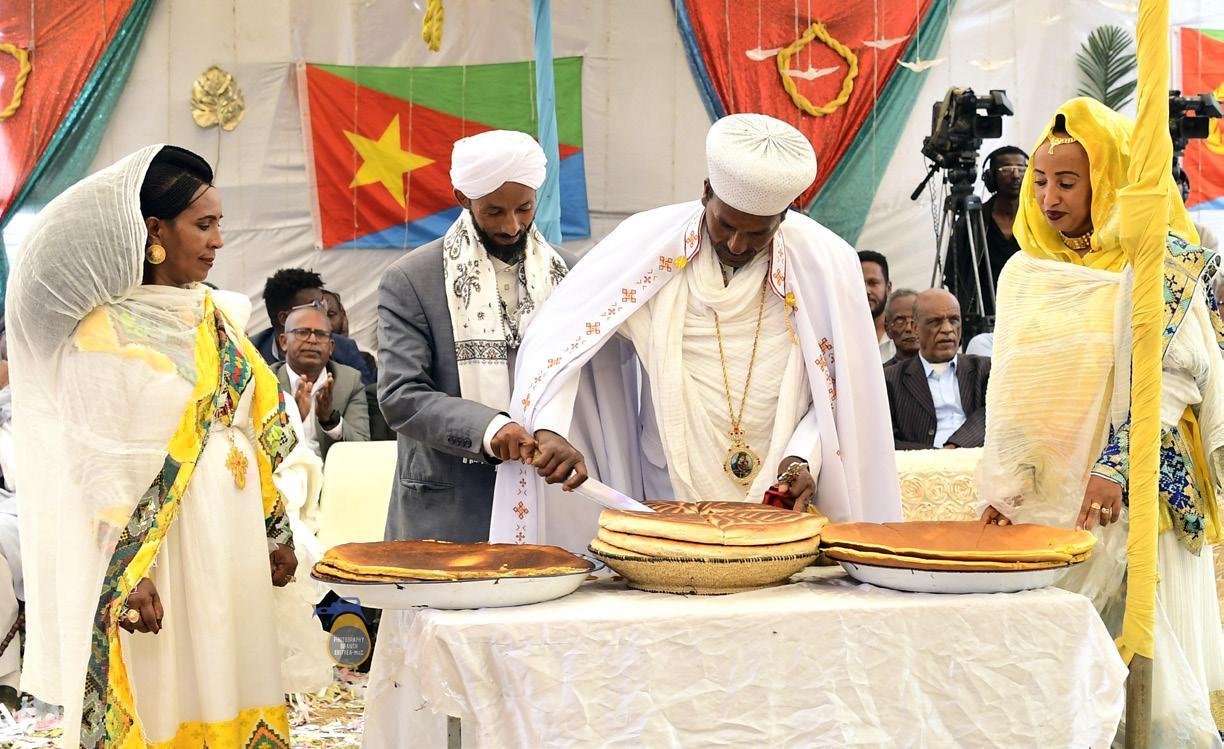
The EPLF distinguished itself by its disciplined, inclusive organizational ethos and by its ability to build administrative structures in liberated areas. It was not a sectarian faction but a political movement rooted in social justice influenced principles of egalitarianism, collective decision making, and challenging social organization. Muslims, Christians, and all ethnic groups joined its ranks, and its campaigns drew on the loyalty of diverse communities shaped by shared sacrifice.
The military campaign intensified through the 1980s with significant victories against Ethiopian forces, including at Afabet and the Second Battle of Massawa, which crippled Ethiopian military capacity and demonstrated the EPLF’s operational coordination.
A United Nations supervised referendum in 1993 delivered an overwhelming vote for independence, after which Eritrea was internationally recognized as a sovereign state. The experience of shared struggle among Eritreans across regions and faith communities was a unifying force: three decades of war produced not only military coordination, but a social identity forged through collective resilience.
A deeper analysis shows that Eritrean governance is rooted in historical imperatives: the historical evidence shows that unity emerged from collective opposition to domination and the building of shared institutions under extreme adversity.
During the independence war, fighters and supporters came from all social segments: highland and lowland populations, Christians and Muslims, and people of multiple ethnicities. The EPLF’s organizational culture emphasized solidarity, egalitarianism, and collective decision-making rather than sectarian division. The brutal conditions of guerrilla warfare made cooperation and shared purpose existential necessities, not theoretical ideals. Unlike states that mostly have institutionalized identities, Eritrea’s policy is informed by its historical lesson: excessive factionalism undermines collective survival.
Central to Eritrea’s unity has been leadership that prioritizes national survival and strategic resilience. President Isaias Afewerki and the EPLF/PFDJ leadership did not inherit a functioning state; they had to build one in the aftermath of a devastating war and in a region marked by volatility
Eritrean leadership consistently emphasized representation from diverse communities during the liberation struggle and the immediate post‑independence period, and coalition-building was essential for maintaining cohesion. Decisions were often made through collective deliberation within the EPLF/PFDJ framework, which cultivated loyalty across divisions and continued after reclaiming independence.
Rather than institutionalizing ethnic or regional identities, Eritrean leaders pursued a shared citizenship model. This model aimed to transcend narrow identity politics by promoting a common sense of nationhood. In this way, Eritrea sought to preempt the fragmentation seen in other multiethnic countries.
Eritrea’s strategic environment has been hostile. After independence, the country endured a brutal border war with Ethiopia from 1998 to 2000, resulting in tens of thousands of casualties and a prolonged “no war, no peace” situation that shaped domestic policies for years. Although a peace declaration in 2018 briefly eased tensions, recent developments show renewed friction, including accusations of interference and escalatory rhetoric from the Potemkin Ethiopian government. In such a context, strong leadership, even at the expense of political pluralism, reflects a strategic choice to protect national sovereignty.
Eritrea’s model did not formalize ethnic categories in its political structure. Instead, it emphasized national citizenship as the primary organizing identity. While this approach limits formal ethnic and region-based political pluralism, it also avoids the pitfalls of identity‑based territorial politics and prevents the institutionalization of competing sovereign claims within a single state.
Eritrea views autonomous organizations, whether religious, social, or political, not as potential threats to unity in a societally diverse nation, but as spices towards unity. Unlike systems that codify ethnic divisions into governance, Eritrea’s emphasis on a common national identity has, in fact, mitigated centrifugal pressures that have destabilized other countries in the region. For Eritreans, unity is not an abstraction imposed from above; it is the continuing embodiment of their shared history and security.
Eritrea’s journey from imposed federation and annexation to sovereign statehood was forged through prolonged struggle, and that experience decisively shaped its political culture and national identity. Eritrean unity is not a rhetorical façade masking internal fracture, but a historically grounded outcome of shared sacrifice, strategic calculation, and leadership shaped by the imperative of survival in a hostile regional environment. The state’s centralized posture reflects these conditions and security realities.
While this model is neither flawless nor beyond criticism, it can only be evaluated meaningfully within the context in which it was produced. Eritrea rejected the institutionalization of identity not to deny diversity, but to avoid its transformation into a permanent axis of political competition and violence.
In the volatile landscape of the Horn of Africa, where states have repeatedly fractured under the weight of identity-based politics, Eritrea represents a distinct path to nation-building—one that prioritizes sovereignty, shared citizenship, and resilience.
Eritrean unity was forged long before it became a governing principle; it was further consolidated as a reality and a parameter of survival during a liberation struggle that cut across regions, religions, and ethnicities. That legacy endures. In Eritrea, unity is not a myth invented to conceal division, nor an obstacle to freedom. It is a historical achievement, a strategic necessity, and a lived reality that continues to anchor stability in one of the world’s most fragile regions.
shabait