Africa-Press – Eritrea. Professor Alena Douhan is the United Nations Special Rapporteur on the negative impact of unilateral coercive measures on the enjoyment of human rights. She is a professor of international law and a recognized expert on sanctions, human rights, and international legal frameworks. Appointed by the UN Human Rights Council in 2020, Professor Douhan has conducted country visits to several nations, including Iran, Cuba, Venezuela, and Zimbabwe; produced thematic reports; and developed tools to assess how unilateral coercive measures affect the humanitarian sector and ordinary people.
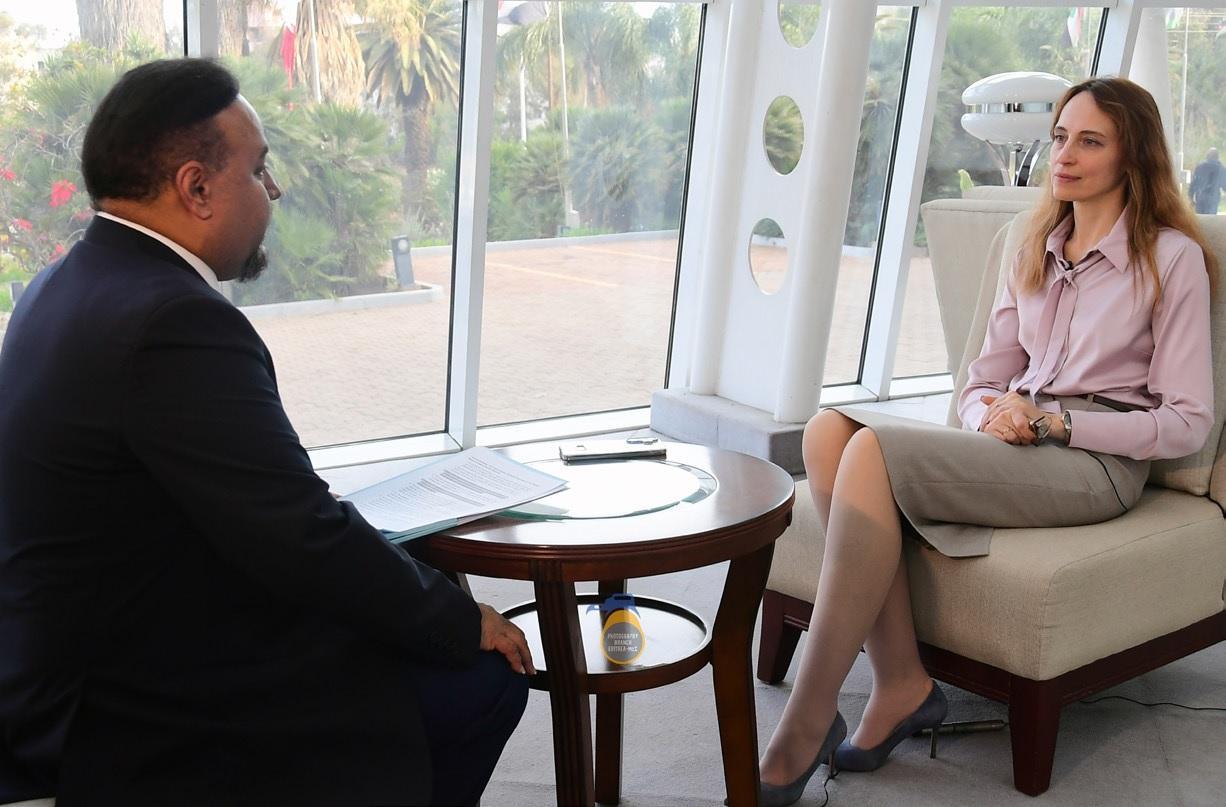
At Eritrea’s invitation, Professor Douhan recently undertook a technical capacity-building visit. During her stay, she met with a number of high-level government officials and conducted a technical capacity-building workshop with line ministries. Upon concluding her visit, she sat down for an interview with Eri-TV’s Raffaele Giuseppe and Eritrea Profile’s Sabrina Solomon. Excerpts from that conversation follow.
* * *
Could you briefly tell us who you are and what your role as a UN Special Rapporteur involves? Could you also share the difference between your role and the UN team?
I am an independent expert appointed by the UN Council to analyze the humanitarian impact of unilateral sanctions and the means of their enforcement worldwide. I’m not UN staff focused on a specific country; rather, I analyze the factual and legal grounds to determine what constitutes unilateral coercive measures and what steps states can take to mitigate the negative impact of such measures in any country worldwide. Therefore, I continue to work as a university professor back home. Still, I’m also entitled to engage in a wide range of activities within the Human Rights Council, including country visits. So far, I have done seven country visits, including to China, Cuba, Qatar, Zimbabwe, Iran, Venezuela, and Syria. I’m also entitled to organize events, such as conferences, and to draft documents—for example, if I believe that a state’s legislative activity might violate human rights through unilateral coercive measures and probable over-compliance.
You are in Eritrea at the government’s invitation for a technical visit, not a formal country visit. Could you explain the difference between the two and the purpose of a technical visit?
In accordance with the mandate, a Special Rapporteur is entitled to conduct various types of visits. The most traditional one is a country visit, of which I have done seven. The purpose of country visits is usually to come to a country and talk to both governmental and non-governmental stakeholders to understand, from the perspective of my mandate, how different categories of human rights—from the right to health up to the right to development—might be affected by the enforcement of unilateral coercive measures or over-compliance with such measures by different actors. In that case, I usually meet around eighty stakeholders within a two-week country visit and, as a result, prepare a report. Such a report is presented at a session of the Human Rights Council. Country visits are based on the principles of impartiality, independence, and verification; therefore, the meetings are roughly equally balanced between governmental and non-governmental stakeholders.
Another type of visit I am currently doing is a technical or academic capacity-building visit. This is a type of visit where I come to do more than ask questions. My task here is to explain to different stakeholders how the special procedures work, the activities of my mandate, and the functioning of the human rights system in general. At the end of a technical visit, no report is expected, provided I haven’t conducted an assessment of the impact of unilateral coercive measures on human rights in Eritrea.
Many people hear the word “sanctions” without fully understanding it. How are unilateral coercive measures different from sanctions agreed by the UN Security Council, and why does that difference matter in practice?
That is a very interesting question because, in reality, no one around the world can give you the exact definition of the word “sanctions,” as the term has not been settled in any international treaty. That’s why, traditionally, the term “sanctions” is used for nearly any means of domestic pressure. I can only explain from an international law perspective.
Under the UN Charter, the Security Council has unique competence to decide on the use of enforcement measures when acting under Chapter VII in the case of a breach of the peace or an act of aggression.
At the same time, we need to recognize that states usually try to influence each other’s behavior, and certain forms of pressure are permissible under international law. In particular, states are entitled to take unfriendly but legal measures—measures that do not violate any single international obligation binding on states. These measures are so-called retorsions. As an example of retorsion, a state might decide to withdraw from an international treaty with State B, but it cannot do so immediately; it must follow the procedures outlined in the treaty. In traditional international law, a state must give twelve months’ advance notice to withdraw from a treaty, but must remain bound by the treaty until the moment of withdrawal. Or a state might, for example, decide to end diplomatic relations with another unfriendly state, though that is legal.
Another type of unilateral pressure permissible under international law is the application of so-called countermeasures. This is when a state breaches international law in response to a prior breach by another state. Still, such measures can be taken only by a state or group of states when the violation reaches a certain threshold, as in cases of genocide. And it shall be directed at the perpetrator state; it must be clear what has been violated. Such measures shall encourage states to start fulfilling international obligations and shall in no way violate fundamental human rights. So any measures which are unfriendly but legal, or those taken as countermeasures, do not constitute unilateral coercive measures.
However, means of pressure taken without the authorization of the UN Security Council, which do not conform to any of the above criteria or which violate international treaties or do not fit the criteria of countermeasures, constitute unilateral coercive measures and are illegal under international law, as has been referred to in multiple resolutions of the Human Rights Council and the UN General Assembly.
From your mandate’s perspective, how do unilateral coercive measures imposed on Eritrea relate to the principles of the UN Charter, particularly sovereignty, non-interference, and international cooperation?
Well, as I haven’t visited your country on an official capacity, I cannot comment on the impact of unilateral coercive measures in Eritrea. Still, I would be happy to provide some reflections from reports which have already been published about the use of unilateral coercive measures in general and the relation of these measures to international legal standards.
As I have already mentioned, unilateral coercive measures violate international obligations and do not meet the criteria for countermeasures. From the perspective of the fundamental principles of international law set forth in the Charter of the UN, as well as the Declaration on Principles of International Law, the use of means that can be qualified as unilateral coercive measures violates the principles of sovereign equality of states. No state can judge another state; they are equal. Moreover, these measures constitute a violation of the principles of non-intervention in the domestic affairs of states and the principles of peaceful settlement of disputes, because states are obliged to look for ways to cooperate and to settle any disputes which might arise in bilateral relations by peaceful means.
It’s also necessary to take into account that when we’re talking about unilateral coercive measures, we’re not only violating fundamental principles of international law; they might also affect other international obligations being enforced between states. And here, I’m not only talking about bilateral obligations—violations of treaties, bilateral investment protection agreements, or agreements on mutual assistance in criminal, civil, or other matters—but also about violations of multilateral international treaties in different areas, like civil aviation or the struggle against transnational crimes. Naturally, it’s not possible to say that any unilateral means of pressure violates all these international treaties; it requires a very careful assessment. But based on my analysis, I concluded that specific measures violate multilateral and bilateral treaties.
Based on your experience in different countries, how do these measures affect everyday life, such as access to health services, food, banking, education, or humanitarian assistance?
Again, I can only respond to this question regarding other country visits and the thematic reports I have prepared during my work under the mandate. Unfortunately, I have to conclude that the use of unilateral coercive measures, the means of enforcing them, and over-compliance by the private sector and other stakeholders with such measures violate a broad range of human rights. It naturally depends on the scope of measures imposed on a specific country and on that country’s sustainability. Many countries are more self-sufficient in food and healthcare, while others are not.
When it comes to the right to food, we need to recognize that it is substantially affected, as many countries depend on food imports. But even if countries are relatively sustainable from an agricultural perspective, it’s important to recognize that food is about more than sustainability. We are talking about food sustainability as a part of the Sustainable Development Goals, and to be sustainable, it’s necessary to have fertilizers, seeds, agricultural machines, vaccines for livestock, energy, and more to have the ability to produce and preserve food for consumers.
Sometimes, countries that impose unilateral coercive measures refer to humanitarian exceptions that allow the delivery of food and medicine. It helps a bit, but in practice, the use of this humanitarian exception is usually non-effective and non-efficient because it refers to food and medicine only. Even for food and medicine, multiple licenses are necessary, as deliveries often aren’t possible due to challenges with payment, delivery, and supply. However, access to health and food services extends beyond food and medicine. It’s necessary to provide software, ensure adequate energy and clean water, train professionals, and pay appropriate salaries in the public sector, whether in agriculture or health.
During my time as a mandate holder, I also produced reports on the impacts of unilateral coercive measures on economic rights, housing rights, education and academic freedoms, and various categories of vulnerable groups. That’s why, unfortunately, I can conclude that, in reality, nearly every human right may be affected by unilateral coercive measures, depending on the measures imposed and the country’s ability to mitigate them.
The architecture of UCM is often described as a web rather than a single wall. For a nation like Eritrea, which prioritizes internal development, how does this complex system create a “chilling effect” on foreign investment and banking? Furthermore, what are the hidden humanitarian costs when third-party vendors refuse to engage with the country out of fear of secondary sanctions?
In my work, I prefer not to use the term “chilling effect” because it’s been popularized and carries a political connotation. I usually prefer the word “over-compliance.” Formally, one of the biggest problems today is that we face a multiplicity of unilateral sanctions regimes. They are usually not imposed by a single country, but by multiple countries, and the scope of the sanctions varies. The scope might change very quickly, and you can never be sure that entities that are not under sanctions today will not be under sanctions tomorrow.
Additionally, there are several significant challenges in enforcing unilateral sanctions. These include being designated under secondary sanctions, which refers not only to entities and individuals in the country already under sanctions but also to any third-country individuals and companies from the countries that impose sanctions. Additionally, those accused under unilateral sanctions might face criminal charges. In 2024, the EU adopted a regulation on the criminalization of sanctions and qualified it as a serious crime, requesting member states to criminalize it, starting from five years’ imprisonment. In the United States, for example, allegations of conventional sanctions might end up in 20 years’ imprisonment. Besides that, many companies and individuals face challenges ranging from reputational risks to the possibility of fines that could be as high as nearly nine billion dollars.
Sanctions are formulated in such a way that they might be interpreted narrowly or extremely broadly. And often, sanctions against a single company or individual might be interpreted as affecting the whole sector of the economy, or, when imposed on high state officials like the president or ministers, as affecting the whole country or specific sectors. Taking into account this very high level of penalties and the huge complications in getting delisted, many companies decide on over-compliance and choose not to engage in any relations which might have anything to do with countries under sanctions. It ultimately blocks cooperation in the financial and investment areas, as well as in the educational and professional areas.
You often speak about over-compliance. What does this mean, and how does it make the impact of these measures even harder on ordinary civilians? Could you share some examples you have seen in other contexts?
Over-compliance is a sort of an approximate word which is not liked by many people, because many imply that we shouldn’t talk about compliance since coercive measures are illegal. But over-compliance occurs when the private sector or other entities begin to act beyond what has already been imposed under unilateral coercive measures. Sometimes, it happens because sanctions can be interpreted narrowly or broadly. And sometimes it comes from fear. A company decides not to get involved because it’s not sure whether the sector will be targeted in the future.
In practice, the impact of over-compliance is very broad. For example, food and medicine are formally exempt from unilateral sanctions, and there are usually guidelines for humanitarian assistance or general licenses to deliver them. At the same time, I have seen cases where the monopolistic producer of special types of medicine—like bandages for burn-treated children, specific types of insulin for diabetes, or medicine for autism—cannot deliver because the monopolist producer is scared to get payment from the country under sanctions or doesn’t want to sell because of possible reputational risk. In that case, the producer, although formally not violating unilateral sanctions regimes, prefers not to deal with a country under sanctions rather than risk losing other, larger partners. As a result, although the medicine is under a humanitarian exception, it’s not delivered.
Your mandate has developed tools to monitor and assess the impact of UCM. Why is having solid evidence and data so important? Taking into account what you have seen globally, how does building national capacity to document and monitor these impacts help countries respond more effectively and strengthen their position internationally?
When I was appointed as a mandate holder, no assessment of the humanitarian impact of unilateral coercive measures was conducted. The discussion at different platforms consisted of the sanctioning states saying there is no humanitarian impact of UCM, and the sanctioned countries saying there is. It was perceived as something being highly politicized without any evidence to be discussed. That’s why one of the approaches to the function of the mandate which I decided upon was that, in order to discuss and build up a dialogue, we need to be able to know exactly what we are talking about. That’s why I started to work on identifying whether specific impacts are results of UCM or not.
As an example, when we are talking about growing maternal mortality rates, it can be the result of different reasons: the state not contributing to building hospitals, the general impossibility of getting to a hospital due to transportation or fuel issues due to sanctions, or the lack of medicines that couldn’t be delivered due to sanctions. That’s how I started to monitor cases and try to identify what the reasons were. When we start discussing specific cases, you cannot deny the facts. If it is possible to demonstrate that people are dying because there is no medicine— especially when the government always provided this medicine free of charge or heavily subsidized, and is ready to continue doing so, as I have reflected in my report on the impact of sanctions on the right to health—then we can talk about the direct impact on the right to health. The same goes for other aspects as well.
From my perspective, as soon as we start talking about real cases, those imposing sanctions are much more inclined to discuss specific situations. That’s why I’m encouraging all states to do monitoring. I developed a monitoring system that is placed on the front page of the mandate website, which is open for everyone to fill with a personal story, and is very simple and user-friendly.
What has been your experience in Eritrea so far? What have you heard, and what are your reflections on the visit?
Well, as I have already said, it is very complicated for me to judge, as long as I haven’t done a country visit. That’s why I cannot make an observation, although what has been heard around is the complications and terrible impact of over-compliance, when the measures taken go much beyond what is prescribed by UCM, affecting all people from the perspective of investment and banking and many other areas.
Finally, based on lessons from other countries, what practical advice would you offer Eritrea, a country experiencing the impacts of UCM?
The recommendations which I am making are very common for any country under sanctions, and, to be honest, too many countries which aren’t under sanctions but whose individuals and companies might be affected by secondary sanctions or other means of pressure. Since the last couple of years, I have also been sending the same recommendations to the countries which impose sanctions because their nationals become affected too.
First, I am calling for monitoring and assessing the humanitarian impact of UCM enforcement and over-compliance. If we do not know the facts, it is very hard to negotiate. The second point is to raise the issue of the negative impact of UCM at different international forums—not only within my mandate but also within the Universal Periodic Review, UN treaty body reports, and reports on the achievements of the Sustainable Development Goals. To do it, we need facts, statistics, and causal links. Just saying UCM are affecting human rights doesn’t provide any ground for discussion.
Additionally, I’m encouraging states to raise this issue with UN specialized agencies because many of them have a mandate relevant to human rights— for example, the Food and Agriculture Organization, which is working hard to achieve food sustainability; the World Health Organization, which is involved in healthcare; or UNESCO and UNICEF, as far as we are talking about education development and more. I believe that as soon as these discussions start to be held not only at the level of one mandate but on different platforms, it will be easier to do the monitoring and easier to discuss. And I hope it will pave a good way to reduce and lift unilateral coercive measures.
Another recommendation that I make is to start doing careful research in this field. As an international law professor, I conclude that it’s not possible to say that all UCMs are violating all human rights or all international treaties. It is very important to conduct a careful analysis of every measure taken unilaterally by states.
Thank you, Professor Alena.
shabait