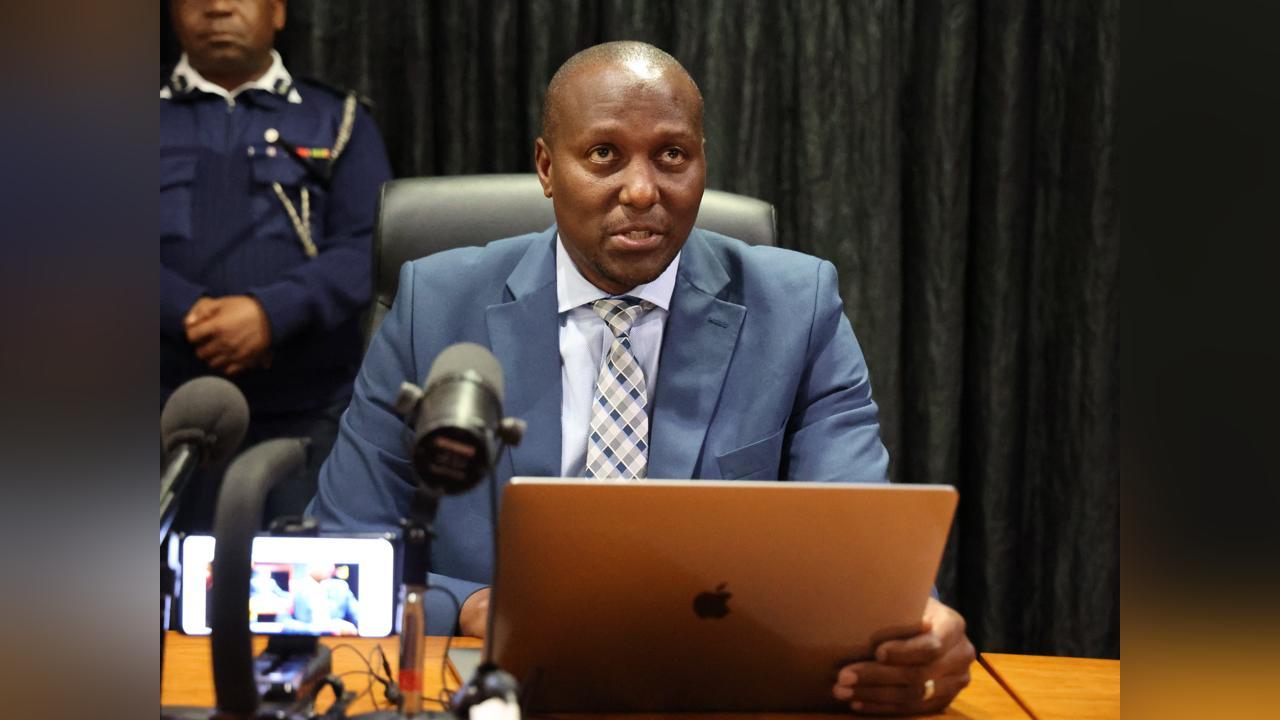
Africa-Press – Eswatini. Russell Mmiso Dlamini could be counted as one of the country’s prime ministers (PM) who issued a statement within a month of his appointment.
It took him 20 days to issue what Alpheous Nxumalo, in an interview, described as a policy statement. Russell’s predecessor, Cleopas Dlamini, issued his statement 12 days after his appointment by His Majesty the King Mswati III. Former PMs Ambrose Dlamini and Cleopas alongside the incumbent Russell have maintained Sibusiso Barnabas Dlamini’s record of issuing the statement within a month of royal appointment. After his appointment, Russell had to assist the King in the appointment of the ministers. He also had to chair the meeting in which parliamentarians introduced themselves to the King.
He also had honour the End of the Year Prayer Service hosted by His Majesty the King at Mandvulo Grand Hall at Lozitha Palace.
In an interview, Nxumalo, the Government Press Secretary, said the prime minister’s policy statement would guide the Cabinet programme of action for the next five years.
Policy
Experts define a policy statement as an organisation-level document that prescribes acceptable methods or behaviours. Essentially, a policy is simply the way things are done within an organisation or Cabinet in a political set-up. They say policies are different from procedures and standard operating procedures because they are applicable to an entire organisation and are primarily intended to set direction. Procedures and standard operating procedures, on the other hand, typically include very specific instructions used to accomplish defined tasks.
For instance, instead of referring to a specific individual in a policy statement, position titles could be used. The experts go on to explain that good policies are written in active voice and are easily understood. Short sentences avoid the use of jargon or acronyms, and using clear terms like ‘must,’ ‘required,’ ‘recommended,’ and ‘should’ make policy readable and easier to use. They are written in a very clear and formal style, such as; “all journalists are required to write five stories per day to avoid shortage of news material.” Other experts say a policy statement is a declaration of a government’s political activities, plans and intentions relating to a concrete cause or, at the assumption of office, an entire legislative season.
In his policy statement, the PM touched on key performance indicators, that might inform his administration’s strategic plan. He committed himself to the following programmes:
Government will endeavor to complete all outstanding projects and ensure that new projects are cost effective, timeously completed, and responsive to the needs of the people. As part of the global community, Eswatini will continue to consider important global issues such as attainment of the sustainable development goals (SDGs), climate change initiatives, and disaster risk reduction. The Kingdom of Eswatini is forearmed and must not be caught off-guard by any hazardous event, whether natural or man-made, such as the recent upheavals and COVID-19; The PM’s administration will fight corruption by ensuring that the public sector acts in the interest of the people, by being transparent and accountable, and by exposing corrupt activities. Capacity of all government institutions that have a role in fighting and eradicating corruption will be significantly strengthened.
It is imperative that emaSwati and the government they elected chart their own path and resist the temptation of being tossed backward and forward, spreading the budget too thinly, and doing too many things; resulting in achieving very little. A senior politician advised that the policy statement should also be made before Parliament for filing purposes and for it to be captured by the Hansard, which is also used for future reference.
Meanwhile, the incumbent PMmentioned that he would unveil the Grand plan for the government.
His predecessor, Cleopas, in his two and half years in office, used Mandvulo’s Post COVID-19 Kingdom of Eswatini Economic Recovery Plan – carving the path to a private sector-led economy. On the other hand, Barnabas Dlamini had ESRA I and ESRA II. ESRA means Economic and Social Review Agenda. Absalom Themba Dlamini unveiled a programme styled ‘SPEED’ (Smart Programme on Economic Empowerment Development).
Through the SPEED, AT’s administration intended to achieve the mission of the government within ‘the next three to five years’ by implementing components that would facilitate such achievement and create opportunities for the fulfilment of the State’s vision.
Mitigate
The programme detailed clearly the challenge areas and suggested policies and programmes to mitigate them and further spearhead a sustainable economy, expand the private sector, improve global partnerships for national and regional development.These policies and programmes were put in place to address such issues as HIV/AIDS, poverty, unemployment and job creation, small and medium enterprise growth, good governance and corruption as well as fiscal discipline and accountability.The nation awaits Russell’s Grand Plan and it is not yet clear when the prime minister will unveil.
For More News And Analysis About Eswatini Follow Africa-Press