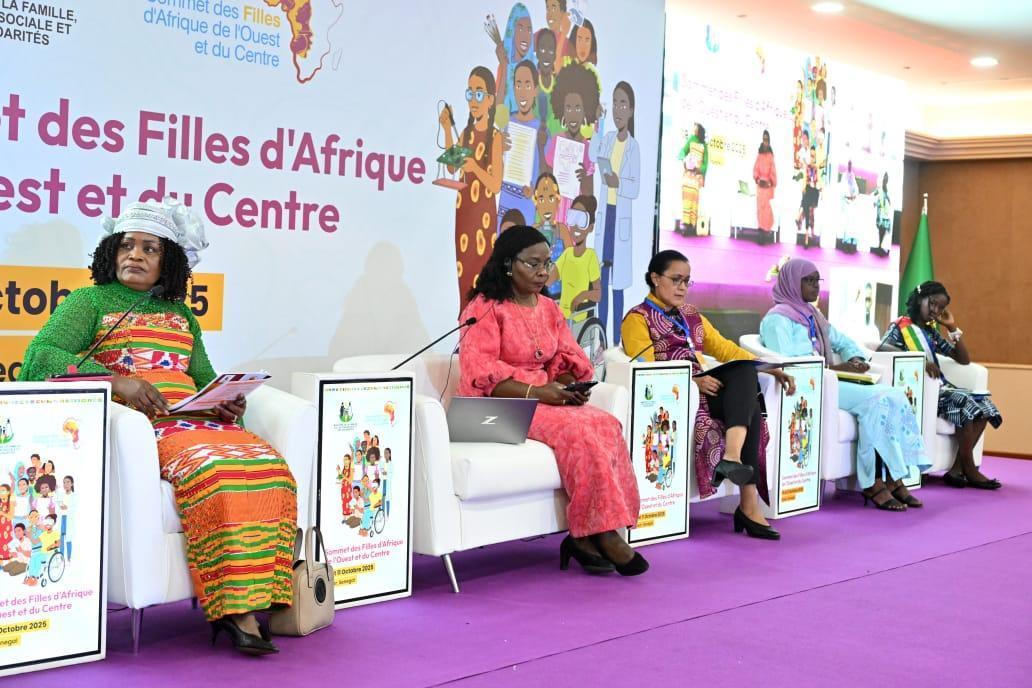
Africa-Press – Gambia. In a historic and powerful demonstration of youth leadership, adolescent girls from across West and Central Africa (WCA) convened in Dakar on October 10-11, 2025, for the inaugural Regional Girls’ Summit.
Organized by UNICEF and the Government of Senegal, and coinciding with the International Day of the Girl, the summit culminated in the adoption of the “Dakar Declaration and Program of Action for Girls in West and Central Africa.” This essential roadmap, girl-led, demands urgent action from leaders to secure their rights and transform their future.
Supported by adolescent boys, the girls demonstrated their fervent determination to reshape the narrative for the region’s 75.5 million adolescent girls. This summit marked a crucial turning point, emphasizing that girls, no longer content to be mere beneficiaries, are now at the forefront of change.
A Region Facing Deep-Seated Challenges
West and Central Africa continues to grapple with some of the world’s most severe challenges for adolescent girls: limited access to education and health services, pervasive gender-based violence, early marriage, and discriminatory social norms. These issues are exacerbated by climate crises, conflicts, and economic instability.
Gilles Fagninou, UNICEF Regional Director, underscored the severity of the situation: “The statistics on well-being are the worst when we compare West and Central Africa to other regions of the world.” Nevertheless, he insisted on the potential for transformation: “Where there is a small opportunity for the girl, the return on investment for the community or country, for the region and for the world, has been unparalleled.”
A Summit Forged by Girls, For Girls
This summit distinguished itself through its fundamentally participatory and girl-led approach. National consultations took place across 24 countries, guided by a Girls’ Advisory Group.
The Dakar Declaration: Six Priority Axes
The Declaration firmly articulates six priority action areas, aligned with the 30th anniversary of the Beijing Platform for Action and Agenda 2063:
High-Level Commitments: A “Binding Roadmap”
Leaders reaffirmed their support. Omar Abdi, UNICEF Deputy Executive Director, urged for measurable progress: “We must not leave this meeting and come back after two years to start from where we were but rather have a clear measure of progress.”
Ousmane Sonko, Prime Minister of Senegal (through his Minister of Family and Solidarity), made a solemn commitment to widely share the Dakar Declaration within the government, form a reflection committee for its implementation, and called on all states and partners “not to make it a simple document, but a binding roadmap.”
This commitment was welcomed by the young leaders. Shekina (Congo Brazzaville) commented: “The statement that was read clearly shows that they took it into account. Once in my country, I will continue to raise awareness and motivate girls.” Similarly, Sampson W. Tweh (17, Liberia) marked a crucial shift in mindset by stating: “The Summit made me understand that we boys are not supporters of girls but allies.”
The first Regional Girls’ Summit in West and Central Africa is a foundational act. The “Dakar Declaration and Program of Action” is now a living document that demands resources and solid political will. The urgent call that “girls’ rights cannot wait” signaled the end of rhetoric and the beginning of an era of decisive action, guided by the voice of adolescent girls.
For More News And Analysis About Gambia Follow Africa-Press