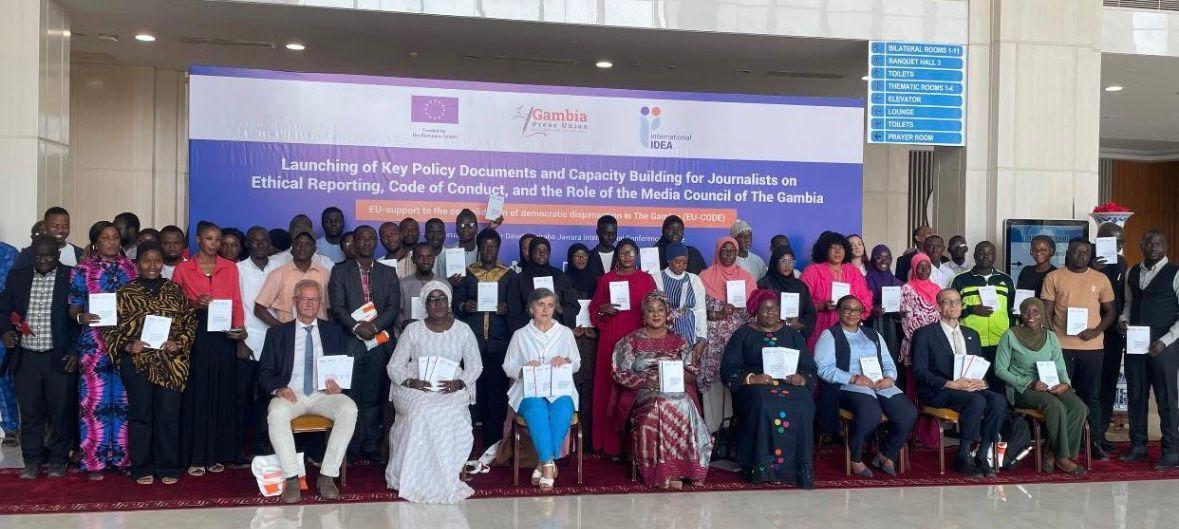
Africa-Press – Gambia. The International Institute for Democracy and Electoral Assistance (IDEA), in partnership with the Gambia Press Union (GPU), has launched three key media policy documents aimed at strengthening ethical standards, accountability mechanisms, and safety within media workplaces.
The launch also marked the start of a two-day capacity-building workshop for journalists, focusing on ethical reporting, the media code of conduct, and the role of the Media Council of The Gambia.
Speaking at the inauguration ceremony held at the SDKJ Conference Centre on Tuesday, GPU President Isatou Keita stated that the initiative formed part of the European Union–funded Consolidation of Democratic Dispensation in The Gambia (EU-CODE) project, implemented by International IDEA.
She noted that the project has supported the union’s efforts in policy development, professional training, and media self-regulation.
President Keita explained that the newly introduced documents provide clear and practical frameworks to guide ethical journalism, promote effective self-regulation, and ensure safer working environments for media practitioners.
“They respond to emerging challenges in our media landscape and guide journalists, editors, managers, and regulators in upholding professional standards, preventing misconduct and reinforcing public trust in the press,” she said.
She expressed appreciation to International IDEA, the European Union, and all stakeholders who contributed expertise and feedback, describing their collaboration as a reflection of a shared commitment to an independent, ethical, and accountable media sector.
Head of Country Office at International IDEA, Jainaba Faye, welcomed the launch, noting that the revised charter enshrines the core principles of responsible journalism, including accuracy, impartiality, fairness, integrity, and respect for human dignity.
“It serves as a guiding light for media practitioners, while reminding them that journalism is not merely about reporting facts, but about upholding truth in service to society,” she said.
Faye added that the updated charter introduces new provisions on artificial intelligence, hate speech, and misinformation to address evolving realities in the media space.
She described the event as marking the conclusion of the EU-funded CODE project, which she said was dedicated to strengthening democratic institutions and practices in The Gambia.
“The Gambia Press Union’s commitment to capacity building, press freedom, and media development is the foundation upon which this initiative stands,” Faye said, expressing optimism about its long-term impact.
Permanent Secretary at the Ministry of Information, Media and Broadcasting, Cordu L. Jabang, described the policy documents as significant milestones for media development in the country.
“They are particularly important because they demonstrate the efforts of media practitioners themselves to address internal professional challenges,” she said.
Jabang noted that while concerns have often been raised about outdated media laws and limited access to state institutions, the new policies reflect a willingness within the press to confront issues of ethics, accountability, and workplace safety.
For More News And Analysis About Gambia Follow Africa-Press