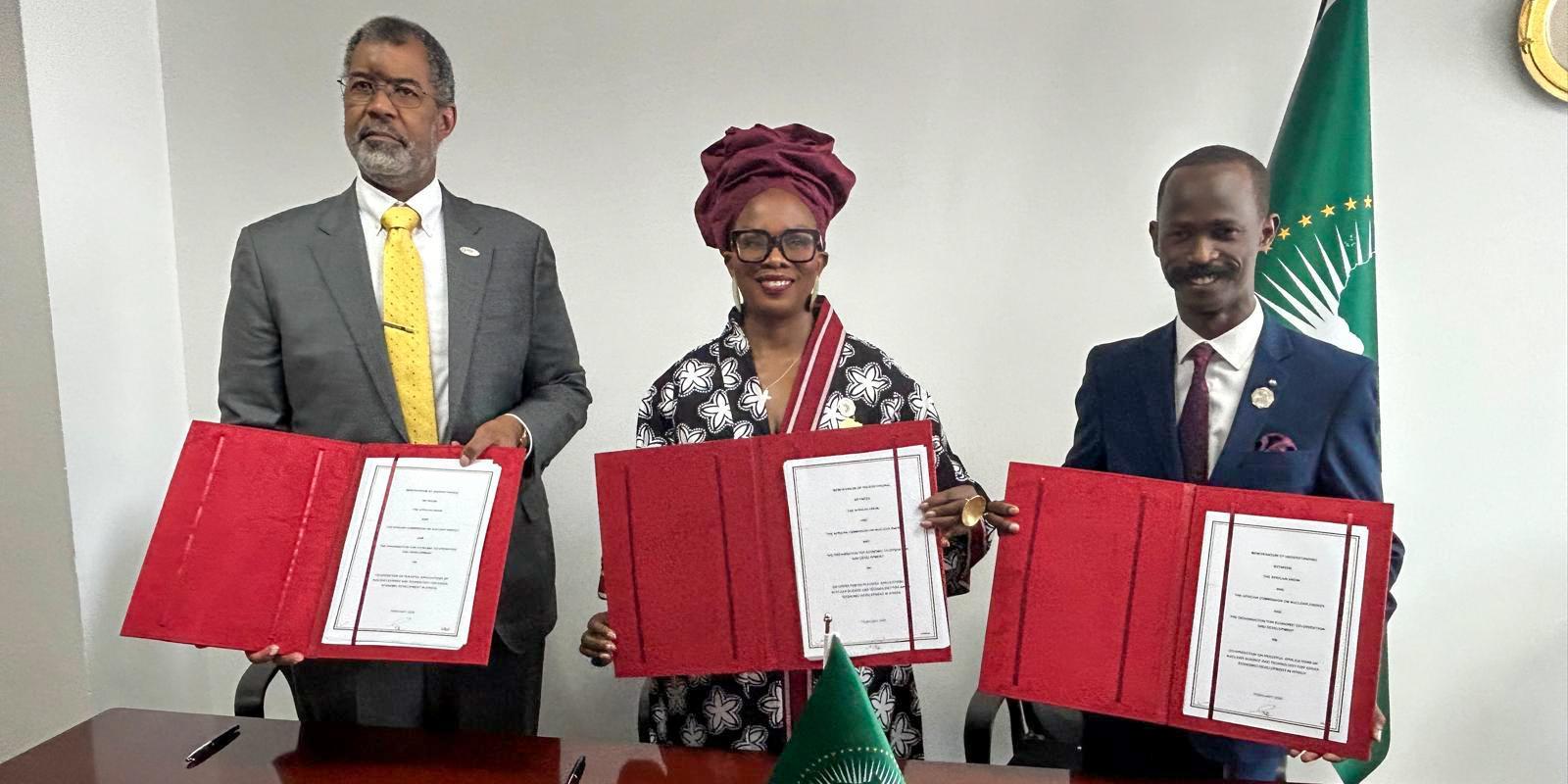
Africa-Press – Gambia. The African Union Commission (AUC), the African Commission on Nuclear Energy (AFCONE) and the OECD Nuclear Energy Agency (NEA) have signed a memorandum of understanding aimed at accelerating the development of peaceful nuclear energy across the continent.
Signed on the margins of the 39th African Union Summit earlier in February, the agreement establishes a formal framework for cooperation on capacity building, regulatory strengthening, research and innovation, and the mobilisation of technical and financial support for Africa’s energy transition and industrialisation drive.
Nuclear pact a strategic step for energy in Africa
The MoU was signed by AU Commissioner for Infrastructure and Energy Lerato Mataboge, AFCONE chairperson Gaspard Liyoko Mboyo and OECD NEA director-general William Magwood IV.
Speaking on behalf of the AUC, Mataboge said the agreement reflects the bloc’s long-term strategy to diversify Africa’s energy mix and improve energy security in line with Agenda 2063.
Have you read? Nuclear energy can help cut power costs in emerging markets
“This memorandum represents more than a partnership – it is a strategic step toward strengthening Africa’s energy sovereignty and advancing the peaceful use of nuclear energy as a catalyst for industrialisation, resilience and sustainable development.”
Africa rich in uranium, but poor in nuclear energy generation
She noted a mismatch between the continent’s natural resources and its electricity output. Africa produces an estimated 15% to 18% of the world’s uranium, largely from Namibia, Niger and South Africa, yet contributes less than 1% of global nuclear electricity generation.
“This imbalance underscores the opportunity for Africa to harness its resources for value-added development at home,” said Mataboge.
The AU views nuclear energy as part of a diversified low-carbon power mix capable of providing reliable baseload electricity, supporting industrial growth and large-scale infrastructure such as desalination, irrigation and wastewater treatment.
Have you read? Appetite for nuclear energy grows across Africa
Mboyo described the agreement as a “new chapter” in international nuclear cooperation, stressing that AFCONE would assist member states in strengthening governance and implementing the Pelindaba Treaty, which promotes the peaceful use of nuclear technology in Africa.
“This is not a bureaucratic exercise, but a strategic step toward secure and sustainable nuclear cooperation at a time when Africa is seeking to meet its massive energy needs while responding to global low-carbon imperatives,” he said.
Agreement aims to support nuclear ambitions in Africa
Magwood said the OECD NEA would provide technical expertise, policy analysis and global best practice guidance to support national nuclear programmes and institutional capacity.
“This framework allows us to share knowledge and technical advice in support of Africa’s peaceful nuclear ambitions and help build human capital across the continent,” he said.
The partners said the initiative aims to turn Africa’s large uranium resource base into domestic value creation through skills development, technology transfer and regional collaboration. Planned activities include joint research, training programmes and policy cooperation.
Have you read? Egypt, Russia advance El-Dabaa nuclear project with fuel pact
The agreement will run for an initial three years, subject to review and renewal.
South Africa is the continent’s only country generating nuclear power, supplying roughly 5% of its electricity from the 1.8GW Koeberg plant.
Egypt is constructing a 4.8GW nuclear facility due for completion around 2031, while Algeria, Ethiopia, Ghana, Kenya, Morocco and Nigeria are at various stages of developing their own nuclear power programmes.