
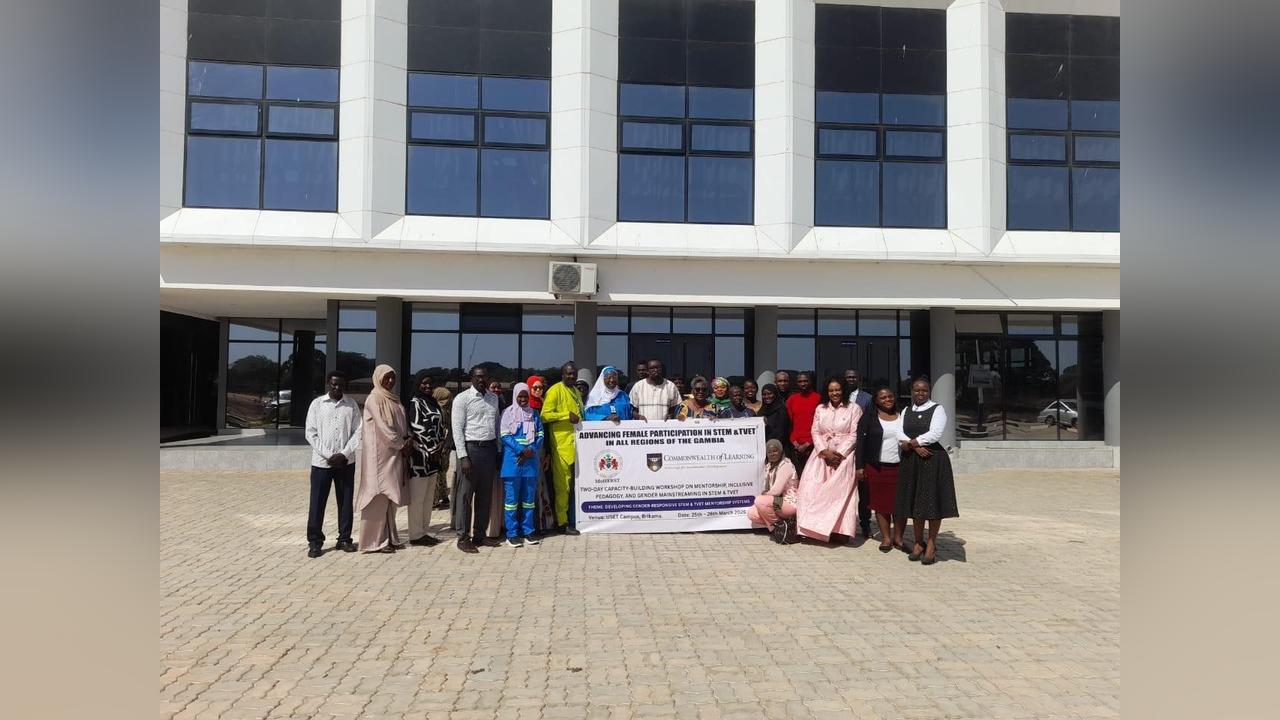
Africa-Press – Gambia. The Ministry of Higher Education, Research, Science and Technology (MoHERST) has stepped up efforts to close the gender gap in science and technical education with the opening of a two-day national workshop aimed at promoting women’s participation in STEM and Technical and Vocational Education and Training (TVET) across The Gambia.
The workshop, held on Wednesday at the University of Applied Science, Engineering and Technology (USET) in Brikama, is themed “Gender-Responsive STEM/TVET and Mentorship System Development.” It brings together policymakers, education stakeholders and practitioners to explore strategies for removing barriers that limit the participation of women and girls in these fields.
Speaking on behalf of USET, Vice Chancellor Nazmat Surajudeen Bakinde described the initiative as timely, stressing that inclusive and equitable education systems are essential for sustainable development. She noted that while STEM and TVET have the potential to drive innovation, economic growth and social transformation, such benefits can only be fully realized when opportunities are accessible to all.
She emphasized the need for deliberate measures to build gender-responsive systems, including inclusive curricula, supportive learning environments and strong mentorship structures. According to her, mentorship is key to building confidence, bridging gaps and nurturing leadership among underrepresented groups.
“This workshop provides an important platform for dialogue and collaboration,” she said, urging participants to contribute actively to shaping sustainable and impactful systems.
Delivering the keynote address on behalf of the Permanent Secretary, Deputy Permanent Secretary Muctarr M.Y. Darboe underscored the urgency of addressing gender disparities in education and skills development.
He described the workshop as both timely and transformative, noting that The Gambia’s ambition to build a knowledge-based economy depends on a skilled and diverse workforce.
Mr. Darboe said women and girls remain significantly underrepresented in STEM and TVET not due to lack of ability, but because of long-standing structural and social barriers. “This is not a reflection of capability; it is the product of structural, social and pedagogical challenges,” he stated.
He further emphasized that gender mainstreaming must go beyond policy statements to practical implementation across all levels of planning and institutional operations.
He called on policymakers, educators and stakeholders to work collectively in creating inclusive environments that actively eliminate discrimination.
The ministry, he added, is currently reviewing gender mainstreaming practices within selected pilot institutions to assess progress and identify existing gaps.
As discussions continue, stakeholders expressed optimism that the workshop will yield concrete recommendations to enhance opportunities for women and girls, while strengthening the country’s human capital development agenda.