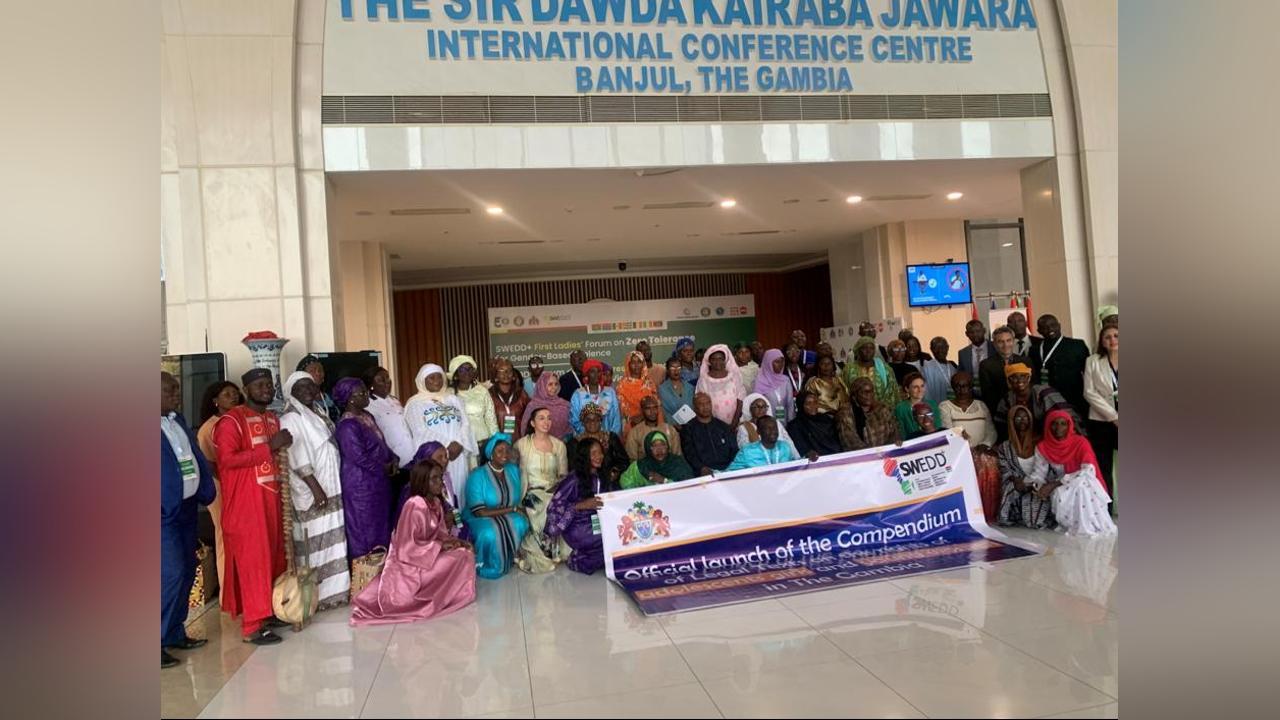
Africa-Press – Gambia. The National Population Commission Secretariat, backed by the World Bank under the Sub-Saharan Women’s Empowerment and Demographic Dividend Plus (SWEDD+) Project, officially launched a national compendium of legal texts on the rights of adolescent girls and young women on Friday. The high-level event was held at the OIC Conference Centre.
The launch signals a decisive push to strengthen legal empowerment and expand access to justice nationwide. While The Gambia has made clear progress in enacting legal protections, government officials acknowledged that poor accessibility, fragmentation of laws, and low public awareness continue to block effective implementation. The compendium confronts these gaps head-on by consolidating all relevant legal texts into a single, user-friendly reference designed to raise legal literacy and drive consistent enforcement.
The event doubled as a strategic coordination forum, bringing together government institutions, the judiciary, civil society, and development partners. A networking session followed the formal proceedings to turn dialogue into coordinated action.
Ismaila Jarjursey, Deputy Director of Population Affairs, described the compendium as an indispensable tool for the legal and justice sector. He said it will immediately improve how stakeholders identify, interpret, and apply the law in cases affecting young women.
“The dedication shown by all partners, especially the members of the Legal Platform, has been outstanding,” Jarjursey said. “No single institution could have achieved this. Through our collective commitment, we have produced a document that is informative, visually accessible, and easily understood by the people who need it most.”
Fatou Kinteh, Minister of Gender, Children and Social Welfare, called the launch a significant milestone in the country’s campaign to combat gender-based violence and lock in stronger protections for women and girls.
“The development of this legal compendium comes at a critical time,” Minister Kinteh stated. “The Gambia has made commendable progress enacting laws and policies that protect the rights of women and girls. But we must be honest: gaps still exist in accessibility, public awareness, and effective implementation of these legal frameworks. This document is built to close those gaps.”
Mariatou Faye, Chairperson of the Legal Platform, outlined the document’s scope and its role in fixing coordination failures across the justice chain.
“At its core, the compendium is a consolidation of the legal landscape,” Chairperson Faye explained. “It brings together, in one accessible resource, the key national, regional, and international legal instruments that govern the rights of adolescent girls and young women. But it is more than a compilation. It is a tool for clarity. It maps the structure of our legal system and makes explicit the interplay between constitutional protections, statutory laws, customary practices, and international obligations.”
Delivering the official launch statement, Hussein Thomasi, the Solicitor General, said the document will strengthen the entire legal system and create stronger, faster protection mechanisms for vulnerable groups.
“Today is not just the unveiling of a legal document,” the Solicitor General said. “It is a significant milestone in our collective efforts to advance gender equality, strengthen access to justice, and safeguard the rights and dignity of adolescent girls and young women across our nation. Despite a robust legal framework, a critical challenge persists. These laws have too often remained fragmented, difficult to access, and poorly understood by the very people they are meant to protect. This compendium ends that fragmentation.”
The 76-page compendium is the latest concrete step in The Gambia’s broader agenda to promote justice, protect vulnerable groups, and accelerate gender equality.
The SWEDD+ Project’s core objective is to strengthen legal and institutional frameworks that promote the rights and empowerment of adolescent girls and young women across health, education, and economic participation. With the legal text now consolidated, officials made clear that the next test is enforcement, public education, and measurable impact on the ground.
For More News And Analysis About Gambia Follow Africa-Press