

Africa-Press – Ghana. Government has announced a blueprint to modernise Ghana’s seed sector as part of efforts to strengthen agricultural production.
The is aimed at enhancing export competitiveness and drive the broader 24‐Hour Economy (24H+) agenda.
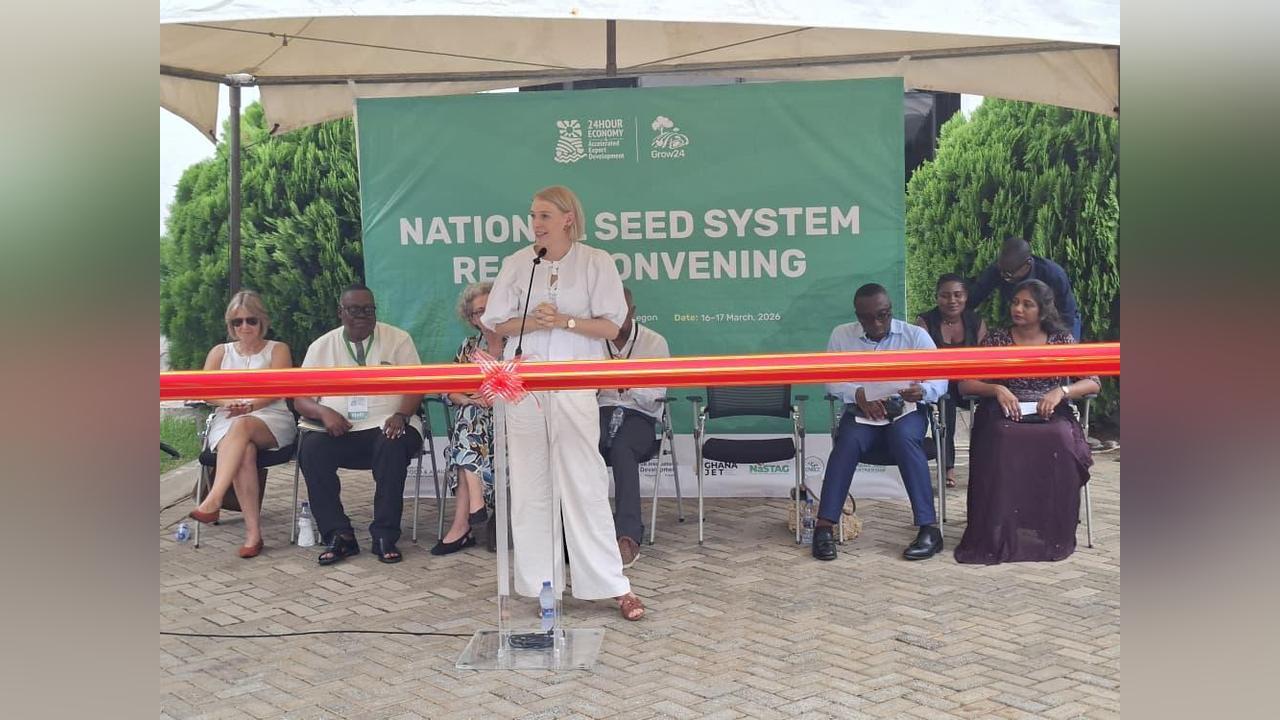
The blueprint was disclosed by Mr. Augustus “Goosie” Obuadum Tanoh, Presidential Advisor on the 24‐Hour Economy and Accelerated Export Development during the Day One of the National Seed System Reset Programme.
The event, organised by the 24-Hour Economy Authority in partnership with the Embassy of the Netherlands in Ghana and the Ghana Seed Partnership, emphasised on building a coherent national seed system capable of supplying high‐quality, certified varieties to farmers, agro‐processing enterprises and export‐oriented value chains.
Mr. Tanoh said the modernisation of the seed sector was not a peripheral intervention but a central pillar of Ghana’s economic transformation architecture.
He said assessments conducted across national research institutions, including the West Africa Centre for Crop Improvement (WACCI), the Council for Scientific and Industrial Research (CSIR), and various seed certification and horticultural innovation facilities show that the country already possessed a strong scientific and institutional base to build an internationally competitive seed industry.
“Ghana is not starting from zero; we are starting from strength that must now be organised into a coherent national seed delivery system,” he said.
According to him, the new strategy seeks to align seed development with government’s GROW24 programme, Feed Ghana centres, agroecological and aquaculture parks, and the Volta Economic Corridor activation plan.
The ultimate objective, he added, was to position the seed system as economic infrastructure that fed jobs, export growth and rural industrialisation.
As part of the blueprint, he said the government had set a 90‐day window to complete several early‐stage deliverables, including firming up early‐generation seed plans, accelerating regulatory approvals, and finalising pilot delivery models for maize and rice.
These interventions, Mr. Tanoh said, will feed directly into the 2026 targets of activating 200,000 jobs, on boarding 500 SMEs into structured financing and park ecosystems, securing over GHS 10 billion in capital commitments.
The Presidential Advisor also outlined plans to strengthen intellectual property protection and licensing systems to support breeders, research institutions and private seed companies.
The aim, he explained, was to create an environment where high‐quality seed varieties were developed, commercialised and distributed at scale, while ensuring affordability and transparency for farmers.
The Advisor stressed that sustainable innovation required clear rules on ownership, revenue sharing and technology transfer, alongside strong deterrence mechanisms against counterfeiting.
“If we strike the right balance, Ghana can replicate the kind of innovation‐driven seed systems seen in leading agricultural countries, while grounding them in our own legal frameworks and farmer realities,” he said.
The Advisor commended the partners for their technical support and emphasised that the success of the seed sector reset would depend on effective coordination between public institutions, private companies, cooperatives, and research bodies.