

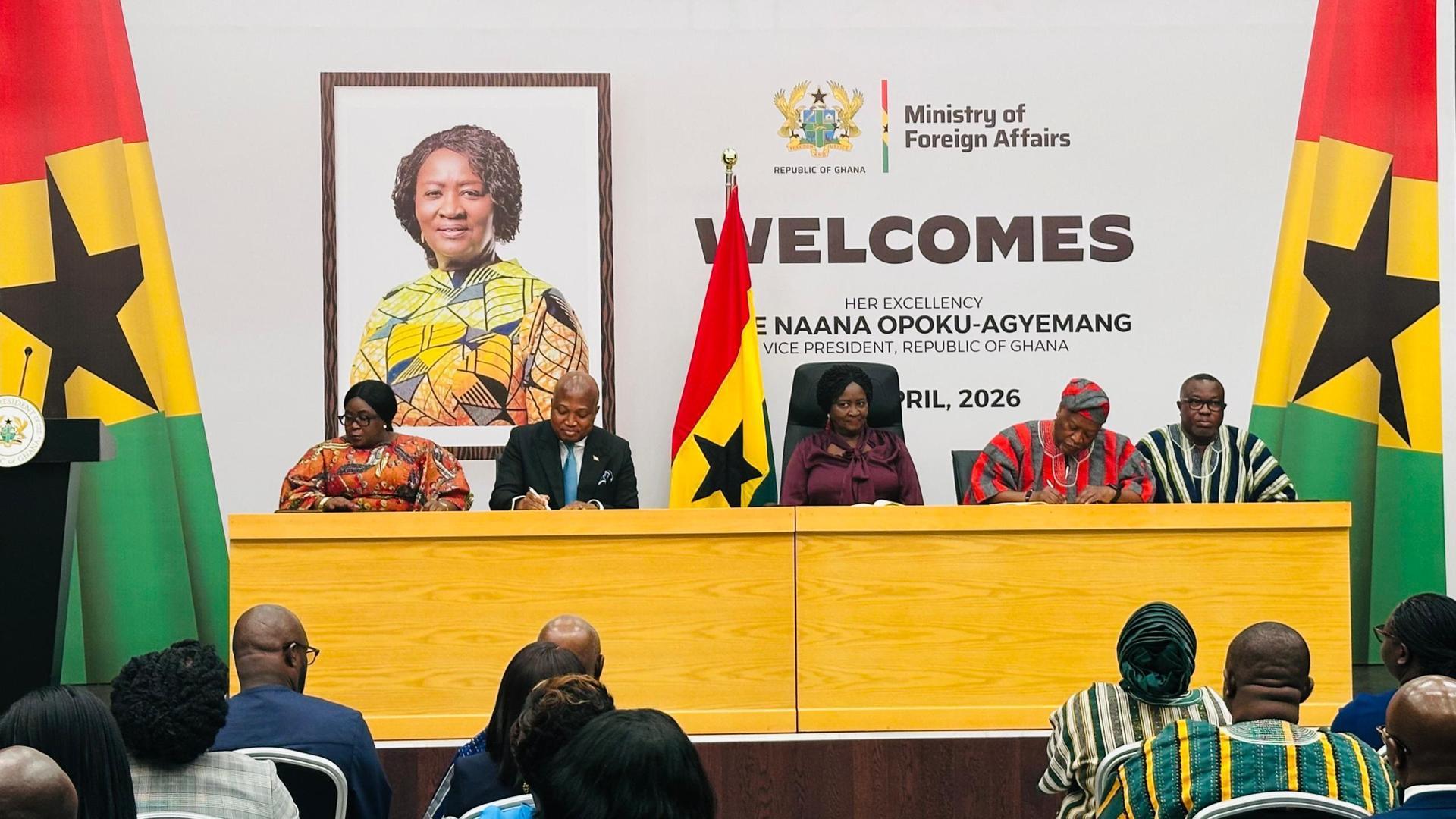
Africa-Press – Ghana. Vice President Professor Naana Jane Opoku-Agyeman has called on the Ministry of Foreign Affairs to play a more strategic role in advancing Ghana’s interests under the African Continental Free Trade Area (AfCFTA).
She stressed the need to promote Ghanaian businesses across international markets. She said beyond diplomacy, trade promotion must become a central pillar of the Ministry’s work, particularly through Ghana’s missions abroad, to ensure that Ghana derived maximum benefit from AfCFTA and other global economic opportunities.
“The role of Foreign Affairs in AfCFTA is critical. Trade is an important part of your responsibility. How do you promote this through all the agencies and directorates that you have?” she queried.
The Vice President made the remarks during a working visit to the Ministry of Foreign Affairs in Accra, where she interacted with management and staff and commended them for their contributions to Ghana’s global image and diplomacy.
She urged Foreign Service officers to intensify efforts in facilitating the expansion of Ghanaian businesses abroad, noting that while many foreign companies thrived in Ghana, the same could not always be said of Ghanaian enterprises operating internationally.
“How many Ghanaian businesses do we have in those countries? And why is that the case?” she asked, calling for a reset in strategy to ensure mutual economic benefits in Ghana’s international relations.
Professor Opoku-Agyeman emphasised that public officials must always recognise their responsibility to serve citizens, including those not physically present in decision-making spaces, and ensure that policies and interventions positively impact all Ghanaians.
She commended the Ministry for its recent reforms, including the expansion of passport application centres to all regions, reduction in passport acquisition costs, and the introduction of a one-day passport service and courier delivery system.
Describing the reforms as “humane interventions,” she noted that they would significantly reduce the burden on citizens, especially those outside Accra, who often faced challenges accessing public services.
The Vice President lauded the Ministry’s efforts to improve staff welfare, particularly the introduction of staff buses, describing it as a thoughtful response to concerns about commuting challenges.
Earlier, Mr Samuel Okudzeto Ablakwa, Minister of Foreign Affairs, expressed gratitude to the Vice President for her consistent support and hands-on involvement in advancing Ghana’s foreign policy objectives.
He said the Vice President had demonstrated exceptional commitment to the Ministry’s work, often stepping in at short notice to represent the country at high-level engagements.
The Minister highlighted Ghana’s recent diplomatic achievements, notably the successful passage of a landmark United Nations resolution declaring the transatlantic slave trade as the gravest crime against humanity.
He described the resolution as a historic milestone achieved through broad international collaboration involving the African Union, Caribbean states, Latin America and the African diaspora.
Mr Ablakwa announced that Ghana would host a high-level global conference in Accra on June 18 and 19 to develop a common framework for reparatory justice, bringing together heads of state, international organisations and advocacy groups.
On consular services, he said the Ministry had undertaken major reforms in passport administration, including the introduction of chip-embedded passports that meet International Civil Aviation Organization (ICAO) standards.
He said the Ministry had cleared a backlog of about 40,000 passport applications and reduced processing time to less than 15 days, with an emergency one-day service now available.
“We have also introduced, for the first time, a courier service so that applicants can receive their passports at home or office without stress,” he said.
The Minister noted that the cost of acquiring a passport had been reduced by 30 per cent to GH₵350, making it more accessible to citizens.
He added that passport application centres had been established in all 16 regions for the first time, ensuring equitable access to services nationwide.
Mr Ablakwa also highlighted efforts to expand visa-free travel for Ghanaians, stating that the country had secured about 50 visa waiver agreements, with 23 negotiated within the past year alone.
He announced plans to roll out an electronic visa (e-visa) system in May to streamline entry processes for visitors, enhance security through integration with international databases, and attract investors.
Additionally, he clarified that Ghana’s proposed free visa policy for Africans would not eliminate vetting procedures but would waive visa fees while maintaining strict security checks.
The Minister added that the Ministry’s adoption of key performance indicators (KPIs) was yielding positive results, with improved service delivery and increased economic diplomacy outcomes across Ghana’s 72 missions worldwide.
He reaffirmed the Ministry’s commitment to staff welfare, citing new allowances, a duty waiver policy for returning Foreign Service officers awaiting parliamentary approval, and the procurement of buses for staff transportation.
Both the Vice President and the Minister underscored the importance of collective responsibility in strengthening Ghana’s international standing, with a renewed focus on economic diplomacy, inclusive service delivery and national development.
For More News And Analysis About Ghana Follow Africa-Press