
Africa-Press – Ghana. Ghana has witnessed a troubling surge in market fires, with devastating incidents at Accra’s Kantamanto Market and Kumasi’s Adum Market, highlighting systemic issues recently.
These infernos did not only destroy livelihoods but exposed deep-rooted problems in market planning, infrastructure, and emergency response.
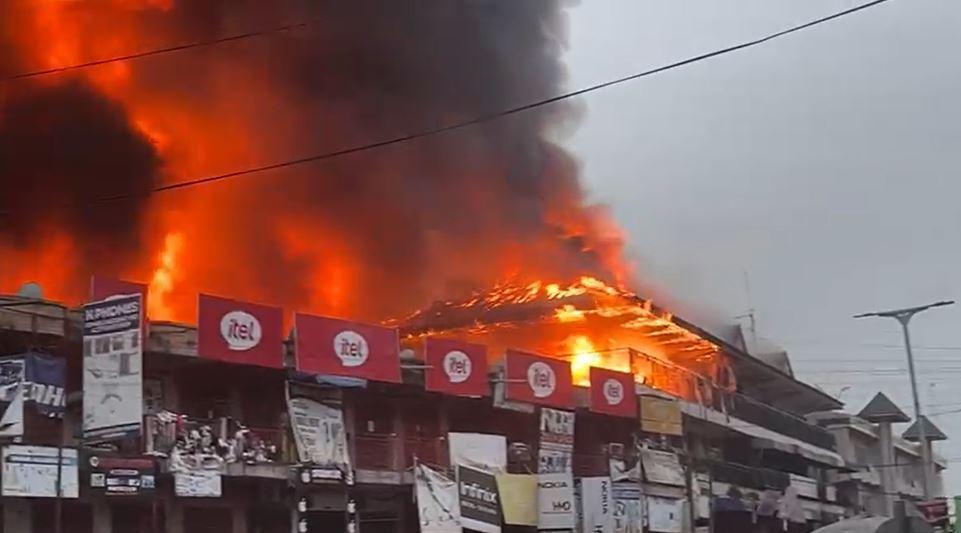
On January 2, 2025, a massive fire engulfed Kantamanto Market in Accra, one of the world’s largest secondhand clothing markets.
The blaze destroyed over 7,000 shops and affected more than 30,000 traders, causing losses running into millions of Ghana cedis. Preliminary investigations suggested faulty electrical wiring as a cause, though arson was not ruled out.
The market’s congested layout, with stalls blocking access roads, severely hindered firefighting efforts. Personnel from the Ghana National Fire Service, reported difficulties accessing the burning sections due to obstructions. This caused further delays in putting out the fire thus exacerbating the damage.
In March 2025, Kumasi’s Adum Market was razed by fire, resulting in the injury of nine people. An incident, similar to that of Kantamanto, was attributed to erratic power supply, commonly known as “dumsor.”
According to Member of Parliament for Subin, Mr Kofi Obiri Yeboah, who visited the scene was told that the fire was allegedly triggered when electricity was restored after an outage, causing a spark that kindled the blaze.
The Nature of Market Fires in Ghana’s major Markets
Market fires in Ghana are made worse by some practices of traders and structural deficiencies. These include unauthorized electrical connections, poor construction, cooking within shops and the storage of flammable materials.
In a notable case, of a fire at Kejetia Market, investigations revealed that the inferno was caused by a trader cooking in her shop close to a chemical store, leading to an explosion.
Moreover, the haphazard citing of shops and blockage of access roads made it difficult for fire tenders to reach affected areas promptly. Many markets lack functional fire hydrants, and existing ones are often inaccessible due to encroachments.
Just like Kantamanto, the congested nature of Adum Market also impeded firefighting efforts. Reports filed by the media and eyewitnesses pointed to the lack of accessible roads to the incidents, fire hydrants and logistical constraints which hindered the Ghana National Fire Service’s response; making the outcome much worse.
The above was corroborated in the statement made by President of John Dramani Mahama, upon his visitation to the scene to commensurate with affected traders: “Information I received from the fire officers indicated that the lack of access roads contributed to the inability of fire tenders to douse off the fire on time.”
President Mahama then directed the National Disaster Management Organisation (NADMO) to provide immediate relief to the affected traders and discussed further financial assistance with the Chief of Staff and the Ashanti Regional Minister.
Nonetheless, the above solution has proven ineffective. Until the proper measures are taken to address the underlying causes, the country be plagued by preventable fires which destroy livelihoods. But one may ask, what are the underlying causes?
Challenges of the Fire Service
The Ghana National Fire Service (GNFS) established in 1963 and restructured in 1997 after the enactment of Act 537, have contributed significantly to fire and disaster management as well as rescue operations throughout the country.
However, the para security service faces significant challenges, such as logistical constraints and structural issues.
Logistical challenges have considerably affected the work of the service over the years, Currently, the GNFS faces acute shortage and poor condition of firefighting equipment. It is estimated that more than half (53.6%) of all fire engines nationwide is non-operational.
This is due to mechanical failures such as engine malfunctions, brake issues, control board problems, and electrical faults.
In the Greater Accra Region for example, lot of fire engines either have faults or out of use. This phenomenon has affected suburbs such as Adenta, Abelemkpe, Trade Fair, and Tema.
In Accra’s Korle Bu area, for instance, there is not a single operational fire truck in operation as the existing one caught fire enroute to an emergency at Kasoa due to its poor condition
To aggravate the situation, the GNFS lacks adequate personal protective equipment (PPE). The Joy online report indicated that firefighters often share the insufficient PPE, thus compromising safety and efficiency.
Many Ghanaians often criticise the GNFS for delays, but it is deeply rooted in the aforementioned logistical and infrastructural challenges. In the Ashanti Region, for instance, response times can range from 12 to over 20 minutes, far exceeding the international standard of 5 minutes.
This delay is partly due to the vast areas covered by single fire stations and the poor condition of fire tenders.
The GNFS’s responsibilities extend beyond firefighting to include road accident rescues, flood responses, and other emergencies. However, the lack of specialised equipment and technologies as in other countries, hampers their effectiveness in these roles.
A critical look into the infrastructure and logistical deficits of the fire service in Ghana will reveal some regional disparities that exacerbate the problem of the service thus affecting the quality of effectiveness.
In the Upper East and Oti Regions for example, there are no operational fire tenders. In Volta Region, 15 out of 17 fire engines as of 2024, are non-functional. In the Upper West Region twelve out of fourteen fire tenders, as of 2024 are out of service.
This above infrastructural and logistical deficiencies coupled with the uneven distribution of fire stations is what has made the GNFS lose confidence and trust in the eyes of many Ghanaians.
One would even be surprised to hear that densely populated high-class areas such as East and North Legon lack fire stations.
Despite the GNFS having over 15,000 trained firefighters, only about 5,000 are truly operational because of the above shortages coupled with administrative inefficiencies
To add salt to injury, the various Metropolitan, Municipal and District Assemblies (MMDAs) have failed to enforce proper market planning and safety regulations on building and structures due to corruption, bureaucracy and political interference.
The lack of oversight has allowed unsafe practices to persist, increasing the risk of fires. Part of Kantamanto Market, which was razed by the fire, has been rebuilt with the same old materials and plan which still blocks access roads and fire hydrants and continue to be poorly wired.
The same old attitude of leaving open fires after cooking and improper storage and disposal of combustible materials persists.
This behaviour only perpetuates the vicious cycle, ensnaring market women and Ghanaians; the perennial loss of livelihoods and political gimmicks of aftermath donations and promises.
Recommendations
Ghana needs determined and committed political leadership and the traders to institute reforms to turn things around for the better.
Some of the reforms needed to end the trend of fire outbreaks in the markets and its attendant evils include the formation of Market Fire Safety Committees by Traders within key market centres such as Kantamanto and Adum to help monitor the risks factors of fire outbreaks, ensure compliance with safety protocols, and serve as first responders during emergency situations.
Secondly, a Mandatory Fire Safety Training programme should be held for all market traders periodically. Traders should be taken through fire safety and prevention measures which includes the proper use of fire extinguishers, safe electrical practices, and emergency evacuation drills.
Failure of traders to attend these mandatory training should be made punishable by law via fines and prosecutions.
Thirdly, all unauthorised electrical practices should cease. This can be done via the various trader’s associations who should insist that traders employ the services of certified electricians thus, avoiding illegal and unsafe electrical connections.
Furthermore, a ban should be put on the habit of traders cooking in shops. Instead, areas should be demarcated or dedicated in the market for such purposes. Flouters should be penalised as a measure keep fires far from flammable materials.
Another important area that needs to be looked at is the need for a Collective Advocacy for Market Redesign were traders must unite to demand safe market layouts such as wide access roads, visible emergency exits, and proper stall spacing from city authorities.
The advocacy can also be used to consistently push for support and engagement with NADMO and District Assemblies to hold local government accountable for infrastructure upgrades and policy enforcement.
Another controversial and sensitive area that needs to be looked at is Insurance for Livelihoods. Though many traders have lost confidence in insurance companies due to personal experiences in the payment of claims and lies told by some agents to lure them to sign up, it is important for traders to be educated properly and encouraged and supported to insure their businesses against fire losses to reduce financial devastation in its aftermath.
On the part of the Ghana National Fire Service, Government must give priority to the acquisition and maintenance of firefighting equipment. This should include the restoration of over 50 per cent of non-functional fire engines and ensure that each region has several functional, modern fire stations.
Also, fire stations need to be more decentralized and accessible. This can be achieved through an even distribution nationwide with densely populated and high-risk areas like Kantamanto in Accra, and Adum in Kumasi given more priority.
It will be a smart thing to do if every major market will have a local operational fire post. This will hasten response and save a lot of lives and livelihoods.
Government as a matter of urgency, should review and increase GNFS’s annual budget, with special funds allocated for the purchasing of modern PPEs, new fire trucks, and regional infrastructure upgrades.
No matter how expensive it may be, a deliberate investment in ultramodern firefighting and prevention technologies such as fire detection systems, drone-assisted fire monitoring, and digital maps to especially overcome challenges posed by congested layouts would be worthwhile.
A coordinated mechanism must be developed to work with MMDAs and market associations to ensure fire prevention strategies are implemented and enforced.
Moreover, the GNFS should be given the legal backing and independence to enforce Fire Code Compliance. They should be legally empowered to inspect, sanction, or close markets and shops that fail to meet fire safety standards without any form of political interference.
Public Fire Safety Campaigns of the GNFS should be regular nationwide to give fire safety education campaigns through radio, TV, and community outreach to change public attitudes and reinforce good practices.
There should be an establishment of a Fire Hydrant Accessibility Taskforce within the GNFS who would in collaboration with MMDAs, ensure that fire hydrants are functional, unblocked, and mapped for quick access during emergencies.
The icing on the cake would be the creation of a National Fire Risk Management Policy for Markets but, that should involve stakeholders from GNFS, NADMO, MMDAs, Ministry of Local Government, traders’ associations and unions, and civil society.
The policy must guide market infrastructure planning, risk audits, and emergency response protocols nationwide.
The above, if taken seriously by leadership, will help mitigate the rate of fire outbreaks which has become an annual ritual in the country.
Source: Ghana News Agency
For More News And Analysis About Ghana Follow Africa-Press