
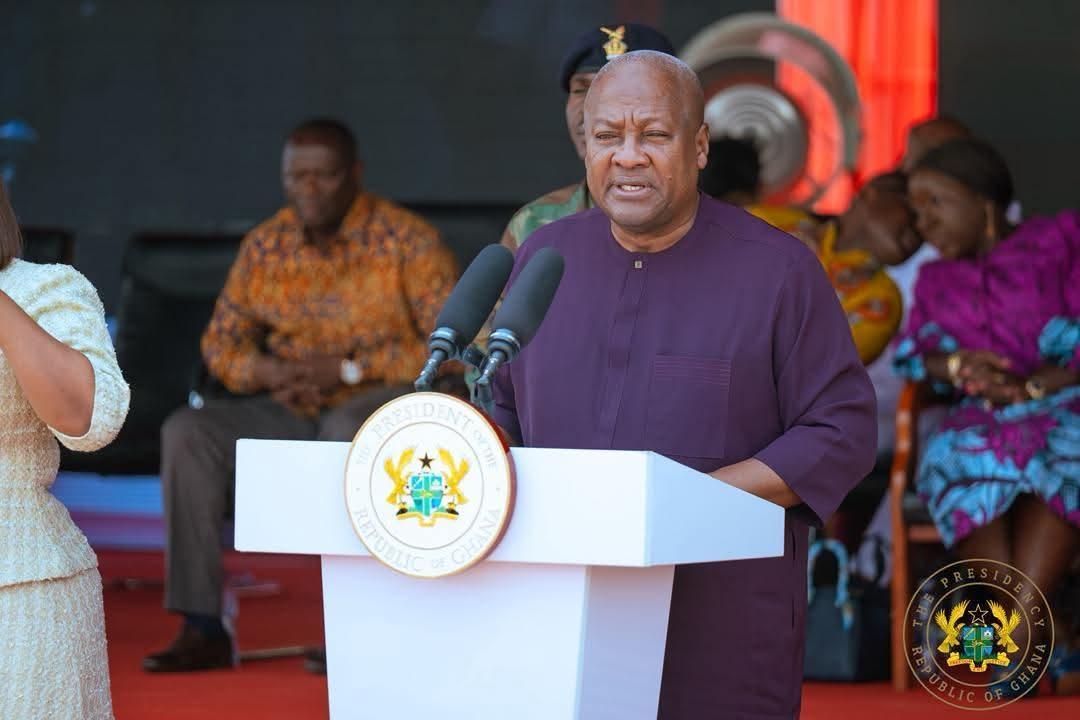
Africa-Press – Ghana. President John Dramani Mahama has said that the Government’s policy of banning export of non-ferrous scrap is expected to boost processed metal exports by $250-300 million annually.
This, he said would also create 5,000 to 10,000 new jobs and increase tax revenues through value-added tax, corporate taxes, and pay-as-you-earn.
President Mahama made the disclosure in his remarks at the commissioning of Phase Two Extension of B5 Plus Limited at Lakpleku in the Ningo-Prampram Municipality of the Greater Accra Region.
The facilities commissioned by President Mahama include: Steel Ball, Section Mill and PEP Extension Manufacturing Plants.
President Mahama said Ghana generated substantial volumes of scrap metal annually.
He noted that through construction, demolition, vehicle imports, and industrial activity, for too long, a significant portion of that scrap had been exported in its raw form.
He said by restricting non-ferrous scrap exports, the Government ensured local processors had priority access to raw material for their production.
He said B5 Plus Group was one of Ghana Revenue Authority’s (GRA) very good payers.
Adding that B5 Plus had paid more than $300 million in taxes and that they were looking to exceed $500 million very soon.
“We are moving up the value chain. We’re exporting finished and semi-finished products, not raw scrap,” the President said.
President Mahama said steel products manufactured here in Ningo could serve the ECOWAS construction markets, the Sahelian infrastructure projects, mining operations across West Africa, cement and mineral processing industries across the whole sub-region.
He noted that instead of importing steel from Asia or Europe, West Africa could source competitively from Ghana’s manufacture; adding that this was a regional value chain integration in real practice and that industrial capacity required raw material security.
He reiterated that under the Big Push Infrastructure Programme, the Government was investing heavily in roads and highways, railway modernization, bridges and interchanges, energy transmission lines, affordable housing, and industrial parks.
“All these I have mentioned require iron and steel. Africa is projected to require over $100 billion annually in infrastructure development,” he said.
The President said West Africa alone faced significant infrastructure deficits and that if Ghana develops a strong steel base, they not only build their own roads and bridges, they would also supply steel to the whole sub-region.
Adding that this was how infrastructure became an industrial strategy.
He said the 24-Hour Economy Programme was particularly relevant to energy-intensive industries such as steel manufacturing.
“And I had the honor and privilege yesterday to sign the 24-hour authority bill into law,” the President said.
“I know that B5 Plus Group is one of the first companies that will register under the 24-hour economy initiative.”
The President said steel production benefits from continuous operation to reduce energy wastage, improve finance efficiency, lower unit production costs, and maximize asset utilization.
He said with dedicated industrial tariff reforms, improved grid stability, and expanding domestic gas supply, manufacturing could operate competitively beyond the traditional hours.
He said the allocation of GH¢110 million in the 2026 budget to operationalize the 24-Hour Initiative Programme reflected the Government’s seriousness.
He said when factories run three shifts instead of one, employment rises, productivity increases, and exports expand.
“We have been engaged in fiscal reform to support industry and business. In the 2026 budget, we have introduced measures that directly benefit manufacturers,” the President said.
“We abolished the COVID-19 health recovery levy. We reduced the effective VAT rate from 21.9 per cent to 20 per cent.”
President Mahama said they had introduced digital VAT monitoring systems and that they were reviewing the income tax, customs, and excise regimes.
He noted that predictable tax policies lower uncertainty, lower compliance friction, and reduce operational costs.
Mr Mukesh Thakwani, the Founder, Chairman and Chief Executive Officer of B5 Plus Group, said as part of their corporate social responsibilities, B5 Plus Ltd would construct a Police Station and a Basic School for the Lakpleku Community.
He therefore appealed to Mr Samuel Nartey George, the Member of Parliament for Ningo-Prampram, assist them with lands for the two projects.