
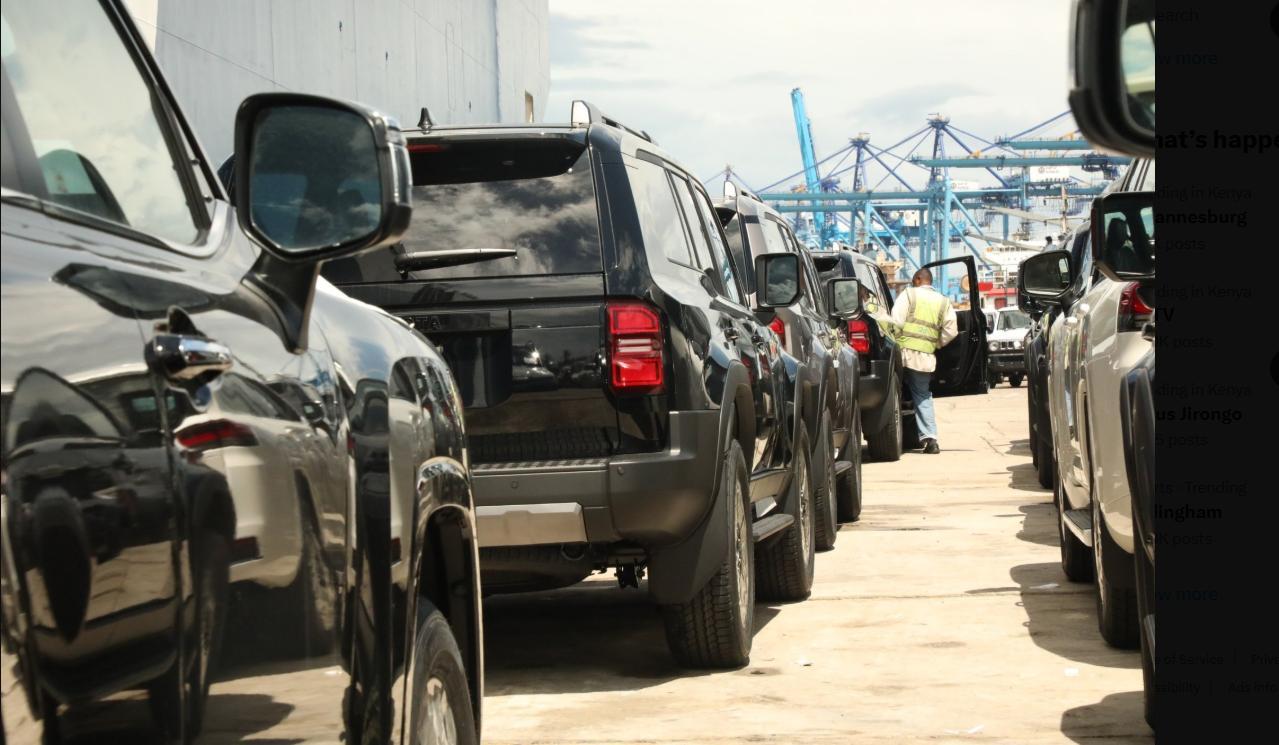
Africa-Press – Kenya. SECOND hand car dealers and importers are rushing to beat the eight year rule on 2018 units with a record eight vessels expected to dock at the Port of Mombasa in the next 10 days.
The ships are bringing in more than 4,700 units in less than 14 days, figures which are monthly average imports between January and November.
Kenya Ports Authority vessel berthing schedule shows the first two vessels are expected on Saturday, two more on Christmas Day with subsequent dockings all the way to December 29, with possibilities of having other vessels coming in on December 30 and 31.
“The port of Mombasa will, in the next 14 days handle a total of 53 vessels, with 29 accounting for container ships. At the same time, the port will receive 15 conventional cargo vessels, eight car carriers and one oil tanker,” KPA management said.
Traditionally, Kenya imports between 4,000 and 7,000 per month with these numbers going up to 9,000 on good months.
The country’s age limit rule for used cars is capped at eight years, meaning Certificates of Roadworthiness for vehicles whose year of first registration is 2018 will not be valid after December 31, 2025.
“All vehicles issued with such certificates must arrive at the port of destination or entry by December 31. Any vehicle registered in 2018 or earlier, arriving after 31, December 2025 will be deemed not compliant with KS 1515:2000 and shall be rejected at the importer’s expense,” Kebs managing director, Esther Ngari, said in a recent public notice.
Starting January 1, 2026, only vehicles whose year of first registration is from January 1, 2019 and later shall be allowed into the country, as they fall within the age limit.
The eight-year rule also covers returning residents and diplomatic staff, with only right-hand drive motor vehicles allowed into the country.
All imports must be accompanied with a Certificate of Roadworthiness from the Kebs contracted inspection agency, with Japan being the main source (80%), United Arab Emirates, United Kingdom, Thailand, Singapore and South Africa.
This is issued by Quality Inspection Services Inc. Japan (QISJ) which is the inspection company contracted by Kebs.
Car importers have been beating the deadline for the past 10 years, including last year, despite longer shipping time occasioned by disruption in the Red Sea as a result of the Houthi Rebels attacks, which forced shipping lines to re-routing to the Cape of Good Hope (South Africa), before coming up to the East.
This increased transit time between Mombasa and key global ports from an average 24 days to 40 days, with some ships taking even longer as they call at different ports before the final destination.
According to the Car Importers Association of Kenya (CIAK) national chairman Peter Otieno, early orders have continued to help importers beat the December 31, deadline.
“We are not under any pressure. Our members are aware of the deadline so by October into November, last minute orders are already made to ensure units are in the Kenyan waters on time before end of December,” Otieno told the Star in a recent interview.
The last time importers were hit by losses on late imports was in 2014, when more than 2,000 used motor vehicles registered in 2006 were locked out of the country.
Since then, importers have been beating the deadline with no major lockout reported, save for 2020 when the Covid-19 pandemic struck, but units which were already in the Kenyan waters were allowed.
Last year, the country imported 72,482 units, the Economic Survey 2025 indicates, up from 70,275 in 2023.
Imported used vehicles dominate the local market with buyers in this segment spending an estimated Sh60 billion annually on the units, whose prices range from as low as Sh700,000 to an average Sh2.5 million, which is the average starting price mark for new cars.