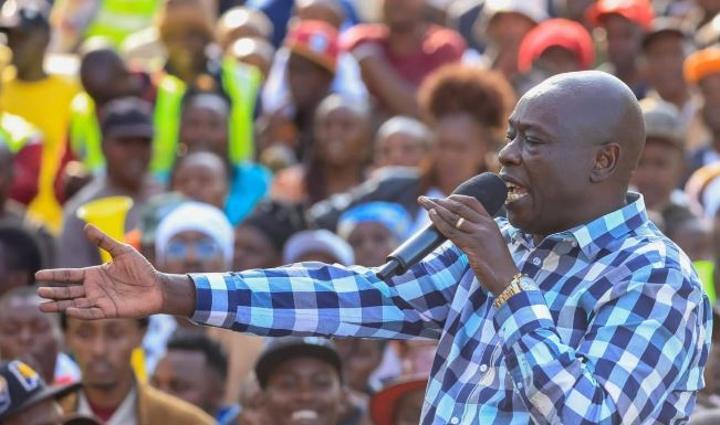
Africa-Press – Kenya. Former Deputy President Rigathi Gachagua is facing his first major test as a party leader as he navigates a delicate balancing act between rewarding early loyalists and accommodating popular new entrants competing for DCP tickets ahead of the 2027 polls.
As Gachagua positions the Democracy for the Citizens Party (DCP) as the primary Mt Kenya political vehicle, disputes over nominations have begun to surface, triggering exits from the young party.
The latest to leave DCP is former Kigumo MP Jamleck Kamau, who on Thursday announced that he was stepping back from active politics.
Kamau, who had declared interest in the Murang’a governor seat on the DCP ticket, said his decision to take a break was due to “reasons beyond my control”.
However, the Star learnt that Kamau’s move may have been influenced by a meeting between Gachagua and former Water PS Joseph Wairagu, who is also seeking the Murang’a governor seat on the DCP ticket.
Wairagu is the party’s Murang’a county coordinator. He visited Gachagua’s Wamunyoro home in January last year.
Kamau follows Juja MP George Koimburi, who announced his exit from DCP last week.
Koimburi accused Gachagua of conmanship and betrayal after his long-time rival, Alosie Kinyanjui, the brother of former CS Moses Kuria, was welcomed into the party.
He said his departure was prompted by what he described as the “auctioning” of DCP tickets to the highest bidders, a claim the party addressed both in a statement and through Gachagua.
“I was played badly. Despite being a diehard supporter of Gachagua and the party, new entrants are coming with Sh5 million and are treated as insiders, while we loyalists are pushed to the periphery,” Koimburi said.
Gachagua, however, said he had simply denied him preferential treatment.
“He asked for a direct ticket because he supported me during impeachment,” he said. “I told him no. DCP is democratic and everyone must go through nominations.”
A similar dispute is cited as the reason behind the fallout between Gachagua and Githunguri MP Gathoni wa Muchomba.
Wamuchomba, who stood with Gachagua during and after the impeachment process, has since emerged as one of his sharpest critics.
She is said to have fallen out with Gachagua after he held talks with Njenga Mabati, also known as Wamabati, another aspirant seeking the DCP ticket for the Githunguri seat.
Speaking on Inooro TV on Tuesday, Wamuchomba said they parted ways after she concluded that Gachagua was not “honest” and had “hidden cards”.
“After using us and taking our money, he is now rushing to people with money,” she said.
“Now that we helped him cross the river and he has a party, he wants the person with money in Githunguri. You will hear many such cases, even in Nyeri.”
The disputes have heightened concerns among early DCP loyalists that their sacrifices could be eclipsed by newcomers with deeper pockets or stronger local networks as the party grows.
They also point to a broader challenge facing Gachagua: How to manage internal competition without triggering fragmentation.
Aware of the risks, Gachagua sought to calm tensions at a recent meeting in Gatundu. He told party members that DCP would conduct free and fair primaries for all elective positions, including seats currently held by his allies.
“There will be no direct tickets,” Gachagua said. “Everyone, including my close allies, will face the people.”
He cited the case of one of his closest allies.
“I have heard there is a young man challenging Senator Karungo wa Thang’wa on a DCP ticket,” the former DP said.
“You will fight it out, and there will be no running away after losing. Remain, and I will sort you out.
However, translating that promise into practice may prove difficult, according to his former adviser and ex-Nyeri Town MP Ngunjiri Wambugu.
By insisting on free and fair nominations for all positions in March 2027, Wambugu said, Gachagua is effectively telling incumbents who support him that their sacrifices may not count.
“He is telling them that even if they resist government pressure, get teargassed, use personal resources for three years, market the party, recruit members and forgo opportunities in government to support him,” he said.
“They will still have to compete for tickets with people who will show up at the last minute.”
He added that this approach reinforces the perception that the party is controlled by Gachagua.
“I have always said Gachagua will eventually give tickets to those with the most money if he succeeds in keeping the party relevant,” Wambugu said.
While party primaries are popular in principle, they often leave behind disgruntled losers, especially in regions where securing a party ticket is effectively equivalent to winning an election.
Gachagua’s biggest challenge, therefore, will be to conduct credible primaries while containing defections that could weaken his party ahead of 2027.