ELIUD KIBII
Africa-Press – Kenya. As US Deputy Secretary of State Christopher Landau touched down in Nairobi to advance Washington’s interests, Foreign Affairs PS Korir Sing’oei was in Beijing to deepen ties with China.
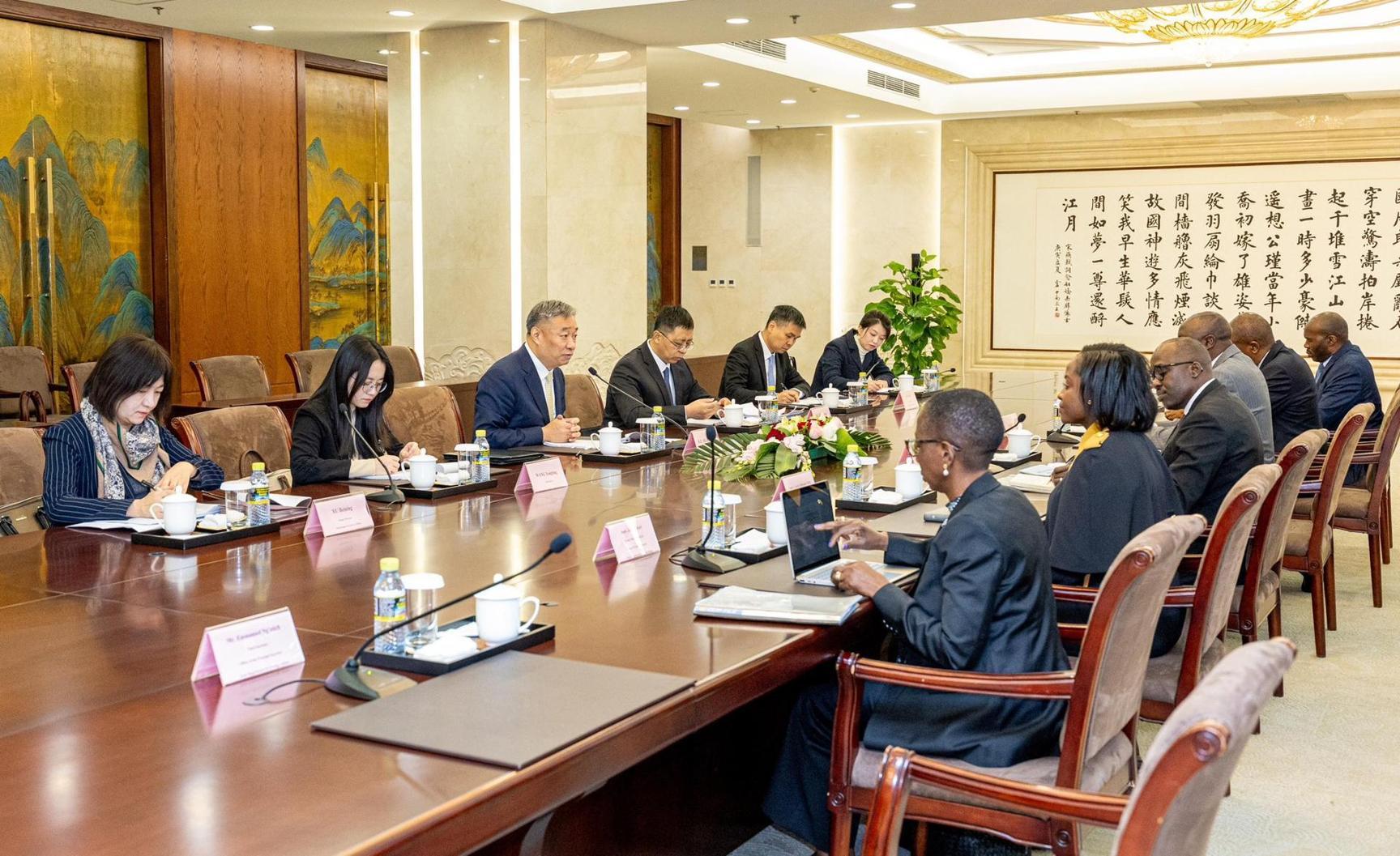
Sing’oei was on a three-day tour of Beijing, where he held a series of high-level engagements with senior officials.
He was accompanied by Ambassador to China Willy Bett, his deputy Lynnette Mwende and President William Ruto’s debt management adviser Dr Haron Sirima.
This even as Landau’s visit signalled Washington’s renewed effort to formally re-centre Kenya as the anchor state in its Africa strategy under President Donald Trump’s second-term foreign policy outlook.
He came to pursue America’s commercial, security and infrastructure interests.
The near-simultaneous engagements not only highlight Kenya’s central place in intensifying US-China competition across Africa but also demonstrate Nairobi’s determination to extract mutual benefits from both capitals.
In Beijing, Sing’oei held consultations with Chinese Vice Foreign Minister Miao Deyu.
Following the meeting, he reaffirmed what he described as “strong bilateral relations anchored on mutual trust and solidarity in advancing shared interests and those of countries in the Global South”.
Their discussions, he said, reviewed progress on agreements signed during Ruto’s State visit to China last year, with both sides expressing satisfaction with the pace of implementation.
Sing’oei also raised broader geopolitical concerns, warning of what he termed the erosion of multilateralism and infractions of the rules-based international order.
In apparent reference to recent global developments, particularly in Venezuela, Sing’oei affirmed Kenya’s commitment to the UN Charter and the reform of global financial, peace and security architectures.
His language appeared closely aligned with Beijing’s Global South messaging.
Infrastructure financing was also discussed, with the RMB 2 billion (Sh37.2 billion) facility earmarked for the construction of 15 county connectivity roads, a commitment made during the 2024 Focac Summit.
Discussions also explored Kenya’s potential entry into Chinese capital markets through the issuance of a Panda Bond to mobilise private financing for priority infrastructure projects in water, energy and transport.
The PS also met officials from the China International Development Cooperation Agency and the China-Africa Development Fund to discuss concessional financing, project implementation and new development funding options to support Ruto’s infrastructure agenda.
Officials from China’s major policy banks, including Cexim and the Bank of China, attended some discussions.
Back in Nairobi, Ruto and Prime CS Musalia Mudavadi, who is also in charge of Foreign Affairs, were holding meetings with Landau, praising the close ties between the two states.
Landau praised Kenya’s role in international peacekeeping, including the Multinational Security Support Mission in Haiti, as well as its counterterrorism cooperation and regional mediation efforts.
The visit, which was part of a wider Africa tour that included Ethiopia, Djibouti and Egypt, came only days after Chinese Foreign Minister Wang Yi completed his own January tour of Africa.
This is a 36-year diplomatic tradition that Beijing uses to set the tone for its Africa policy each year.
This delicate balancing act has, however, caused concerns both in Washington and Beijing.
Following Ruto’s initial Look West stance, Beijing in September 2024 called for “sincere” partnership.
On the other hand, US Senator Jim Risch, who chairs the Senate Foreign Affairs Committee, called for a review of Kenya’s status as a US major non-Nato ally following Ruto’s remark that China are “co-architects of a new world order”.
In response, Ruto said Kenya is not looking east or west but forward, indicating intent to maintain “strategic ambiguity”.
Foreign policy analysts argue that, while diversified partnerships provide leverage and financing options, they also expose Kenya to pressure as rivalry sharpens between the two competing global powers with opposing ideologies.
Source: The Star