
BY MAURICE AKETCH
Africa-Press – Kenya. One of the most consistent causes of failure and collapses is poor workmanship. Many buildings are erected by contractors who lack adequate training or supervision.
Unqualified individuals posing as professionals have infiltrated the industry. Without proper oversight, critical stages, such as foundation preparation, reinforcement placement and concrete curing, are often mishandled.
A building is only as strong as the skill of those who construct it, and when workmanship is compromised, collapse becomes almost inevitable. Closely tied to workmanship is the use of substandard materials.
The report notes that cement, steel and aggregates are sometimes adulterated or sourced from unreliable suppliers. For example, reinforcement bars may not meet tensile strength requirements, while concrete mixes are watered down to cut costs.
These shortcuts save money in the short term but fatally weaken structures. In Nairobi’s rapidly urbanising environment, where demand for housing is high, unscrupulous suppliers exploit gaps in enforcement to flood the market with inferior products.
Another critical factor is non‐compliance with building standards and regulations. Kenya has building codes and safety requirements, but enforcement is patchy.
Developers often bypass approval processes, or approvals are granted without a thorough technical review. In practice, this means buildings rise without proper geotechnical surveys, structural designs or adherence to zoning regulations.
Some buildings are designed without considering soil conditions, wind loads or future modifications. Others are overloaded when additional floors are added without structural appraisals.
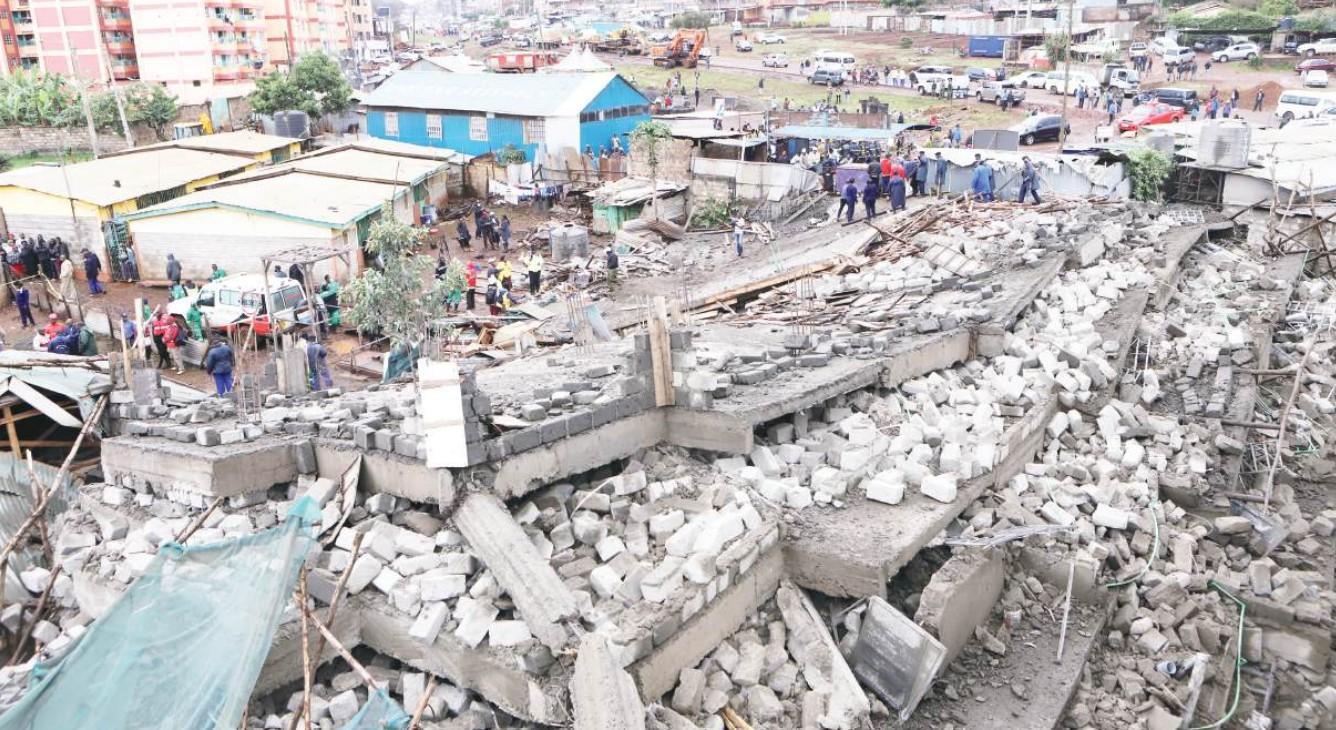
Nairobi has witnessed several collapses where structures initially stood but failed once extra storeys were piled on. Buildings are not static; they require regular inspection and maintenance.
Yet maintenance culture in Kenya is weak. Cracks, leaks and corrosion are ignored until they escalate into structural failures. Materials are the backbone of any structure.
When cement achieves the right compressive strength, when steel reinforcement meets international standards and when aggregates are properly graded, the concrete gains resilience.
Conversely, when materials are compromised, even the best design cannot save a structure. In Nairobi, where urbanisation pressures are immense, the temptation to cut corners is high.
Developers race to meet housing demand, contractors compete on cost, and regulators struggle with limited capacity. Yet the cost of neglect is catastrophic.
Collapsed buildings claim lives, destroy property and erode public trust in the construction industry. They also burden the economy as resources are diverted to emergency response and reconstruction.
To move from reactive disaster management to proactive safety, the authority proposes several measures, such as rigorous policy harmonisation. The current regulatory maze between counties and national government agencies must be streamlined.
This calls for the entrenchment of a comprehensive National Construction Industry Policy to ensure institutional synergy, harmony, information sharing and adequate and prudent use of resources.
Central to this is a “one-stop” approval system to ensure every project undergoes rigorous, non-duplicated scrutiny. There is also a need to continue investing heavily in training and the professionalisation of contractors. Elevating the human capital of the industry ensures that safety standards are understood and implemented at the ground level, not just on paper.
While the recently published National Building Code (NBC) 2024 introduces stricter requirements for material testing, its success depends on monitoring the entire supply chain and imposing stiffer penalties on suppliers of substandard products.
The current state of structural vulnerabilities across the nation serves as a definitive wake-up call. For too long, the dangerous cocktail of poor design, substandard materials, poor implementation methodologies and developer impunity, among others, has compromised public safety.
Yet, safe housing remains a fundamental right rather than a negotiable expense. While the construction industry is a vital engine of Kenya’s economic growth, its success must be measured by stability rather than height.
Through the rigorous and collaborative implementation of the National Building Code (NBC) 2024 and the current initiative by the Ministry of Lands, Public Works, Housing and Urban Development, NCA is confident in significantly reducing the era of structural failures.
Ultimately, the safety of our country’s-built environment depends on a collective commitment to build with unwavering integrity. ”
Source: The Star